
Kosovo
A Balkan state with contested recognition and a NATO-led security presence
Kosovo is a Balkan state that declared independence from Serbia in 2008. It is recognized by many countries but not by Serbia, Russia, China, and others, making its status central to Balkan stability.
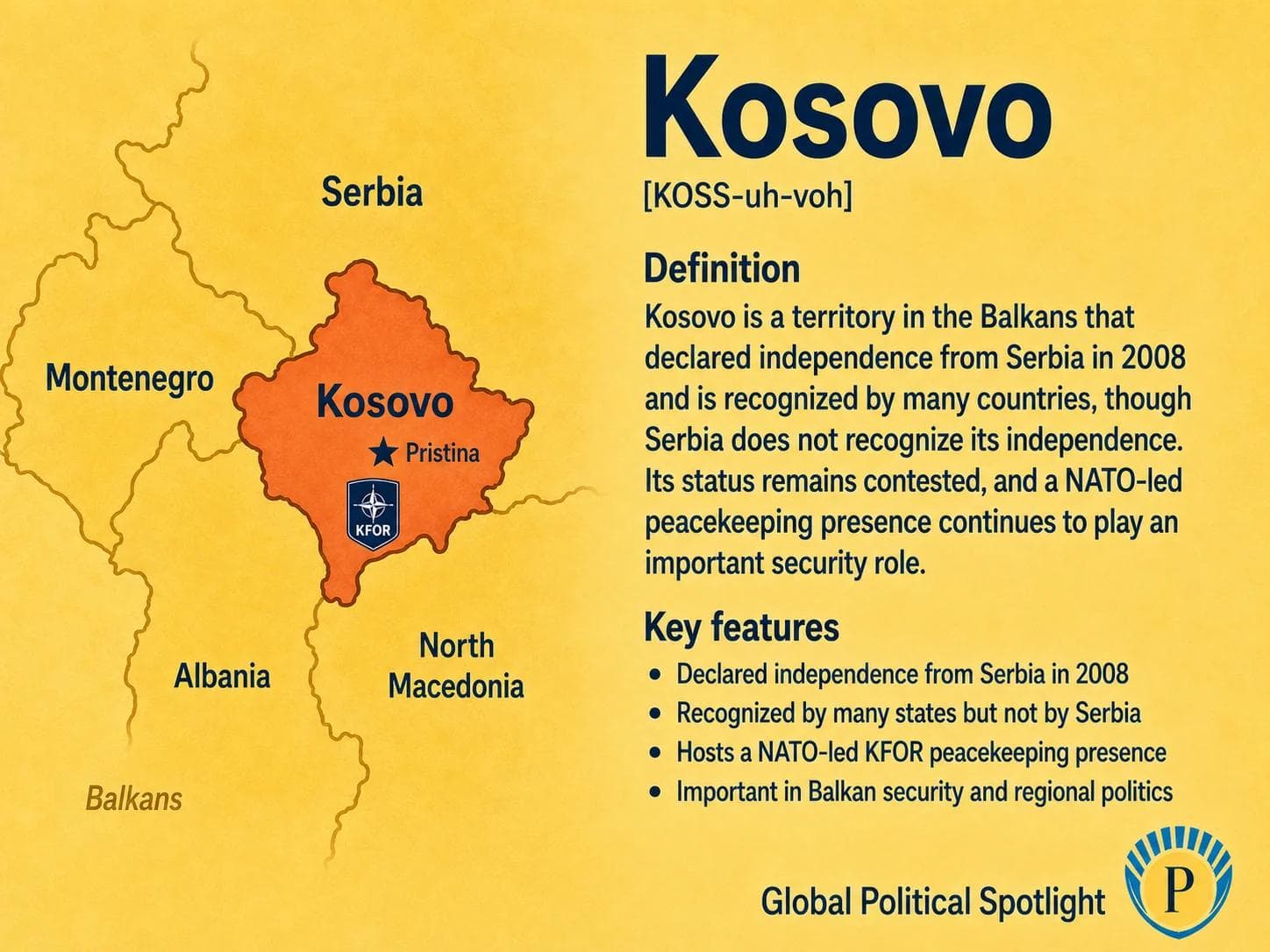
Definition
Kosovo is a landlocked territory in the western Balkans that declared independence from Serbia in 2008 after years of international administration following the 1998-1999 Kosovo conflict. It has its own institutions, elections, security structures, and foreign policy, and is recognized as an independent state by many countries.
Serbia does not recognize Kosovo's independence and continues to regard it as part of its sovereign territory. Russia, China, and several other states also do not recognize Kosovo, which limits its membership in some international organizations and keeps recognition at the center of the dispute.
Why It Matters
Kosovo matters because its status remains one of the most important unresolved issues in the post-Yugoslav Balkans. The dispute affects Serbia's foreign policy, Kosovo's international integration, EU enlargement diplomacy, NATO security planning, and regional stability.
The issue is especially sensitive in northern Kosovo, where ethnic Serb-majority municipalities have contested relations with Pristina's institutions. NATO's KFOR mission and EU-mediated dialogue are designed to reduce escalation risks and support a political normalization process.
GPS should track Kosovo as a contested statehood issue where recognition politics, Serbia-Kosovo dialogue, NATO/KFOR security presence, ethnic Serb municipal governance, EU mediation, Russian and Chinese diplomatic positions, and Balkan stability intersect. Key watchpoints include northern Kosovo tensions, implementation of EU-brokered agreements, Serbian and Kosovar domestic politics, KFOR force posture, recognition changes, and Kosovo's efforts to join international institutions.
Key Facts
- Type
- Contested statehood and Balkan territorial-political dispute
- Location
- Western Balkans, bordered by Serbia, Albania, North Macedonia, and Montenegro
- Declaration of independence
- Kosovo declared independence from Serbia on 17 February 2008
- Recognition status
- Recognized by many states, including the United States and most EU members, but not by Serbia, Russia, China, and several others
- Security presence
- NATO's Kosovo Force, known as KFOR, has operated under a UN mandate since 1999
- Diplomatic framework
- The EU facilitates the Serbia-Kosovo dialogue aimed at normalization of relations
- Local governance issue
- Ethnic Serb-majority municipalities, especially in northern Kosovo, are central to disputes over authority, policing, elections, and local self-management
- Strategic relevance
- Balkan stability, EU enlargement, NATO security posture, recognition politics, and Russia-West diplomatic competition
FAQ
What is Kosovo?
Kosovo is a landlocked Balkan state that declared independence from Serbia in 2008. It has its own government and institutions, but its statehood remains contested because Serbia and several other countries do not recognize it.
Why is Kosovo disputed?
Kosovo is disputed because Serbia rejects Kosovo's 2008 declaration of independence and considers it part of Serbian territory. Kosovo's government and many recognizing states view Kosovo as an independent state that emerged from the post-1999 international settlement.
Who recognizes Kosovo?
Kosovo is recognized by many countries, including the United States and most European Union members. Serbia, Russia, China, and several other states do not recognize it, which limits Kosovo's participation in some international organizations.
What is KFOR in Kosovo?
KFOR is the NATO-led Kosovo Force. It was deployed in 1999 under a UN mandate to help maintain a safe and secure environment and freedom of movement in Kosovo.
Why are ethnic Serb municipalities important?
Ethnic Serb-majority municipalities, particularly in northern Kosovo, are central to disputes over local authority, policing, elections, identity, and links to Serbia. Their status is a major issue in EU-mediated normalization talks.
Why does Kosovo matter for Balkan stability?
Kosovo matters because tensions between Pristina and Belgrade can affect the wider western Balkans, EU enlargement, NATO security planning, minority rights, and the diplomatic competition between Western governments and Serbia's partners, including Russia and China.
Recent Developments
Serbia and Kosovo accepted an EU-facilitated implementation annex in Ohrid
The EU said Serbia and Kosovo agreed on an implementation annex to the Agreement on the Path to Normalisation of Relations. The framework remains a central reference point for diplomacy, even as implementation has remained politically difficult.
European External Action ServiceThe Council of Europe process highlighted Kosovo's contested international integration
Kosovo's bid to join the Council of Europe remained a major example of how recognition, minority rights, rule-of-law commitments, and Serbia-Kosovo normalization continue to shape Kosovo's international status.
Council of Europe Parliamentary AssemblySources6 references
- NATO KFOR
Official NATO page for the Kosovo Force, including its mandate and security role.
- United Nations Security Council
UN Security Council Resolution 1244, the core UN framework following the 1999 Kosovo conflict.
- International Court of Justice
ICJ advisory opinion case on whether Kosovo's declaration of independence was in accordance with international law.
- European External Action Service
EU source on the Agreement on the Path to Normalisation between Kosovo and Serbia.
- European Union External Action
Official EU background on the Belgrade-Pristina dialogue.
- Encyclopaedia Britannica
Reference overview of Kosovo's geography, history, independence, and political status.

GPSNews App
Read GPSNews on iPhone
Daily geopolitical briefings, government updates, and prediction signals in one focused app.
Newsletter
Stay Ahead Of The Next Signal
Get briefings in your inbox when new analysis and reports are published.