
Crimea
A Black Sea peninsula at the center of the Russia-Ukraine territorial dispute
Crimea is a strategic Black Sea peninsula internationally recognized as part of Ukraine but occupied and claimed by Russia since 2014, making it central to sovereignty, sanctions, naval power, and the war in Ukraine.
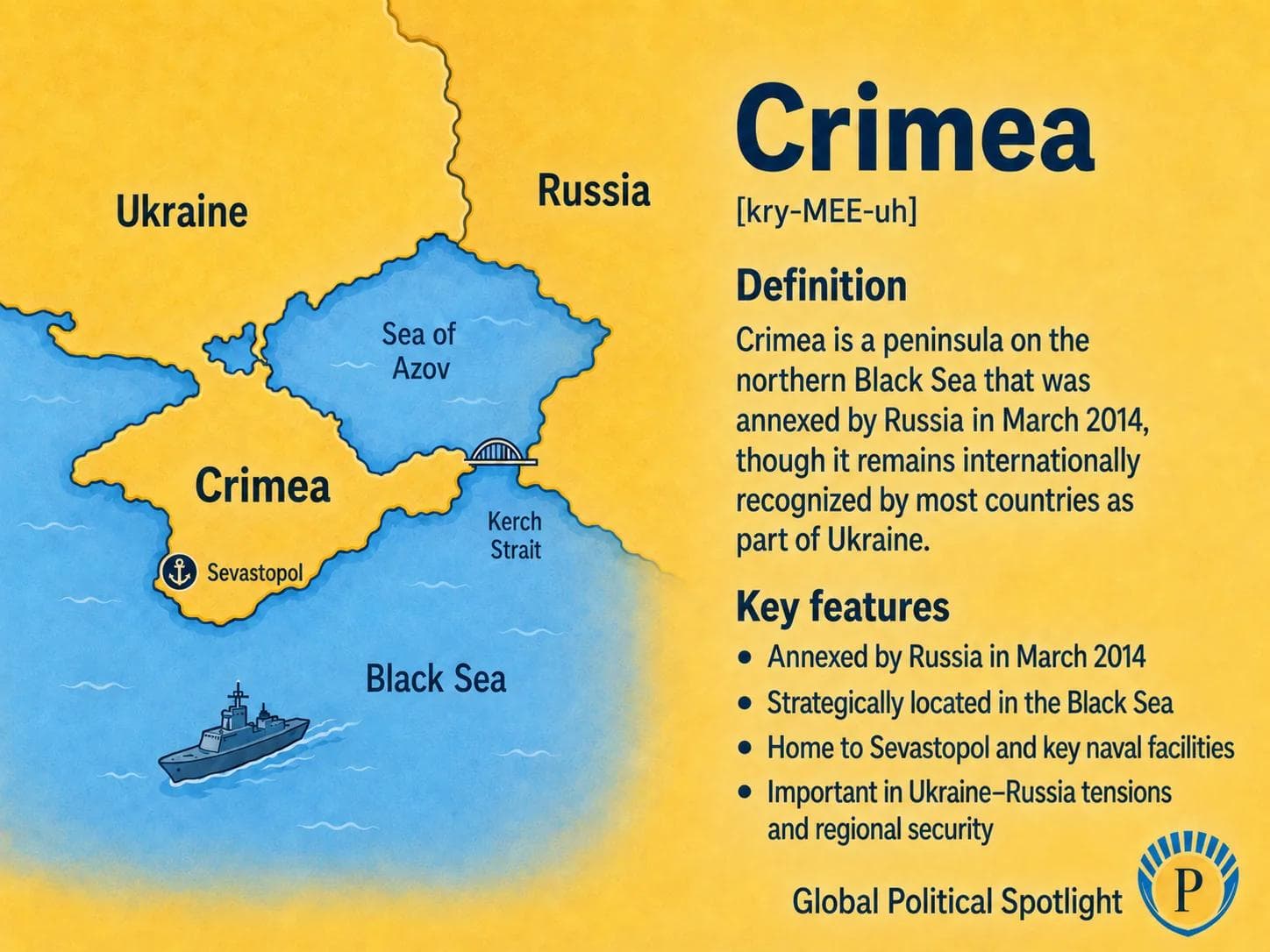
Definition
Crimea is a peninsula extending into the Black Sea, connected to mainland Ukraine by the Isthmus of Perekop and linked to Russia by the Kerch Strait bridge. Its geography gives it strategic importance for Black Sea access, coastal defence, naval basing, and regional military logistics.
Internationally, Crimea is widely recognized as part of Ukraine. Russia occupied and claimed to annex the peninsula in 2014 after a disputed referendum held under Russian military control. Ukraine, the United Nations General Assembly, the European Union, NATO members, and many other governments do not recognize Russia's annexation.
Why It Matters
Crimea matters because it is one of the central territorial issues in the Russia-Ukraine war and a major test case for the international norm against acquiring territory by force. Its status affects diplomacy, sanctions, military planning, Black Sea security, and future negotiations over European security.
The peninsula also matters operationally. Sevastopol has long hosted Russia's Black Sea Fleet, while the Kerch Strait, coastal airfields, ports, and transport links make Crimea relevant to naval operations, missile strikes, logistics, grain-route security, and wider Black Sea deterrence.
GPS should track Crimea as an enduring sovereignty dispute and strategic military geography where Ukrainian territorial integrity, Russian Black Sea posture, sanctions policy, naval access, infrastructure vulnerability, and war-termination diplomacy intersect. Key watchpoints include military activity around Sevastopol and the Kerch Strait, Ukrainian strikes on Russian military infrastructure, sanctions enforcement, international recognition positions, Black Sea shipping security, and any negotiation language concerning territorial status.
Key Facts
- Type
- Disputed and occupied Black Sea peninsula
- Location
- Northern Black Sea, connected to mainland Ukraine by the Isthmus of Perekop and separated from Russia by the Kerch Strait
- International legal status
- Widely recognized internationally as part of Ukraine; occupied and claimed by Russia since 2014
- Primary actors
- Ukraine, Russia, Crimean local communities, European Union, NATO members, United Nations
- Key city
- Sevastopol, a major Black Sea port and long-standing base for Russia's Black Sea Fleet
- Strategic infrastructure
- Kerch Strait bridge, Black Sea ports, airfields, coastal defences, energy and transport links
- Historical turning point
- Russia occupied and claimed to annex Crimea in 2014 after Ukraine's political crisis and the fall of President Viktor Yanukovych
- Security relevance
- Central to Black Sea military balance, Russia-Ukraine war logistics, sanctions policy, and European security diplomacy
FAQ
What is Crimea?
Crimea is a peninsula in the northern Black Sea. It is internationally recognized as part of Ukraine, but Russia has occupied and claimed it since 2014.
Why is Crimea disputed?
Crimea is disputed because Russia occupied the peninsula in 2014 and claimed to annex it after a referendum held under Russian military control. Ukraine and many other states reject the annexation and regard Crimea as Ukrainian territory under Russian occupation.
Who controls Crimea today?
Russia exercises de facto control over Crimea, while Ukraine maintains that Crimea is sovereign Ukrainian territory. Most Western governments and many international institutions do not recognize Russia's claim.
Why does Crimea matter militarily?
Crimea matters militarily because it provides access to Black Sea ports, airfields, coastal missile positions, logistics routes, and Sevastopol, the main base associated with Russia's Black Sea Fleet.
What is the Kerch Strait bridge?
The Kerch Strait bridge links Russia to Crimea across the Kerch Strait. It is strategically important because it supports road and rail movement to the peninsula and has been a recurring focus of military and political attention during the Russia-Ukraine war.
What does international law say about Crimea?
The dominant international position is that Crimea remains part of Ukraine and that Russia's annexation is not legally recognized. UN General Assembly resolutions have affirmed Ukraine's territorial integrity and called on states not to recognize changes to Crimea's status.
Recent Developments
The UN General Assembly affirmed Ukraine's territorial integrity
UN General Assembly Resolution 68/262 affirmed Ukraine's territorial integrity and called on states not to recognize any change in the status of Crimea based on the March 2014 referendum. The resolution remains a key international reference point for the non-recognition policy.
United NationsRussia's full-scale invasion made Crimea central to the wider Ukraine war
Russia's full-scale invasion of Ukraine in February 2022 made Crimea even more important as a military platform, logistics hub, and political issue in the broader war over Ukrainian sovereignty and territorial integrity.
United NationsSources6 references
- United Nations Digital Library
UN General Assembly Resolution 68/262 affirming the territorial integrity of Ukraine.
- United Nations Digital Library
UN General Assembly Resolution 75/29 on the problem of militarization of Crimea and parts of the Black Sea and Sea of Azov.
- European Council
EU overview of restrictive measures related to Crimea and Sevastopol.
- NATO
NATO background on relations with Ukraine and the alliance position on Russia's annexation of Crimea.
- U.S. Department of State
Official U.S. statement of non-recognition of Russia's claimed annexation of Crimea.
- Encyclopaedia Britannica
Reference overview of Crimea's geography, history, and political status.

GPSNews App
Read GPSNews on iPhone
Daily geopolitical briefings, government updates, and prediction signals in one focused app.
Newsletter
Stay Ahead Of The Next Signal
Get briefings in your inbox when new analysis and reports are published.