
South Ossetia & Abkhazia
Breakaway territories internationally recognized as part of Georgia but backed by Russia
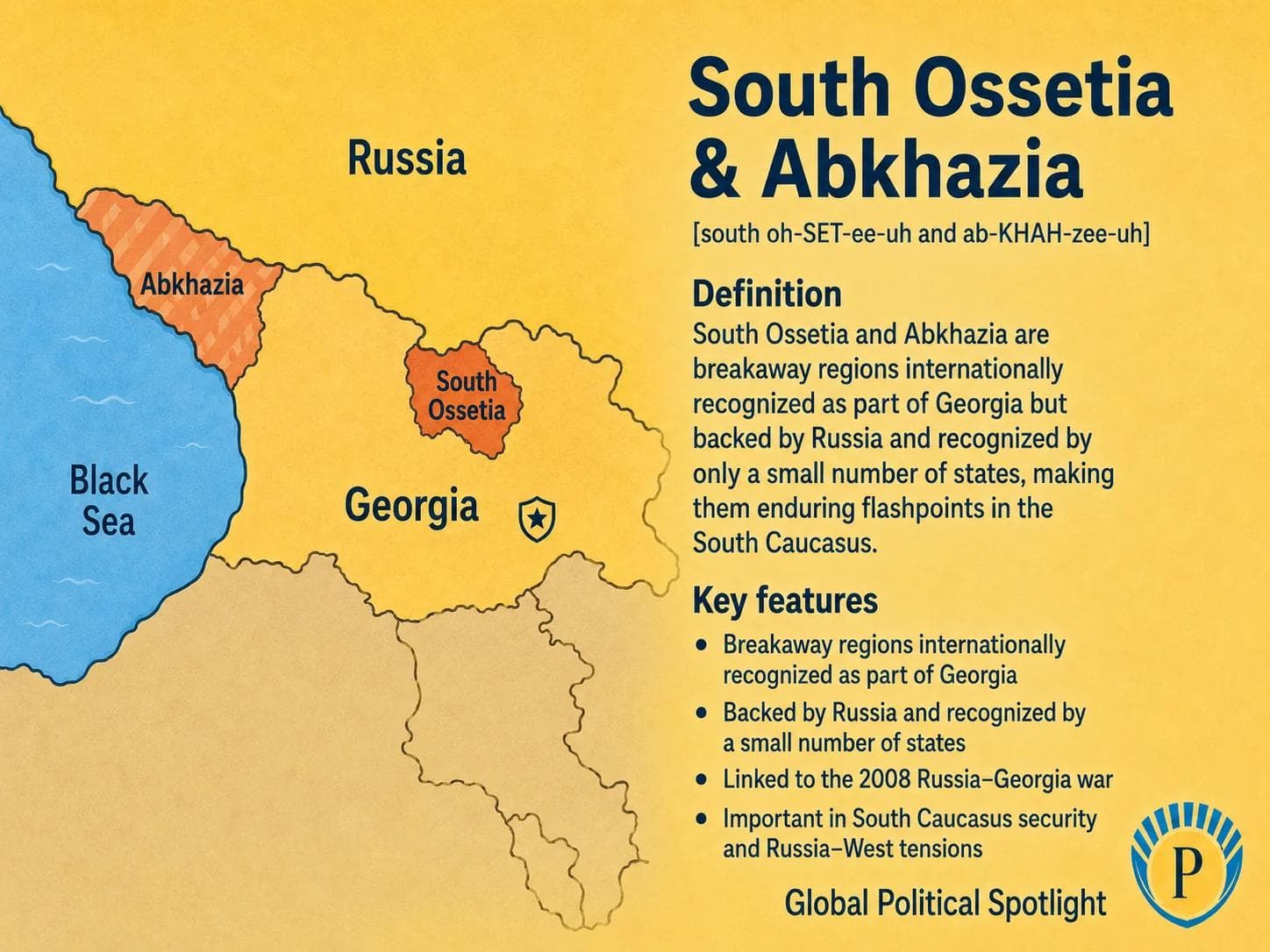
South Ossetia and Abkhazia are breakaway territories internationally recognized as part of Georgia but backed and recognized by Russia, making them central to frozen conflict dynamics in the Caucasus.
Definition
South Ossetia and Abkhazia are breakaway territories in the South Caucasus that are internationally recognized by most states as part of Georgia. Both developed de facto separate administrations after conflicts in the early 1990s and became more deeply tied to Russia after the 2008 Russia-Georgia war.
Russia recognized South Ossetia and Abkhazia as independent states in August 2008 and maintains a substantial security role in both territories. Georgia and most of the international community reject that recognition and describe the areas as occupied Georgian territories.
Why It Matters
South Ossetia and Abkhazia matter because they are central to Georgia's territorial integrity, Russia's regional military posture, and the broader European security debate over frozen conflicts and territorial revisionism. Their unresolved status affects Georgia's Euro-Atlantic ambitions and relations with Russia.
They also matter because the conflicts create persistent security risks through Russian military deployments, administrative boundary lines, movement restrictions, detentions, and borderization. Abkhazia's Black Sea coastline adds maritime relevance, while South Ossetia's position near central Georgia makes it strategically sensitive.
GPS should track South Ossetia and Abkhazia as frozen conflict zones where Georgian sovereignty claims, Russian military presence, recognition disputes, borderization, Black Sea security, and Caucasus stability intersect. Key watchpoints include movement along administrative boundary lines, Russian force posture, Geneva International Discussions, Georgian domestic politics, EU monitoring activity, Abkhazia's Black Sea dynamics, and wider Russia-West confrontation.
Key Facts
- Type
- Breakaway territories and frozen conflict zones
- Location
- South Caucasus; Abkhazia lies on the Black Sea coast, while South Ossetia lies north of central Georgia near the Russian border
- International legal status
- Widely recognized internationally as part of Georgia
- Russian position
- Russia recognized Abkhazia and South Ossetia as independent states in 2008 and maintains military forces in both territories
- Georgian position
- Georgia regards both territories as occupied parts of its sovereign territory
- Key conflict year
- The 2008 Russia-Georgia war was the major turning point in Russia's recognition and military entrenchment in both territories
- Security mechanism
- The Geneva International Discussions remain a main diplomatic format for addressing security and humanitarian issues after the 2008 war
- Strategic relevance
- Russian regional leverage, Georgian territorial integrity, Black Sea security, Caucasus stability, and Euro-Atlantic integration politics
FAQ
What are South Ossetia and Abkhazia?
South Ossetia and Abkhazia are breakaway territories internationally recognized by most states as part of Georgia. They have de facto separate administrations and are backed by Russia.
Why are South Ossetia and Abkhazia disputed?
They are disputed because Georgia considers them part of its sovereign territory, while Russia recognized them as independent states after the 2008 war. Most countries do not recognize their independence.
Who controls South Ossetia and Abkhazia today?
Local de facto authorities administer the territories with strong Russian political, economic, and security backing. Georgia does not exercise effective control over either territory.
What was the 2008 Russia-Georgia war?
The 2008 war was a short conflict between Russia and Georgia centered on South Ossetia, with fighting also affecting Abkhazia. After the war, Russia recognized both territories as independent and expanded its security role there.
What does borderization mean in Georgia?
Borderization refers to the installation or expansion of fences, signs, trenches, and other barriers along the administrative boundary lines around South Ossetia and Abkhazia. Georgia and international monitors describe it as a recurring source of humanitarian and security concern.
Why do South Ossetia and Abkhazia matter for Caucasus security?
They matter because they create unresolved conflict lines inside Georgia, support Russian leverage in the South Caucasus, affect Black Sea and regional military dynamics, and complicate Georgia's relations with NATO, the European Union, and Russia.
Recent Developments
Russia recognized South Ossetia and Abkhazia
Russia recognized South Ossetia and Abkhazia as independent states after the 2008 Russia-Georgia war. Georgia and most states rejected the move, making recognition a central feature of the continuing dispute.
Russian Ministry of Foreign AffairsGeneva International Discussions began after the 2008 war
The Geneva International Discussions were launched after the Russia-Georgia war to address security and humanitarian consequences of the conflict. The format remains a recurring diplomatic channel involving Georgia, Russia, representatives from Abkhazia and South Ossetia, and international actors.
Organization for Security and Co-operation in EuropeSources6 references
- Government of Georgia
Official Georgian foreign ministry source on Georgia's position regarding Abkhazia and South Ossetia.
- European Union Monitoring Mission in Georgia
Official EU monitoring mission source for information on stability, monitoring, and administrative boundary line issues after the 2008 war.
- Organization for Security and Co-operation in Europe
Official OSCE page on the Geneva International Discussions following the 2008 conflict in Georgia.
- United Nations General Assembly
UN document repository containing resolutions and records related to internally displaced persons and the conflict-affected regions of Georgia.
- NATO
NATO background on relations with Georgia and support for Georgia's territorial integrity.
- Encyclopaedia Britannica
Reference overview of Abkhazia's geography, history, and political status, useful for background context alongside South Ossetia.

GPSNews App
Read GPSNews on iPhone
Daily geopolitical briefings, government updates, and prediction signals in one focused app.
Newsletter
Stay Ahead Of The Next Signal
Get briefings in your inbox when new analysis and reports are published.