
Western Sahara
A disputed North African territory shaped by Moroccan control, Sahrawi self-determination claims, and UN peace efforts
Western Sahara is a disputed territory in North Africa claimed by Morocco and the Polisario Front, with long-running UN involvement, contested recognition, and strategic relevance for resources and regional politics.
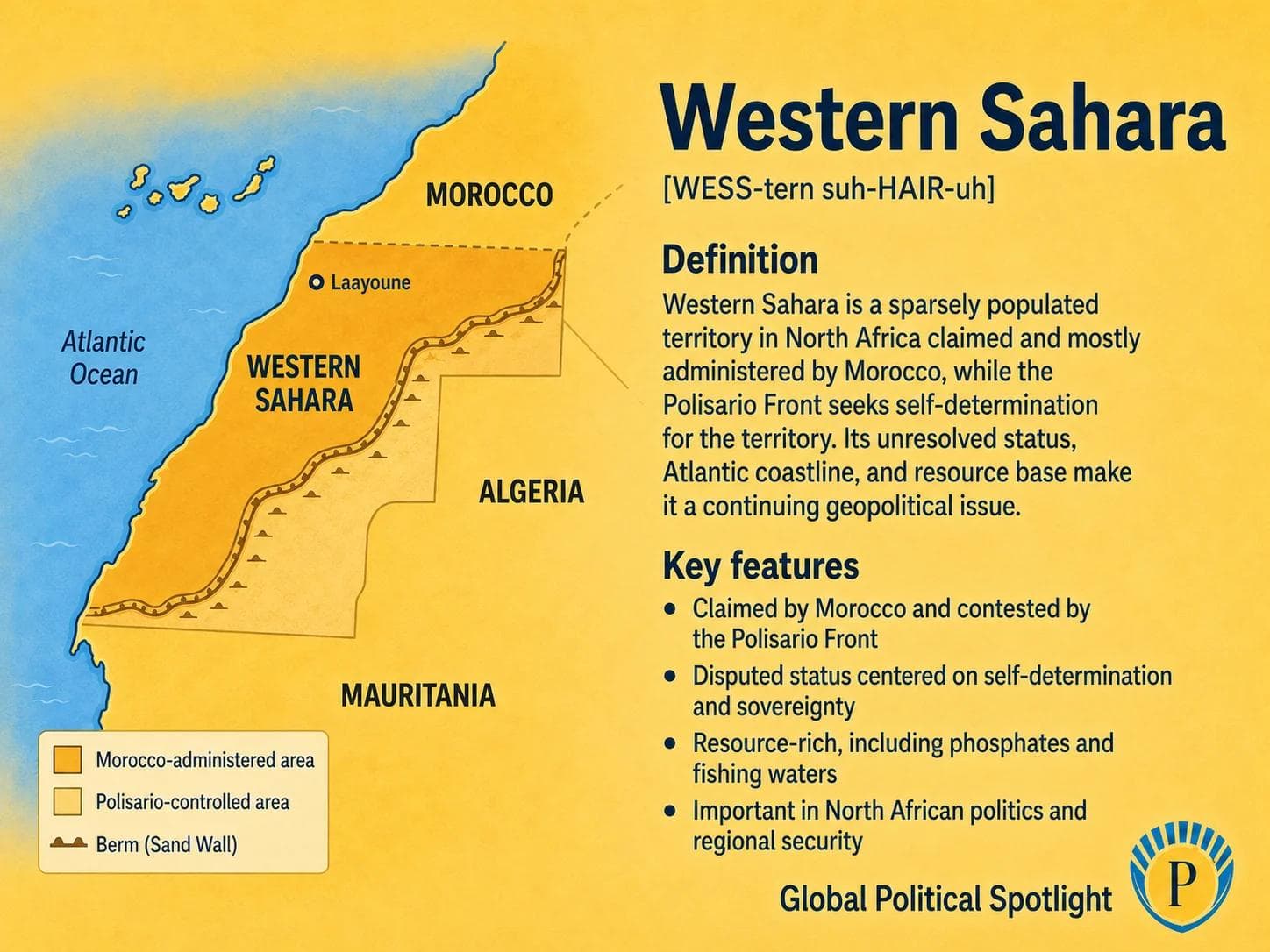
Definition
Western Sahara is a sparsely populated territory on the Atlantic coast of North Africa, bordered by Morocco, Algeria, and Mauritania. Morocco controls most of the territory and administers it as part of its southern provinces, while the Polisario Front claims independence for the Sahrawi people through the Sahrawi Arab Democratic Republic.
The dispute emerged after Spain withdrew from the territory in 1975. A war between Morocco and the Polisario Front ended in a 1991 UN-brokered ceasefire that created the United Nations Mission for the Referendum in Western Sahara, known as MINURSO, but a final political settlement has not been reached.
Why It Matters
Western Sahara matters because it is one of the world's longest-running unresolved self-determination disputes. It affects Morocco's regional strategy, Algeria-Morocco rivalry, African Union diplomacy, UN peace efforts, recognition politics, and debates over territorial sovereignty.
The territory also has practical economic and strategic significance. Phosphate deposits, Atlantic fisheries, coastal access, and the Moroccan-built berm make Western Sahara relevant to resource governance, military geography, trade policy, and North African security.
GPS should track Western Sahara as an enduring territorial and self-determination dispute where Moroccan control, Polisario claims, Algerian support, UN diplomacy, resource governance, recognition politics, and North African stability intersect. Key watchpoints include MINURSO mandate renewals, UN envoy activity, recognition shifts, Morocco-Algeria tensions, developments around the berm, trade and resource rulings, and changes in international positions on autonomy or independence.
Key Facts
- Type
- Disputed territory and self-determination conflict
- Location
- Northwest Africa, on the Atlantic coast, bordered by Morocco, Algeria, and Mauritania
- Primary actors
- Morocco, Polisario Front, Sahrawi Arab Democratic Republic, Algeria, United Nations
- Current control
- Morocco controls most of Western Sahara, including the main cities and Atlantic coast
- Polisario position
- The Polisario Front seeks Sahrawi self-determination and independence through the Sahrawi Arab Democratic Republic
- Key barrier
- The Moroccan-built berm divides Moroccan-controlled areas from Polisario-controlled areas east of the barrier
- UN role
- MINURSO was established in 1991 to monitor the ceasefire and support a political process
- Resource relevance
- Phosphate deposits, Atlantic fisheries, renewable energy potential, and coastal trade access are central to the dispute's economic dimension
FAQ
What is Western Sahara?
Western Sahara is a disputed territory on the Atlantic coast of North Africa. Morocco controls most of the territory, while the Polisario Front claims independence for the Sahrawi people.
Why is Western Sahara disputed?
The dispute began after Spain withdrew from the territory in 1975. Morocco claimed the territory, while the Polisario Front sought independence. A UN-brokered ceasefire began in 1991, but a final settlement has not been reached.
Who controls Western Sahara today?
Morocco controls most of Western Sahara, including the main cities and coastline. The Polisario Front controls areas east of the berm and operates the Sahrawi Arab Democratic Republic, which is recognized by some states but not by many others.
What is the berm in Western Sahara?
The berm is a long fortified sand and defensive barrier built by Morocco. It separates Moroccan-controlled areas from Polisario-held areas and is one of the most visible physical features of the conflict.
What role does Algeria play in Western Sahara?
Algeria supports the Polisario Front and hosts Sahrawi refugee camps near Tindouf. The dispute is therefore closely linked to Algeria-Morocco rivalry and broader North African diplomacy.
Why does Western Sahara matter economically?
Western Sahara matters economically because of phosphate resources, Atlantic fisheries, coastal access, and potential renewable energy projects. These resources raise legal and political questions about consent, sovereignty, and benefit-sharing.
Recent Developments
The UN Security Council renewed MINURSO's mandate
The UN Security Council renewed the mandate of the United Nations Mission for the Referendum in Western Sahara, keeping UN monitoring and the political process central to the unresolved dispute.
United Nations Security CouncilThe United States recognized Moroccan sovereignty over Western Sahara
The United States recognized Moroccan sovereignty over Western Sahara in 2020, marking a major diplomatic shift in recognition politics. The position remains important in debates over autonomy, independence, and international mediation.
U.S. Department of StateSources6 references
- United Nations MINURSO
Official UN mission site for MINURSO, the peacekeeping mission connected to Western Sahara.
- United Nations Security Council
UN Security Council press release on the renewal of MINURSO's mandate.
- United Nations Peacemaker
UN-hosted background on the 1991 settlement proposal and ceasefire framework.
- International Court of Justice
ICJ advisory opinion on Western Sahara, a key legal reference in the dispute.
- U.S. Department of State
Official U.S. statement recognizing Moroccan sovereignty over Western Sahara in 2020.
- Encyclopaedia Britannica
Reference overview of Western Sahara's geography, history, and political status.

GPSNews App
Read GPSNews on iPhone
Daily geopolitical briefings, government updates, and prediction signals in one focused app.
Newsletter
Stay Ahead Of The Next Signal
Get briefings in your inbox when new analysis and reports are published.