
Balkanization
The fragmentation of a state or region into smaller, often rival political units
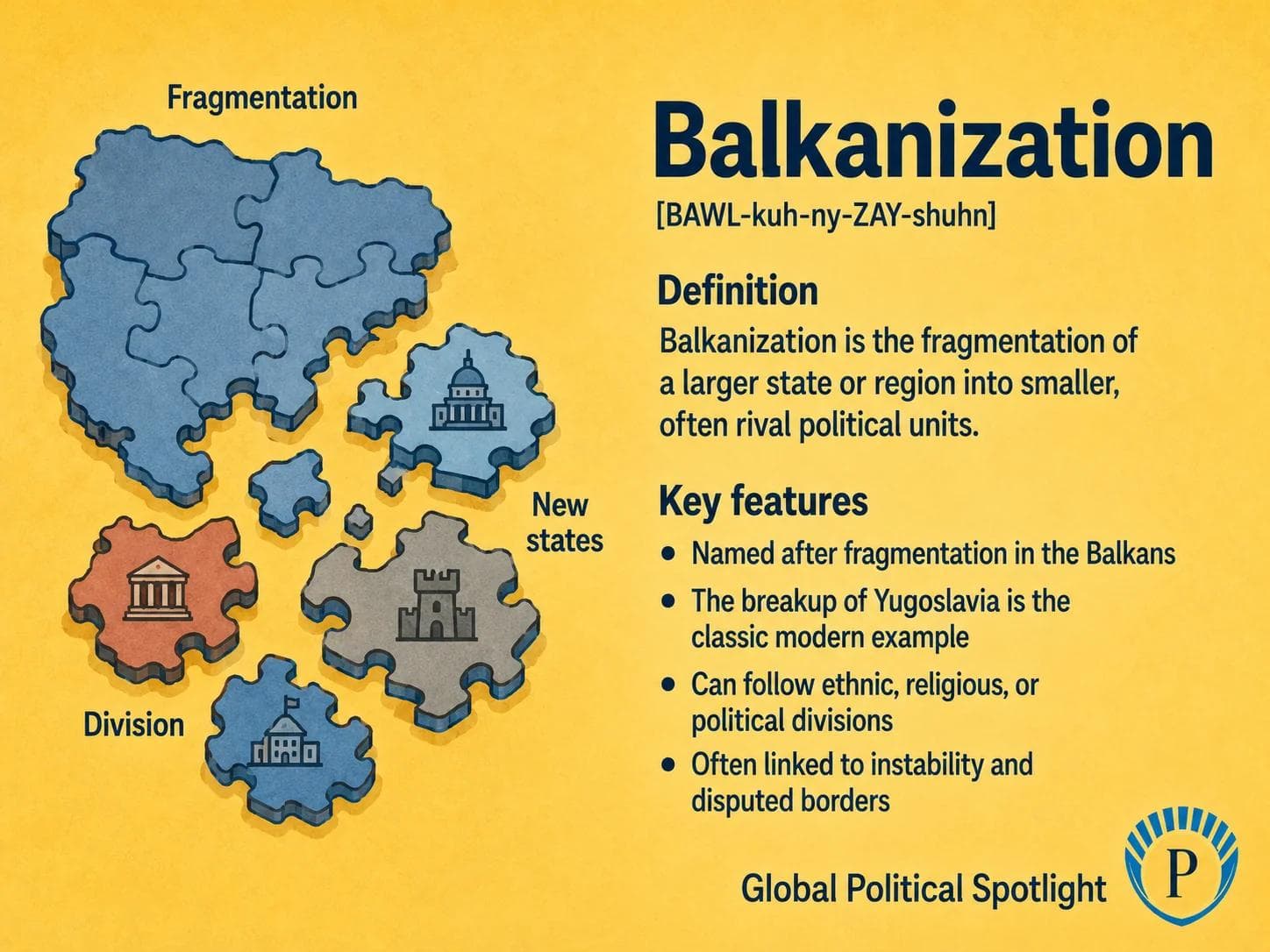
Balkanization is the fragmentation of a larger state or region into smaller political units, often along ethnic, religious, linguistic, or political lines.
Definition
Balkanization is the fragmentation of a larger state, empire, federation, or region into smaller political units. These units may become independent states, autonomous territories, contested regions, or rival authorities, often divided by ethnicity, religion, language, ideology, or historical grievances.
The term comes from the Balkans, a region in southeastern Europe where the decline of the Ottoman Empire and later the breakup of Yugoslavia produced multiple states, border disputes, wars, and competing national claims.
Balkanization is usually used to describe fragmentation that creates instability or rivalry, but not every political breakup is violent or illegitimate. Some separations occur through negotiated processes, constitutional arrangements, or internationally recognized independence.
Why It Matters
Balkanization matters because it can weaken state authority, produce disputed borders, create minority-rights problems, and invite external intervention. Fragmentation can turn internal political disputes into regional security crises when neighboring states support rival communities or claim protective roles.
The concept is central to understanding separatism, civil war, state collapse, ethnic conflict, self-determination, recognition disputes, and post-conflict peacebuilding. It also helps explain why international actors often treat territorial integrity and minority protection as linked security concerns.
GPS should track Balkanization as a concept connected to state fragmentation, separatist movements, disputed borders, identity politics, minority rights, external patronage, and post-conflict settlement design. The key analytical issue is whether fragmentation produces recognized statehood, negotiated autonomy, frozen conflict, or prolonged instability.
Key Facts
- Concept type
- State fragmentation and political geography
- Core meaning
- The breakup of a larger state or region into smaller political units
- Origin of term
- Named after the Balkans, a historically fragmented region in southeastern Europe
- Classic example
- The breakup of Yugoslavia in the 1990s is often cited as a major example
- Common drivers
- Ethnic, religious, linguistic, political, historical, or territorial divisions
- Security risk
- Fragmentation can create disputed borders, rival authorities, refugee flows, and external intervention risks
- Legal tension
- Balkanization often raises difficult questions about self-determination, territorial integrity, and international recognition
- Important limit
- Not every state breakup is violent; some political separations are negotiated or internationally recognized
FAQ
What does Balkanization mean?
Balkanization means the fragmentation of a larger state or region into smaller political units, often with rival governments, contested borders, or divisions based on ethnicity, religion, language, or political identity.
Why is it called Balkanization?
The term comes from the Balkans in southeastern Europe, where imperial decline, nationalism, wars, and the breakup of Yugoslavia produced multiple states, contested borders, and competing national claims.
Is the breakup of Yugoslavia an example of Balkanization?
Yes. The breakup of Yugoslavia is one of the most commonly cited examples because it involved the fragmentation of a multiethnic federation into several states, accompanied by war, ethnic violence, disputed borders, and international intervention.
Is Balkanization always violent?
No. The term is often associated with instability and conflict, but political fragmentation can also occur through negotiated settlements, constitutional processes, or internationally recognized independence. The risk level depends on borders, institutions, identity claims, and external involvement.
How is Balkanization different from self-determination?
Self-determination is a principle that peoples may claim to determine their political status. Balkanization describes the fragmentation process and is often used when that process produces rivalry or instability. The same case may be described differently depending on legal, political, and historical perspectives.
Why does Balkanization matter in geopolitics?
It matters because fragmented states and regions can produce border disputes, minority-rights conflicts, refugee flows, external intervention, frozen conflicts, and challenges to sovereignty and territorial integrity.
Recent Developments
UN vote reaffirmed territorial integrity as a core international principle
The UN General Assembly resolution on Ukraine reaffirmed sovereignty, political independence, and territorial integrity, illustrating the continuing relevance of anti-fragmentation norms in international diplomacy.
United Nations Digital LibraryKosovo-Serbia normalization talks showed the durability of Balkan border disputes
EU-facilitated talks in Ohrid highlighted how unresolved recognition, minority rights, and sovereignty disputes in the Western Balkans remain central to regional stability.
European External Action ServiceSources6 references
- Encyclopaedia Britannica
Reference overview of Balkanization as a concept of political fragmentation.
- Encyclopaedia Britannica
Reference background on the Balkans region and its historical political fragmentation.
- United Nations
Foundational institutional reference for sovereignty, territorial integrity, self-determination, and international peace.
- United Nations Digital Library
UN General Assembly resolution reaffirming sovereignty and territorial integrity principles in relation to Ukraine.
- International Criminal Tribunal for the former Yugoslavia
Institutional background on the conflicts linked to the breakup of the former Yugoslavia.
- European External Action Service
Official EU reference on Kosovo-Serbia normalization efforts and continuing Western Balkan sovereignty disputes.

GPSNews App
Read GPSNews on iPhone
Daily geopolitical briefings, government updates, and prediction signals in one focused app.
Newsletter
Stay Ahead Of The Next Signal
Get briefings in your inbox when new analysis and reports are published.