
Kashmir
A Himalayan region at the center of a long-running India-Pakistan-China territorial dispute
Kashmir is a Himalayan region divided between India, Pakistan, and China, with competing sovereignty claims, militarized boundaries, and deep significance for South Asian security, water resources, and nuclear risk.
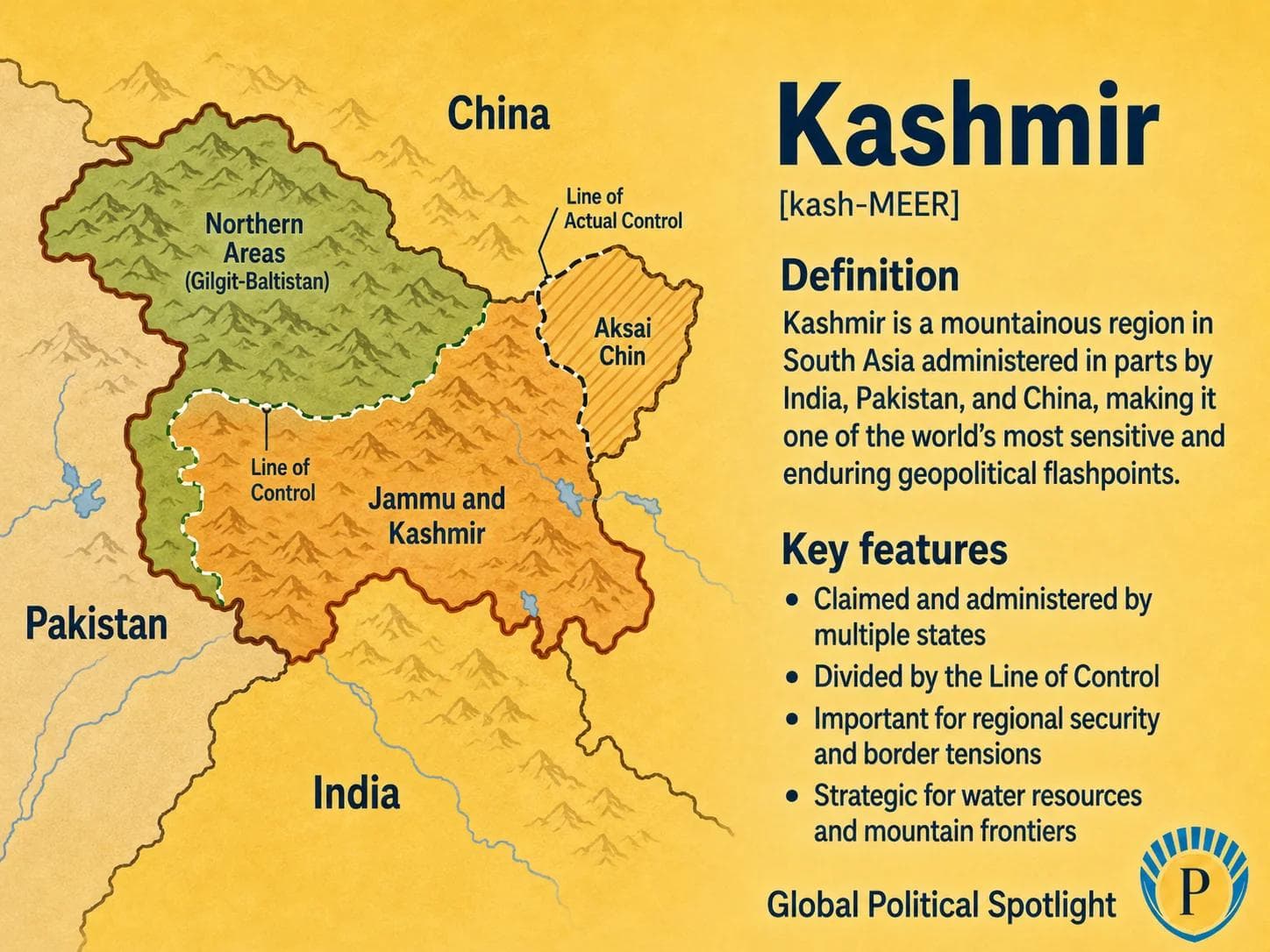
Definition
Kashmir is a mountainous Himalayan region historically associated with the former princely state of Jammu and Kashmir. Since the partition of British India in 1947, the region has been divided and disputed, with India, Pakistan, and China controlling different areas.
India administers Jammu and Kashmir and Ladakh, Pakistan administers Azad Jammu and Kashmir and Gilgit-Baltistan, and China controls Aksai Chin and the Trans-Karakoram Tract. The India-Pakistan Line of Control and the India-China Line of Actual Control are among the region's most important military and political boundaries.
Why It Matters
Kashmir matters because it is one of the world's most enduring territorial disputes involving nuclear-armed states. It affects India-Pakistan relations, India-China tensions, military deployments, cross-border crisis management, and the diplomatic agenda of South Asia.
The region also has strategic value because of its high-altitude terrain, proximity to major borders, glacier systems, and river headwaters linked to the Indus basin. Political decisions in Kashmir can therefore affect security, water governance, local rights, and broader regional stability.
GPS should track Kashmir as an enduring dispute where sovereignty claims, nuclear deterrence, internal governance, border militarization, counterinsurgency, water security, and India-Pakistan-China relations intersect. Key watchpoints include Line of Control incidents, India-China border tensions in Ladakh, changes in local political status, human-rights and civil-liberties debates, Indus basin water diplomacy, and international statements on regional de-escalation.
Key Facts
- Type
- Disputed Himalayan region
- Primary actors
- India, Pakistan, China, and local political communities across the divided region
- Indian-administered areas
- Jammu and Kashmir, and Ladakh
- Pakistan-administered areas
- Azad Jammu and Kashmir, and Gilgit-Baltistan
- Chinese-administered areas
- Aksai Chin and the Trans-Karakoram Tract
- Key boundary lines
- The Line of Control separates Indian- and Pakistani-administered areas; the Line of Actual Control separates Indian- and Chinese-held positions in contested sectors
- Historical turning point
- The dispute emerged during the 1947 partition of British India and the first India-Pakistan war over Jammu and Kashmir
- Strategic relevance
- Nuclear-armed rivalry, high-altitude military positions, water resources, border infrastructure, and South Asian crisis stability
FAQ
What is Kashmir?
Kashmir is a Himalayan region historically linked to the former princely state of Jammu and Kashmir. It is now divided between India, Pakistan, and China, with competing territorial claims and several militarized boundary lines.
Why is Kashmir disputed?
The dispute began during the 1947 partition of British India, when the princely state of Jammu and Kashmir became contested between India and Pakistan. China later became a direct territorial actor through control of Aksai Chin and related border disputes.
Who controls Kashmir today?
India administers Jammu and Kashmir and Ladakh. Pakistan administers Azad Jammu and Kashmir and Gilgit-Baltistan. China controls Aksai Chin and the Trans-Karakoram Tract. Each actor describes its position through different legal and historical claims.
What is the Line of Control in Kashmir?
The Line of Control is the military control line separating Indian-administered and Pakistani-administered parts of Kashmir. It is not an internationally recognized final border, but it is central to ceasefire management and crisis stability.
Why does Kashmir matter geopolitically?
Kashmir matters because it involves nuclear-armed India and Pakistan, India-China border tensions, high-altitude military infrastructure, river headwaters, domestic governance questions, and recurring diplomatic disputes.
Is Kashmir only an India-Pakistan issue?
No. India and Pakistan are the main actors in the best-known part of the dispute, but China also controls territory historically associated with the wider Jammu and Kashmir region, especially Aksai Chin. Kashmir also has local political, legal, and human-security dimensions.
Recent Developments
India revoked Jammu and Kashmir's special constitutional status
India removed the special status previously associated with Article 370 and reorganized the former state of Jammu and Kashmir into two union territories: Jammu and Kashmir, and Ladakh. The decision remains a major reference point for governance, rights, and diplomacy around the dispute.
Government of IndiaIndia and Pakistan reaffirmed ceasefire commitments along the Line of Control
The directors general of military operations of India and Pakistan agreed to observe existing ceasefire understandings along the Line of Control and other sectors, making ceasefire durability a continuing indicator for regional stability.
Government of India Press Information BureauSources6 references
- United Nations Security Council
UN Security Council Resolution 47 from 1948, an important early UN document on the Jammu and Kashmir dispute.
- Government of India
Official text of the Jammu and Kashmir Reorganisation Act, 2019, which reorganized the former state into two union territories.
- Government of Pakistan Ministry of Foreign Affairs
Official Pakistan foreign ministry page outlining Pakistan's position on Kashmir.
- Government of India Press Information Bureau
Official Indian statement on the 2021 India-Pakistan reaffirmation of ceasefire understandings along the Line of Control.
- Encyclopaedia Britannica
Reference overview of Kashmir's geography, history, and divided administration.
- World Bank
Institutional background on the Indus Waters Treaty, relevant to river systems connected to the wider Kashmir dispute.

GPSNews App
Read GPSNews on iPhone
Daily geopolitical briefings, government updates, and prediction signals in one focused app.
Newsletter
Stay Ahead Of The Next Signal
Get briefings in your inbox when new analysis and reports are published.