
Proxy War
A conflict where outside powers support local actors instead of fighting directly
A proxy war is a conflict in which outside powers support local states, armed groups, or political factions through money, weapons, training, intelligence, or logistics instead of fighting each other directly.
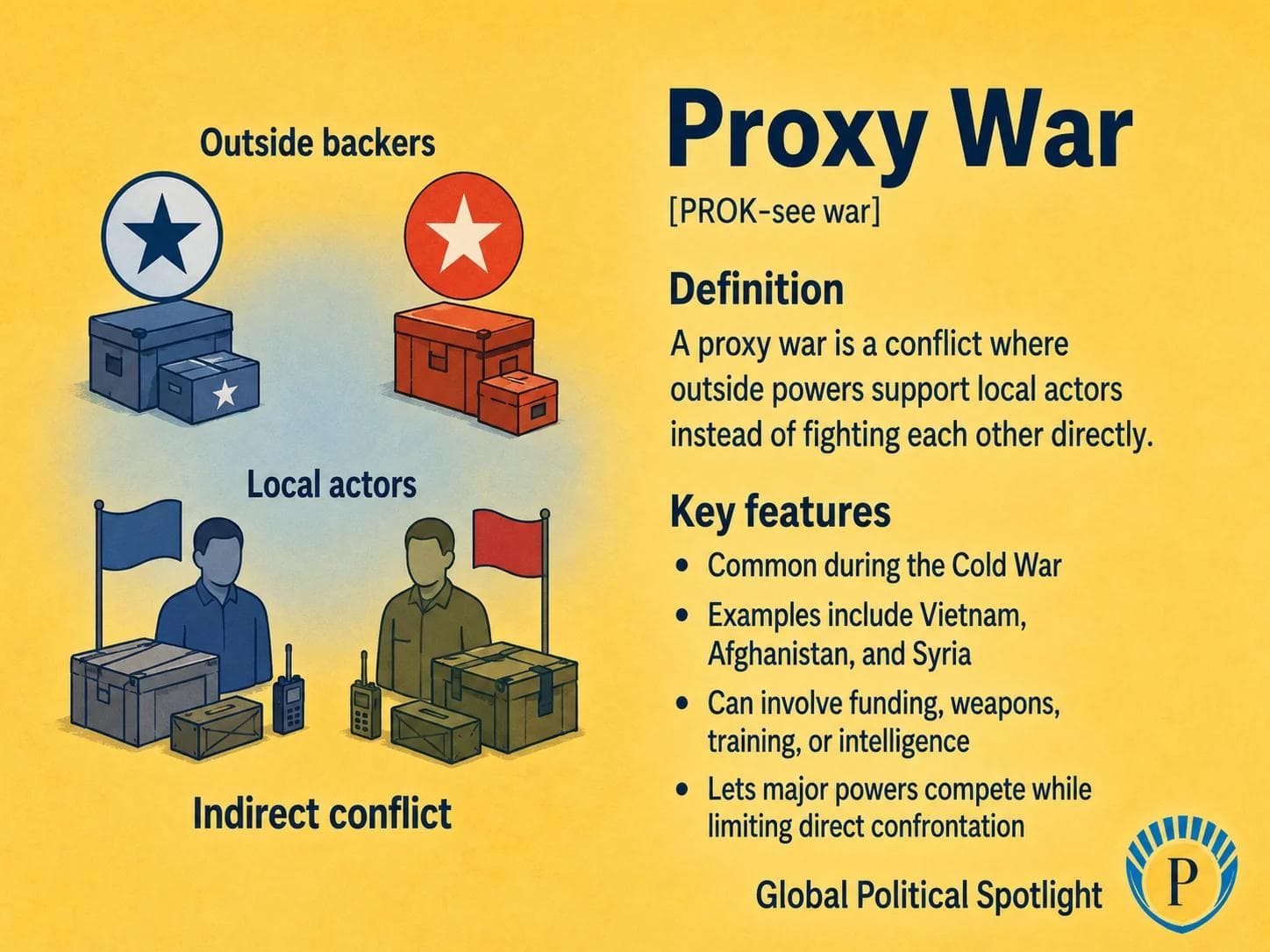
Definition
A proxy war is a conflict in which external powers support local actors rather than fighting one another directly. The local actors may be governments, rebel groups, militias, political movements, or armed factions, while the outside powers provide resources such as weapons, money, training, intelligence, logistics, or diplomatic backing.
Proxy wars are common in great-power rivalry because they allow states to pursue strategic goals while reducing the risk and cost of direct military confrontation. The Cold War produced many proxy conflicts, as the United States and Soviet Union supported opposing sides in regional wars across Asia, Africa, Latin America, and the Middle East.
The term does not mean that local actors lack their own interests. Proxy relationships are often complex: outside sponsors may influence a conflict, but local actors usually have independent political, military, ideological, ethnic, religious, or territorial objectives.
Why It Matters
Proxy wars matter because they can internationalize local conflicts. A civil war or regional dispute can become more destructive when outside powers supply arms, money, intelligence, or diplomatic protection to competing sides.
They also shape escalation risk. Proxy support can help major powers avoid direct war, but it can also blur responsibility, prolong fighting, complicate peace negotiations, and increase the chance that external rivals become more directly involved.
For civilians and fragile states, proxy wars can be especially damaging because external support may sustain armed actors long after a conflict's local resources would otherwise be exhausted.
Proxy war is a key GPS concept for analyzing how major and regional powers compete below the threshold of direct conflict. GPS should track external arms flows, training networks, intelligence support, sanctions, diplomatic cover, financing channels, and the degree of control sponsors actually have over local partners.
Key Facts
- Type
- Indirect conflict
- Core idea
- Outside powers support local actors instead of fighting each other directly
- Common support
- Weapons, funding, training, intelligence, logistics, advisors, sanctions relief, and diplomatic backing
- Common actors
- States, rebel groups, militias, insurgents, governments, political factions, and private military networks
- Cold War role
- Proxy conflicts were a major feature of U.S.-Soviet rivalry across multiple regions
- Strategic purpose
- Sponsors can weaken rivals, expand influence, preserve deniability, or avoid direct escalation
- Main risk
- External support can prolong conflicts, increase civilian harm, and make peace settlements harder
- Key limitation
- Proxy actors often pursue their own interests and may not fully obey outside sponsors
FAQ
What is a proxy war?
A proxy war is a conflict where outside powers support local actors rather than fighting each other directly. Support can include weapons, money, training, intelligence, logistics, or diplomatic backing.
Why do countries fight proxy wars?
States may use proxy wars to weaken rivals, expand influence, support allies, avoid direct escalation, reduce domestic political costs, or maintain plausible deniability.
What is a Cold War example of a proxy war?
The Korean War, Vietnam War, Soviet-Afghan War, and several conflicts in Africa and Latin America are often discussed as Cold War proxy conflicts because outside powers supported opposing sides as part of wider U.S.-Soviet rivalry.
Are proxy wars always controlled by outside powers?
No. Local actors usually have their own goals and may resist, exploit, or reinterpret outside support. A proxy relationship does not mean the sponsor fully controls the local actor.
How are proxy wars different from direct wars?
In a direct war, the main rival states fight each other openly with their own forces. In a proxy war, outside powers influence the conflict indirectly through local partners, material support, intelligence, or diplomatic backing.
Why are proxy wars hard to end?
Proxy wars can be hard to end because local grievances, outside interests, arms supplies, competing sponsors, weak institutions, and mistrust among factions can all keep the conflict going.
Recent Developments
UN General Assembly condemned Russia's invasion of Ukraine
The UN General Assembly demanded that Russia withdraw from Ukraine, while many outside states later provided extensive military, financial, humanitarian, or diplomatic support to Ukraine, illustrating how external support can shape a major interstate conflict without all supporters becoming direct combatants.
United NationsG7 reaffirmed support for Ukraine
The G7 stated continued support for Ukraine, including financial and security assistance, reflecting the continuing relevance of external support mechanisms in modern conflict and deterrence politics.
G7 ItalySources6 references
- Encyclopaedia Britannica
Reference definition and overview of proxy war as a political and military concept.
- United Nations Charter
Primary source for principles of sovereignty, non-use of force, and international peace and security.
- International Committee of the Red Cross
Institutional source for international humanitarian law, relevant to armed conflicts regardless of proxy sponsorship.
- Office of the Historian, U.S. Department of State
Historical background on the Soviet-Afghan War, widely discussed as a Cold War proxy conflict.
- United Nations
UN General Assembly coverage of the 2022 resolution demanding Russia withdraw from Ukraine.
- SIPRI
Reference database for arms transfers, useful for tracking material support patterns in conflicts.

GPSNews App
Read GPSNews on iPhone
Daily geopolitical briefings, government updates, and prediction signals in one focused app.
Newsletter
Stay Ahead Of The Next Signal
Get briefings in your inbox when new analysis and reports are published.