
Hybrid Warfare
A conflict strategy that blends military, cyber, information, political, and irregular tools
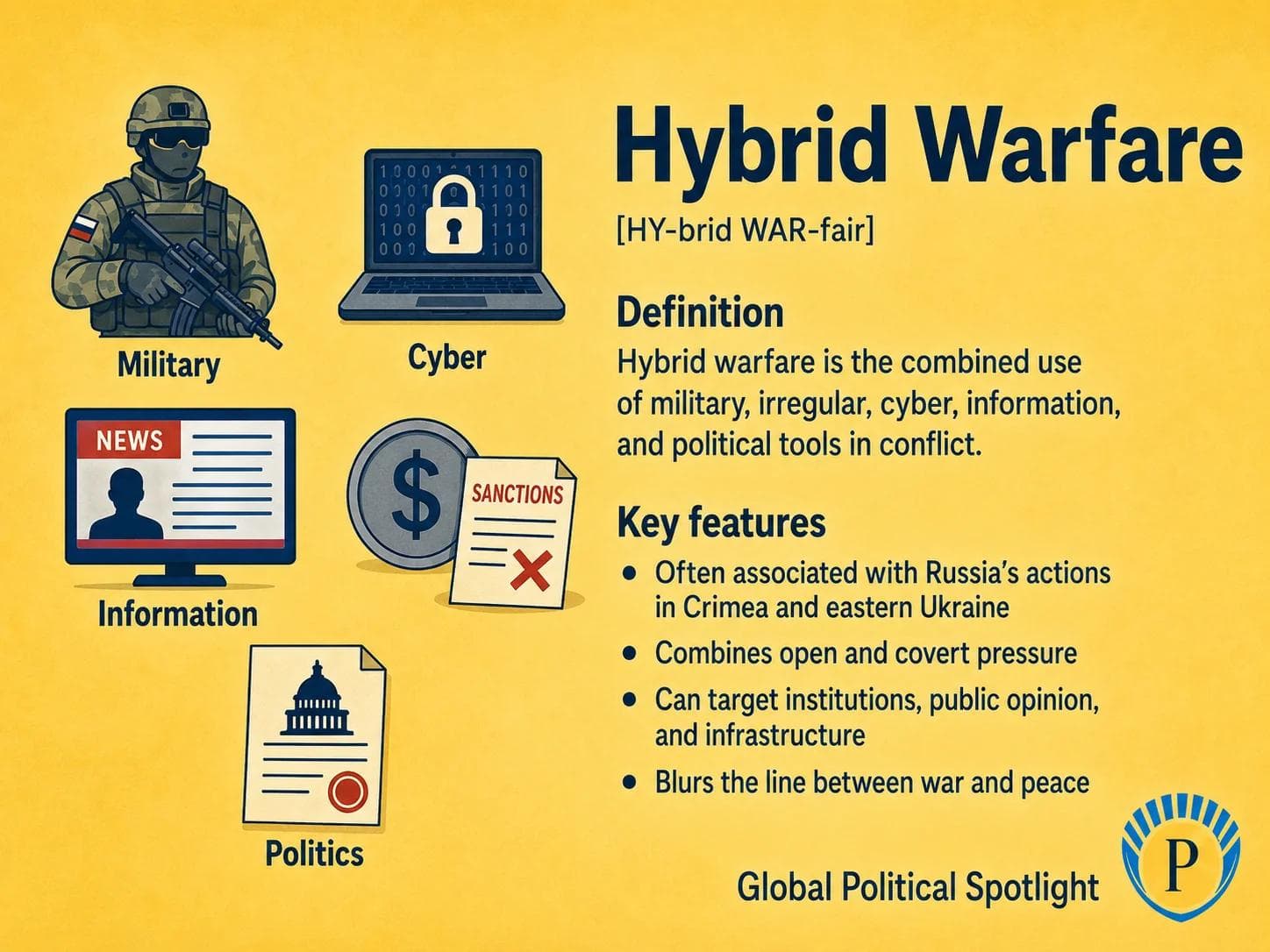
Hybrid warfare is the coordinated use of conventional force, irregular tactics, cyber operations, disinformation, economic pressure, and political influence to weaken or coerce an opponent.
Definition
Hybrid warfare is a conflict strategy that combines conventional military force with non-conventional tools such as cyber operations, information manipulation, political influence, economic pressure, sabotage, irregular forces, and covert activity. It is designed to weaken an opponent across several domains at once.
The concept is often used to describe strategies that blur the boundary between war and peace. Rather than relying only on battlefield operations, hybrid warfare targets institutions, public trust, infrastructure, elections, media ecosystems, military readiness, and alliance cohesion.
Russia’s actions in Crimea and eastern Ukraine from 2014 are frequently cited as examples because they involved military pressure, irregular forces, information operations, political manipulation, and ambiguity over attribution. The term is now also applied more broadly to state and non-state strategies across cyber, economic, and political domains.
Why It Matters
Hybrid warfare matters because it allows states and non-state actors to pursue strategic objectives without always crossing clear thresholds for conventional war. This can make response decisions harder for governments, alliances, courts, and international institutions.
It is especially important for democracies and alliances because hybrid campaigns can target political trust, critical infrastructure, media environments, electoral systems, and social cohesion. These pressures may weaken a state before or alongside military escalation.
GPS should track hybrid warfare as a cross-domain strategy linking cyber threats, disinformation, irregular operations, coercive diplomacy, sabotage, sanctions evasion, infrastructure vulnerability, and gray-zone competition. The key analytical questions are which tools are being combined, whether attribution is clear, which thresholds are being tested, and whether institutions can respond without over-escalating.
Key Facts
- Concept type
- Modern conflict strategy
- Core mechanism
- Combining military and non-military tools to pressure an opponent across multiple domains
- Common tools
- Conventional force, irregular groups, cyber operations, disinformation, political influence, sabotage, and economic coercion
- Strategic feature
- Blurs the line between war and peace, open and covert action, and civilian and military targets
- Frequently cited example
- Russia’s actions in Crimea and eastern Ukraine from 2014 are widely discussed as hybrid warfare cases
- Primary targets
- Institutions, public opinion, critical infrastructure, command systems, alliances, and political legitimacy
- Response challenge
- Hybrid campaigns can be hard to attribute quickly, making legal, diplomatic, and military responses difficult
- Important limit
- Hybrid warfare is not a completely new form of conflict; many elements have historical roots, but modern technology expands their speed and reach
FAQ
What is hybrid warfare?
Hybrid warfare is the combined use of military, cyber, information, political, economic, and irregular tools to weaken or coerce an opponent. It often works by creating ambiguity and pressure below the threshold of open war.
Why is hybrid warfare hard to respond to?
It can be difficult to respond to because the attacker may hide responsibility, use proxies, operate in civilian domains, or combine many smaller actions that do not clearly trigger a military or legal response.
Is hybrid warfare the same as cyber warfare?
No. Cyber operations can be part of hybrid warfare, but hybrid warfare is broader. It may also include disinformation, political influence, sabotage, economic pressure, irregular forces, and conventional military threats.
Why is Russia often linked to hybrid warfare?
Russia is often linked to the term because its actions in Crimea and eastern Ukraine from 2014 combined military pressure, irregular forces, political manipulation, information operations, and ambiguity over attribution.
What does hybrid warfare target?
Hybrid warfare can target military forces, government institutions, media systems, elections, public opinion, critical infrastructure, energy networks, transport systems, and alliance cohesion.
Is hybrid warfare new?
Not entirely. States have long used propaganda, covert action, proxies, sabotage, and economic pressure. What is newer is the speed, scale, and connectivity created by cyber tools, digital media, and global infrastructure dependence.
Recent Developments
NATO identified hybrid threats as a persistent security challenge
NATO’s 2022 Strategic Concept described hybrid operations, cyber threats, coercive tactics, and disinformation as part of the alliance’s security environment, reinforcing the concept’s continuing relevance.
NATOEU adopted the Strategic Compass with hybrid threat resilience as a priority
The EU Strategic Compass emphasized resilience against cyberattacks, disinformation, foreign interference, and hybrid threats, reflecting how non-military pressure is treated as a core security concern.
Council of the European UnionSources6 references
- NATO
Institutional reference on NATO’s security environment, including hybrid threats, cyber threats, disinformation, and coercive tactics.
- NATO
Official NATO overview of hybrid threats and alliance resilience measures.
- Council of the European Union
Official EU reference on the Strategic Compass and resilience against hybrid threats.
- European Centre of Excellence for Countering Hybrid Threats
Institutional reference focused on hybrid threats, resilience, and cross-domain security challenges.
- RAND Corporation
Research overview on hybrid warfare, irregular conflict, and multi-domain coercion.
- Encyclopaedia Britannica
Reference overview of hybrid warfare as a form of conflict combining conventional and unconventional methods.
GPSNews App
Read GPSNews on iPhone
Daily geopolitical briefings, government updates, and prediction signals in one focused app.
Newsletter
Stay Ahead Of The Next Signal
Get briefings in your inbox when new analysis and reports are published.