
Starlink in Warfare
How low-Earth-orbit satellite internet has reshaped battlefield communications and commercial space dependency
Starlink in warfare refers to the use of SpaceX's low-Earth-orbit satellite internet system for resilient communications, battlefield connectivity, drone support, and emergency network access, especially highlighted during the war in Ukraine.
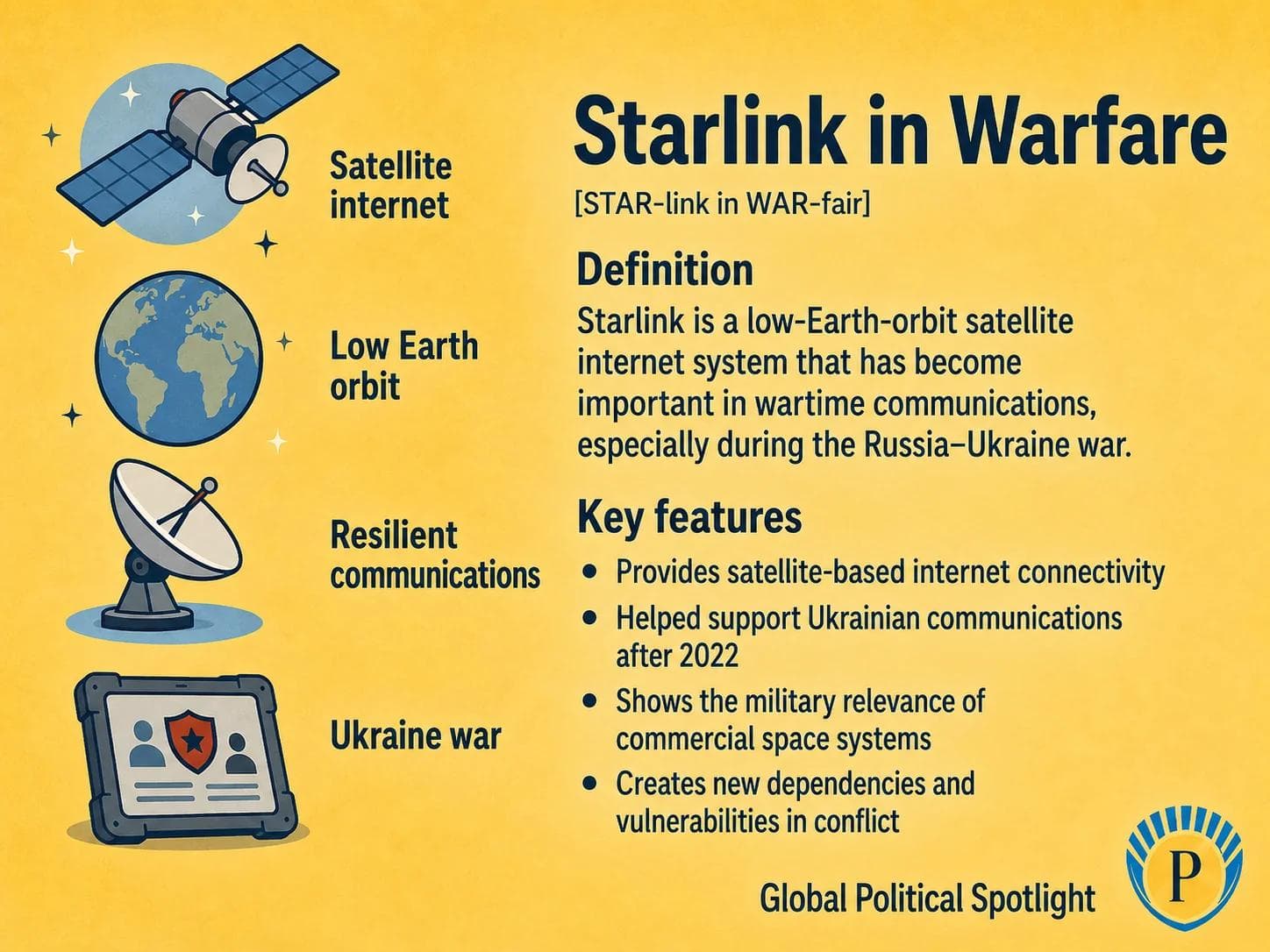
Definition
Starlink is a low-Earth-orbit satellite internet system operated by SpaceX. In wartime contexts, it can provide connectivity when terrestrial communications networks are damaged, jammed, overloaded, or unavailable.
Its role became especially visible after Russia's 2022 full-scale invasion of Ukraine, where Starlink terminals helped support civilian communications, government continuity, battlefield coordination, drone operations, and connectivity in areas where fixed infrastructure was degraded.
Starlink in warfare is not only a technical issue. It raises strategic questions about military dependence on commercial space providers, export controls, service restrictions, electromagnetic interference, cyber resilience, and the role of private companies in armed conflict.
Why It Matters
Starlink matters in warfare because communications are a foundation of modern military operations. Units need connectivity for command and control, intelligence sharing, drone feeds, logistics, targeting coordination, and coordination with civilian authorities.
Low-Earth-orbit satellite internet can be more resilient than some ground networks because it relies on many satellites and portable user terminals. At the same time, terminals can be detected, jammed, hacked, restricted by service policy, or disrupted by attacks on ground stations, supply chains, and spectrum access.
GPS should monitor Starlink in warfare as a reference case for the militarization of commercial space infrastructure. Key watch areas include Ukraine war communications, U.S. and allied procurement of commercial satellite services, battlefield drone connectivity, Russian and other counter-space responses, private-sector control over access, and the legal or policy frameworks governing commercial systems used in conflict.
Key Facts
- Type
- Low-Earth-orbit satellite internet system used in wartime communications
- Operator
- SpaceX
- Orbit type
- Low Earth orbit, using large constellations of satellites closer to Earth than traditional geostationary satellites
- Wartime role
- Provides connectivity for command posts, mobile units, emergency networks, drones, and damaged communications environments
- Ukraine relevance
- Became a prominent communications tool after Russia's 2022 full-scale invasion of Ukraine
- Strategic advantage
- Portable terminals and distributed satellites can improve communications resilience when ground networks are degraded
- Key vulnerability
- Terminals and links may face jamming, cyber threats, geofencing, policy restrictions, detection, supply constraints, or dependence on commercial decisions
- Policy issue
- Raises questions about how governments should regulate, fund, protect, and depend on commercial space systems during conflict
FAQ
What is Starlink in warfare?
Starlink in warfare refers to the use of SpaceX's low-Earth-orbit satellite internet system for communications in conflict settings. It can help military, government, humanitarian, and civilian users stay connected when ground networks are damaged or unreliable.
Why has Starlink mattered in Ukraine?
Starlink became important in Ukraine because it provided resilient internet connectivity during Russia's full-scale invasion. It helped support communications where terrestrial networks were damaged, disrupted, or insufficient for wartime needs.
How does low-Earth-orbit satellite internet help battlefield communications?
Low-Earth-orbit constellations can provide relatively low-latency internet through portable terminals. This can support command posts, mobile units, drone teams, logistics, and emergency communications without relying only on fixed ground infrastructure.
What are the vulnerabilities of Starlink in warfare?
Starlink can face jamming, cyber attacks, terminal detection, supply problems, service restrictions, geofencing, weather or terrain limits, and dependence on private-sector decisions. It is resilient, but it is not invulnerable.
Why does commercial space dependency matter?
Commercial space dependency matters because governments and militaries may rely on private companies for critical wartime functions. This creates questions about contracts, sovereignty, liability, escalation, export rules, and who controls access during a crisis.
Is Starlink a military system?
Starlink is a commercial satellite internet system, but it can be used in military and wartime contexts. SpaceX has also developed Starshield as a separate offering for government and national security customers.
Recent Developments
Starlink service was activated for Ukraine after Russia's full-scale invasion
Starlink terminals and service became part of Ukraine's wartime communications environment after Russia's full-scale invasion, highlighting the importance of commercial satellite internet for government continuity, civilian connectivity, and battlefield communications.
SpaceXU.S. Department of Defense contracted for Starlink services in Ukraine
The U.S. Department of Defense confirmed a contract for Starlink services to support Ukraine, reflecting the shift from ad hoc wartime reliance toward more formal government procurement of commercial satellite communications.
U.S. Department of DefenseSources6 references
- SpaceX - Starlink
Operator reference for Starlink satellite internet services and basic system information.
- U.S. Department of Defense - Starlink Services Contract
Official U.S. defense statement confirming a contract for Starlink services to support Ukraine.
- U.S. Space Force - Commercial Space Strategy
Official U.S. military reference for the growing role of commercial space capabilities in national security.
- Congressional Research Service
Institutional source for U.S. defense space policy, commercial satellite communications, and military reliance on private-sector space systems.
- Secure World Foundation
Reference organization for space security, commercial space governance, and norms of behavior in outer space.
- Center for Strategic and International Studies - Aerospace Security
Think tank source for analysis of satellite systems, space security, counterspace threats, and commercial space roles in conflict.

GPSNews App
Read GPSNews on iPhone
Daily geopolitical briefings, government updates, and prediction signals in one focused app.
Newsletter
Stay Ahead Of The Next Signal
Get briefings in your inbox when new analysis and reports are published.