
Escalation Dominance
The ability to outmatch an opponent at higher levels of conflict intensity
Escalation dominance is the ability of a state or actor to prevail, deter, or impose higher costs than an opponent at successive levels of conflict intensity.
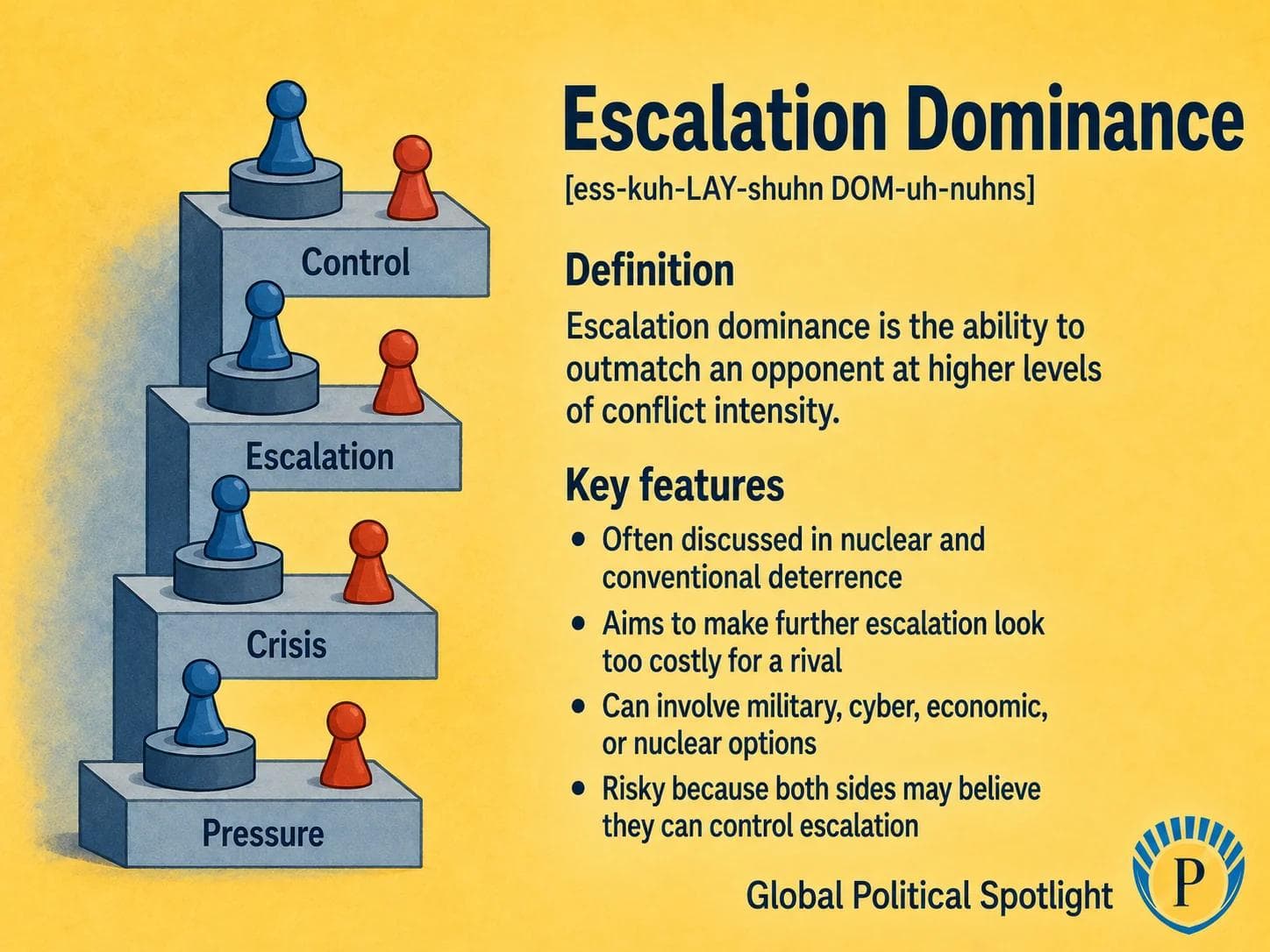
Definition
Escalation dominance is a strategy concept describing the ability of a state or actor to outmatch an opponent if a conflict moves to higher levels of intensity. The basic idea is that a rival should believe escalation will leave it worse off, either because it cannot match the response or because the costs would become unacceptable.
The concept is often discussed in nuclear and conventional deterrence, but it can also apply across cyber operations, economic coercion, information campaigns, military mobilization, and diplomatic pressure. A state may seek credible options at multiple levels so it is not forced to choose between doing nothing and launching a major war.
Escalation dominance does not mean escalation is easy to control. It is risky because both sides may believe they have the upper hand, misread signals, underestimate resolve, or assume that the other side will back down before the conflict becomes uncontrollable.
Why It Matters
Escalation dominance matters because it sits at the center of deterrence strategy. If a state can credibly threaten stronger responses at each level of a conflict, it may discourage an opponent from taking further risks.
It also matters for crisis stability. When rivals believe escalation can be managed, they may take actions that are intended to be limited but still create pathways toward larger conflict. This is especially dangerous when nuclear weapons, long-range strike systems, cyber capabilities, or alliance commitments are involved.
For policymakers, the concept highlights the need for credible capabilities, clear signaling, proportional response options, crisis communication, and an understanding of how an adversary interprets risk.
Escalation dominance is a key GPS concept for analyzing deterrence, crisis behavior, nuclear signaling, conventional force posture, cyber conflict, sanctions escalation, and alliance credibility. GPS should watch how states build response options across different domains, how they communicate red lines, and whether rivals interpret those signals as deterrence, coercion, or preparation for escalation.
Key Facts
- Type
- Deterrence and military strategy concept
- Core idea
- The ability to outmatch or impose unacceptable costs on an opponent at higher levels of conflict
- Main purpose
- To deter an opponent from escalating by making further escalation appear too costly or unwinnable
- Common domains
- Diplomatic, economic, cyber, conventional military, space, information, and nuclear measures
- Nuclear relevance
- Often discussed in relation to nuclear deterrence, second-strike capability, limited nuclear options, and crisis stability
- Conventional relevance
- Can involve superior forces, mobility, precision strike, air defense, logistics, basing access, and alliance support
- Main risk
- Both sides may believe they control escalation, increasing the chance of miscalculation
- Key limitation
- Dominance depends not only on capabilities, but also on credibility, resolve, communication, and adversary perception
FAQ
What is escalation dominance?
Escalation dominance is the ability of a state or actor to outmatch an opponent at higher levels of conflict intensity, making further escalation appear too costly, risky, or unwinnable for the opponent.
How does escalation dominance relate to deterrence?
It supports deterrence by giving a state credible response options if an opponent escalates. The goal is to convince the opponent that moving to a higher level of conflict will not produce an advantage.
Is escalation dominance only about nuclear weapons?
No. Nuclear weapons are a major part of the concept, but escalation dominance can also involve conventional military power, cyber operations, economic measures, space capabilities, diplomacy, intelligence, and alliance commitments.
Why is escalation dominance risky?
It is risky because rivals may misunderstand signals, underestimate each other's resolve, or both believe they can control the next step. That can turn a limited confrontation into a larger crisis.
What is an escalation ladder?
An escalation ladder is a way of thinking about conflict as a series of increasing steps, from diplomatic pressure and limited actions to conventional war and potentially nuclear use. Escalation dominance means having credible advantages or responses across those steps.
Can a weaker state have escalation dominance?
Sometimes, in a specific domain or local theater. A weaker state may have local geography, resolve, cyber tools, missile forces, or alliance backing that gives it leverage at certain levels, even if it is weaker overall.
Recent Developments
U.S. defense strategy emphasized integrated deterrence
The 2022 U.S. National Defense Strategy described integrated deterrence across domains, theaters, and instruments of national power, reflecting the importance of credible response options in a contested security environment.
U.S. Department of DefenseNATO reaffirmed deterrence and defense posture
NATO's 2024 Washington Summit Declaration emphasized deterrence, defense, nuclear deterrence, and forward defense posture, illustrating how escalation control and credible response options remain central to alliance strategy.
NATOSources6 references
- U.S. Department of Defense
Official U.S. defense strategy source discussing integrated deterrence, nuclear posture, and strategic competition.
- NATO
Institutional overview of NATO deterrence and defense posture, including nuclear and conventional dimensions.
- NATO
Official 2024 Washington Summit Declaration covering deterrence, defense, nuclear posture, and alliance security commitments.
- RAND Corporation
Research background on deterrence theory and strategic stability.
- Congressional Research Service
Reference overview of defense primer concepts related to nuclear forces and strategic deterrence.
- Arms Control Association
Reference background on nuclear weapons holdings and nuclear-armed states, relevant to escalation and deterrence analysis.

GPSNews App
Read GPSNews on iPhone
Daily geopolitical briefings, government updates, and prediction signals in one focused app.
Newsletter
Stay Ahead Of The Next Signal
Get briefings in your inbox when new analysis and reports are published.