
Trident II D5 SLBM
A submarine-launched ballistic missile central to U.S. and UK sea-based nuclear deterrence
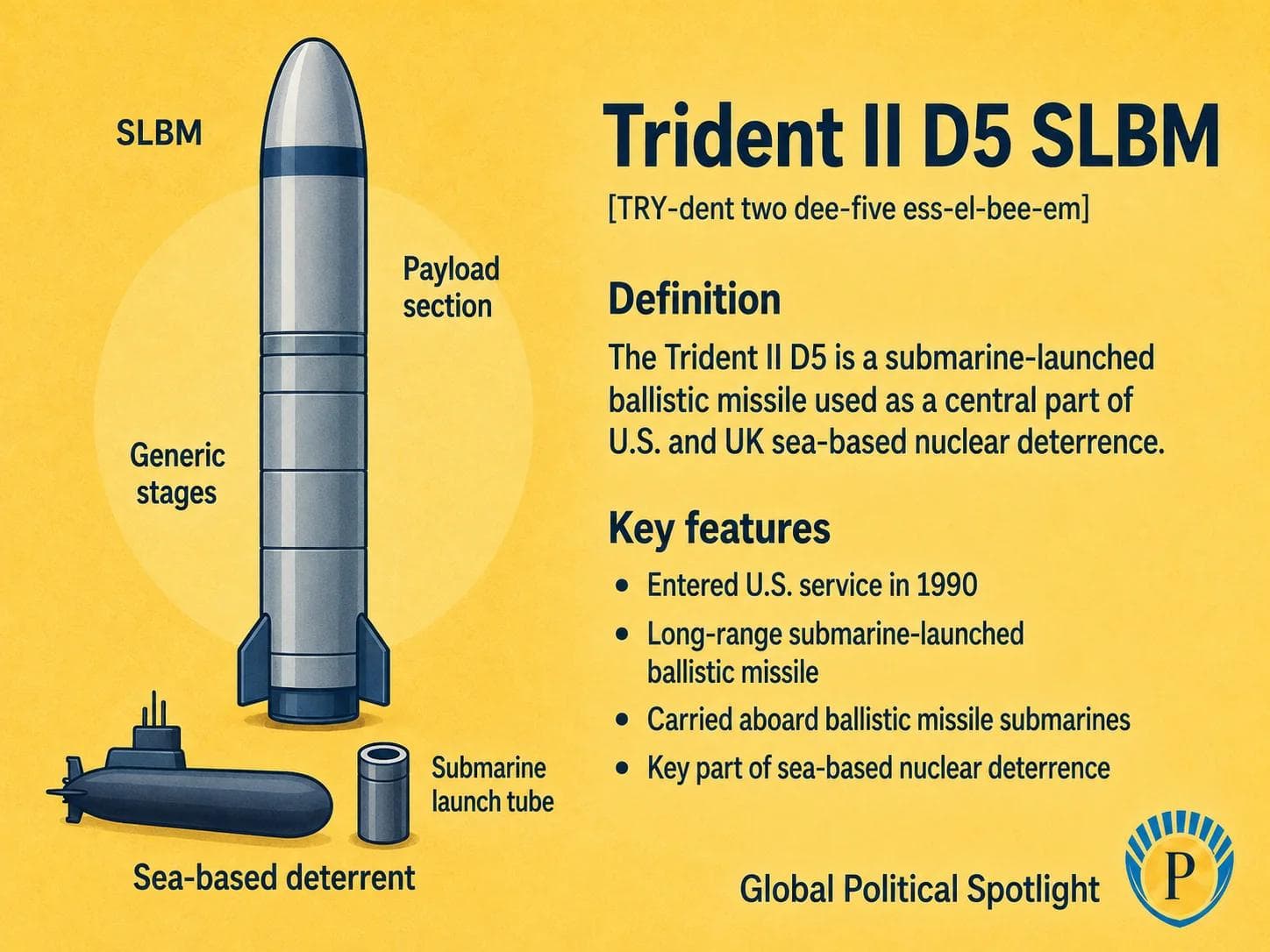
The Trident II D5 is a submarine-launched ballistic missile carried by U.S. Ohio-class and UK Vanguard-class ballistic missile submarines, forming a core sea-based component of both countries' nuclear deterrents.
Definition
The Trident II D5 is a submarine-launched ballistic missile, or SLBM, designed to be fired from ballistic missile submarines while they are at sea. It is deployed by the United States Navy on Ohio-class submarines and by the United Kingdom on Vanguard-class submarines, with both countries using it as a central part of their sea-based nuclear deterrent.
Unlike land-based missiles, an SLBM is carried in vertical launch tubes aboard a submarine. This gives the deterrent a survivable second-strike role because submarines can remain hidden underwater, making them harder to locate and target in a crisis.
Why It Matters
The Trident II D5 matters because it underpins the sea-based leg of U.S. nuclear deterrence and the United Kingdom's continuous at-sea deterrent. Its strategic importance comes less from day-to-day visibility and more from the survivability of submarines that can remain dispersed and concealed.
For NATO and wider strategic stability, Trident connects nuclear posture, alliance reassurance, arms-control debates, submarine procurement, and long-term deterrence planning. Its modernization and life-extension programs are therefore watched closely by governments, defense planners, and arms-control analysts.
GPS should watch the Trident II D5 as a durable indicator of U.S. and UK sea-based nuclear deterrence, submarine modernization, and nuclear command-and-control resilience. Key long-term issues include the transition from Ohio-class to Columbia-class submarines, the UK's Dreadnought-class program, missile life-extension efforts, arms-control debates, and the role of survivable second-strike forces in strategic stability.
Key Facts
- Type
- Submarine-launched ballistic missile
- Primary users
- United States and United Kingdom
- Launch platform
- Ballistic missile submarines with vertical missile launch tubes
- U.S. platform
- Ohio-class submarines, with planned transition to Columbia-class submarines
- UK platform
- Vanguard-class submarines, with planned transition to Dreadnought-class submarines
- Strategic role
- Provides a survivable sea-based nuclear deterrent and second-strike capability
- Triad relevance
- Forms the sea-based leg of the U.S. nuclear triad alongside land-based ICBMs and strategic bombers
- Alliance relevance
- Supports U.S. extended deterrence and the United Kingdom's independent nuclear deterrent within the NATO alliance
FAQ
What is the Trident II D5 SLBM?
The Trident II D5 is a submarine-launched ballistic missile carried by U.S. and UK ballistic missile submarines. It is designed for long-range nuclear deterrence from concealed submarines at sea.
Why is Trident II D5 important?
It is important because submarine-launched missiles are difficult to preemptively target when submarines remain hidden. This makes Trident central to second-strike deterrence and strategic stability.
Which countries use Trident II D5?
The United States and the United Kingdom use the Trident II D5. The United States deploys it as part of its nuclear triad, while the United Kingdom uses Trident as the missile system for its sea-based nuclear deterrent.
Is Trident II D5 part of the nuclear triad?
Yes. For the United States, Trident II D5 supports the sea-based leg of the nuclear triad, alongside land-based intercontinental ballistic missiles and strategic bombers.
What makes submarine-launched ballistic missiles different from land-based missiles?
Submarine-launched ballistic missiles are carried at sea by submarines rather than fixed silos or road-mobile launchers. Their main advantage is survivability, because submarines can patrol underwater and are harder to detect.
What are the limits of Trident II D5?
Trident depends on secure submarines, command-and-control systems, crew readiness, maintenance cycles, and political authorization. Its deterrent value also relies on adversaries believing the system would remain survivable and usable after an attack.
Recent Developments
U.S. Navy continued Trident II D5 life-extension planning
U.S. Navy budget and program materials continued to describe the Trident II D5 and its life-extension work as essential to sustaining the sea-based strategic deterrent through current and future ballistic missile submarine forces.
U.S. Navy Strategic Systems ProgramsUK defence planning continued to center on the Dreadnought submarine transition
The United Kingdom continued work on replacing Vanguard-class ballistic missile submarines with Dreadnought-class submarines, preserving the Trident-based continuous at-sea deterrent as a long-term pillar of UK nuclear policy.
UK Ministry of DefenceSources6 references
- U.S. Navy Strategic Systems Programs
Official U.S. Navy command responsible for sea-based strategic weapons systems, including Trident.
- U.S. Navy Fact File: Fleet Ballistic Missile Submarines
Official U.S. Navy reference on ballistic missile submarines and their deterrence role.
- UK Ministry of Defence: Dreadnought Submarine Programme
Official UK government collection on the future submarine program replacing Vanguard-class submarines.
- NATO: Nuclear Deterrence
NATO reference page explaining the alliance's nuclear deterrence posture.
- Congressional Research Service
Reference source for U.S. strategic nuclear forces, modernization programs, and arms-control context.
- Royal Navy: Submarine Service
Official Royal Navy reference for the UK submarine service and continuous at-sea deterrent context.

GPSNews App
Read GPSNews on iPhone
Daily geopolitical briefings, government updates, and prediction signals in one focused app.
Newsletter
Stay Ahead Of The Next Signal
Get briefings in your inbox when new analysis and reports are published.