
Nationalism and Populism
Two powerful political ideas that shape identity, representation, sovereignty, and foreign policy
Nationalism emphasizes the identity, interests, and sovereignty of the nation, while populism frames politics as a struggle between ordinary people and a corrupt or detached elite.
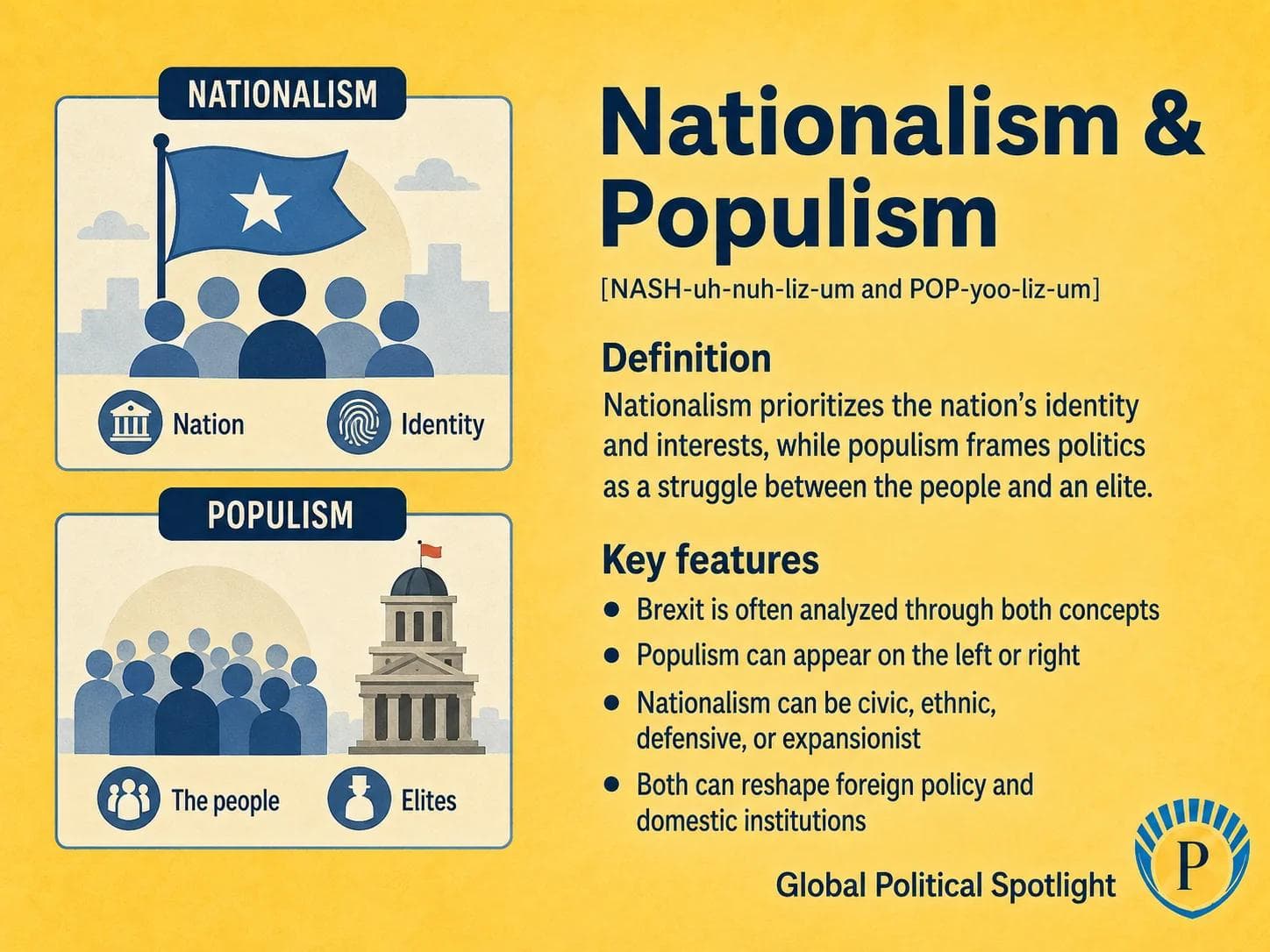
Definition
Nationalism is a political idea that places the nation, its identity, its sovereignty, and its perceived interests at the center of political life. It can emphasize shared history, language, culture, citizenship, territory, institutions, or national self-determination.
Populism is a political style or ideology that frames society as divided between ordinary people and a corrupt, distant, or self-serving elite. Populist movements often claim to represent the true will of the people against established parties, courts, media, experts, bureaucracies, or international institutions.
The two concepts often overlap, but they are not the same. Nationalism can be civic, ethnic, defensive, anti-colonial, liberal, conservative, or expansionist. Populism can appear on the left or right, and may attach itself to nationalism, socialism, anti-corruption politics, religious identity, or anti-globalization movements.
Why It Matters
Nationalism and populism matter because they influence how governments define sovereignty, citizenship, borders, trade, migration, alliances, and national interest. They can strengthen democratic participation and collective identity, but they can also intensify exclusion, polarization, and distrust of institutions.
In foreign policy, nationalist and populist politics can challenge multilateral institutions, reshape alliance commitments, increase skepticism toward globalization, and prioritize domestic political mandates over international cooperation. Brexit is a major example of how sovereignty-focused and anti-elite narratives can reshape state strategy.
For political analysis, the key is to separate the two concepts carefully. A nationalist movement is not automatically populist, and a populist movement is not always nationalist. Their effects depend on institutions, leadership, minority protections, media systems, economic conditions, and historical context.
Nationalism and populism are key GPS concepts for analyzing domestic political forces that reshape foreign policy, alliances, trade, migration, regional integration, democratic institutions, and public trust. GPS should track how leaders invoke national sovereignty, anti-elite narratives, border control, cultural identity, economic grievance, and democratic legitimacy to justify policy change.
Key Facts
- Type
- Political ideology and political style concepts
- Nationalism
- Emphasizes the nation’s identity, sovereignty, unity, interests, and self-determination
- Populism
- Frames politics as a struggle between ordinary people and a corrupt, detached, or illegitimate elite
- Key difference
- Nationalism focuses on the nation; populism focuses on the people-versus-elite divide
- Political range
- Populism can appear on the left or right, while nationalism can be civic, ethnic, defensive, or expansionist
- Foreign policy impact
- Can shape positions on alliances, trade, immigration, sovereignty, border control, and international institutions
- Common example
- Brexit is often analyzed through sovereignty-focused nationalism and populist criticism of political and EU elites
- Main risk
- Can weaken institutional checks, intensify polarization, exclude minorities, or turn foreign policy into identity politics
FAQ
What is nationalism?
Nationalism is a political idea that emphasizes the nation’s identity, sovereignty, unity, and interests. It can be based on citizenship, culture, language, history, ethnicity, territory, or shared political institutions.
What is populism?
Populism is a political approach that frames politics as a struggle between ordinary people and a corrupt or detached elite. Populist leaders often claim that they alone represent the real will of the people.
Are nationalism and populism the same?
No. Nationalism focuses on the nation and its identity or interests. Populism focuses on a people-versus-elite conflict. They often overlap, but either concept can exist without the other.
Can populism be left-wing or right-wing?
Yes. Right-wing populism often emphasizes nationalism, borders, immigration, culture, and sovereignty. Left-wing populism often emphasizes inequality, corporate power, economic elites, corruption, and redistribution.
How do nationalism and populism affect foreign policy?
They can push governments toward sovereignty-first policies, skepticism of international institutions, stricter border control, trade protection, alliance renegotiation, and rhetoric that prioritizes domestic voters over multilateral cooperation.
Was Brexit nationalist or populist?
Brexit is often analyzed as both. It involved nationalist arguments about sovereignty and control, as well as populist claims that ordinary voters were being ignored by political, bureaucratic, and European Union elites.
Recent Developments
The United Kingdom formally left the European Union
The United Kingdom’s withdrawal from the EU marked a major example of sovereignty-focused politics and anti-establishment campaigning reshaping a state’s relationship with regional integration.
European UnionEuropean Parliament elections reflected pressure on mainstream parties
The 2024 European Parliament elections showed continued support for nationalist, populist, and Eurosceptic parties in several member states, while pro-EU groups remained central to parliamentary coalition-building.
European ParliamentSources6 references
- Encyclopaedia Britannica
Reference definition and historical background on nationalism.
- Encyclopaedia Britannica
Reference definition and background on populism as a political concept.
- European Union
Official EU chronology covering the United Kingdom’s withdrawal from the European Union.
- European Parliament
Official results source for European Parliament elections, useful for tracking nationalist, populist, and Eurosceptic party performance.
- International IDEA
Institutional source on democracy, representation, institutions, and democratic performance.
- OECD
Institutional background on trust in government, relevant to anti-elite politics and institutional legitimacy.

GPSNews App
Read GPSNews on iPhone
Daily geopolitical briefings, government updates, and prediction signals in one focused app.
Newsletter
Stay Ahead Of The Next Signal
Get briefings in your inbox when new analysis and reports are published.