
Nation vs. State vs. Nation-State
Three core concepts for understanding identity, sovereignty, territory, and political authority
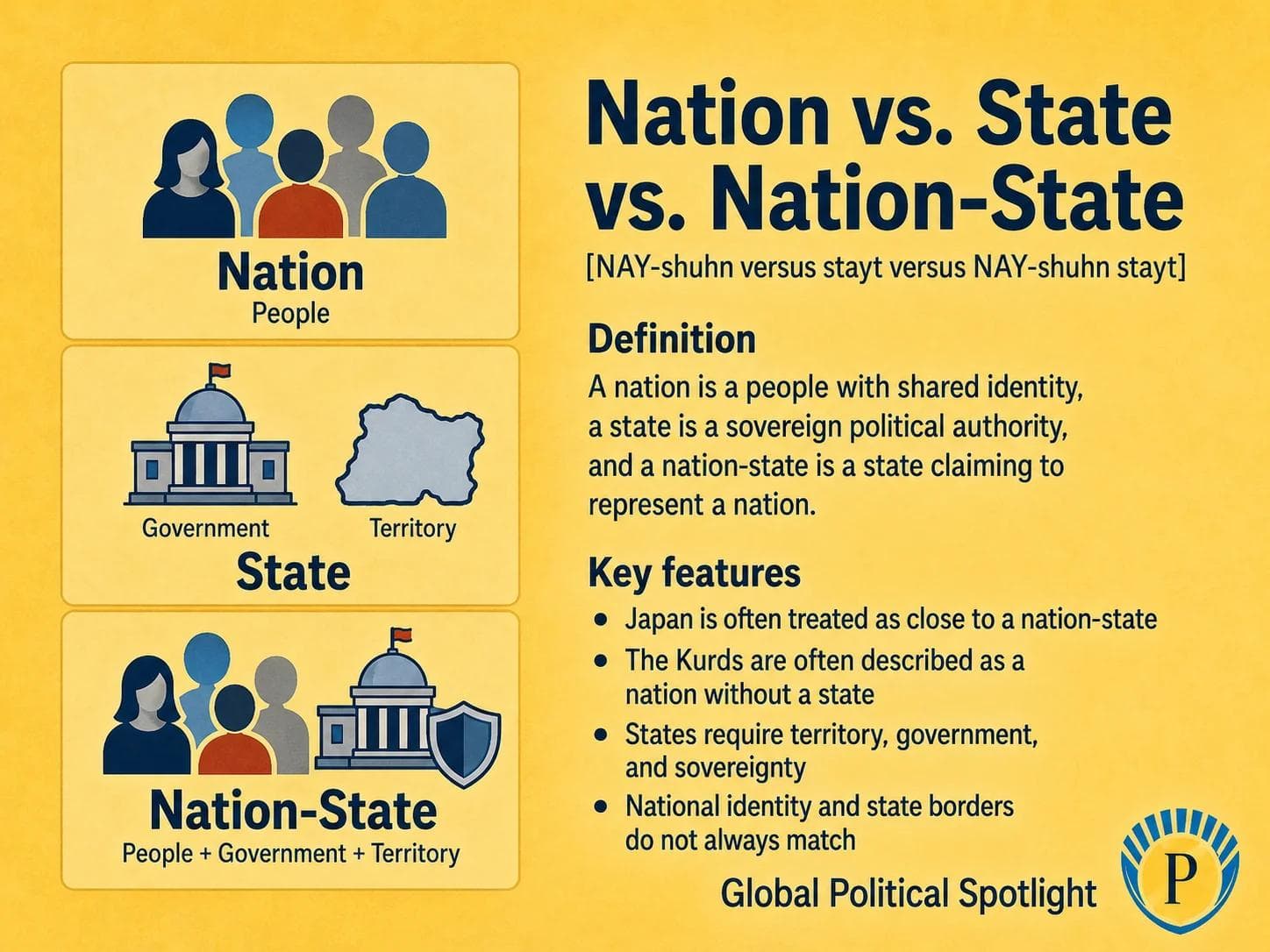
A nation is a people with shared identity, a state is a sovereign political authority with territory and government, and a nation-state is a state that claims to represent a nation.
Definition
A nation is a group of people who understand themselves as sharing a common identity, often based on history, language, culture, ethnicity, religion, political memory, or a sense of collective belonging. A nation does not necessarily have internationally recognized territory or a sovereign government.
A state is a sovereign political authority with a defined territory, a government, a population, and the capacity to enter relations with other states. In international law and diplomacy, states are the main recognized units of the international system.
A nation-state is a state that claims to represent a nation, usually by linking political sovereignty to a shared national identity. Some states closely fit this model, while others contain multiple nations, minority groups, or contested national claims.
Why It Matters
These distinctions matter because many geopolitical disputes involve a mismatch between national identity and state borders. A group may see itself as a nation without having a state, while a state may govern several national communities with different political aspirations.
The concepts are central to sovereignty, self-determination, separatism, minority rights, border disputes, state recognition, and nation-building. They also help explain why political legitimacy can depend not only on government control, but on whether people believe the state represents their identity.
GPS should track nation, state, and nation-state as foundational concepts behind sovereignty claims, separatist movements, state recognition disputes, minority rights, constitutional design, border conflicts, and nationalist politics. The key analytical issue is whether political authority, territorial control, and national identity align or remain contested.
Key Facts
- Concept type
- Political geography and international relations
- Nation
- A people with a shared identity, history, culture, language, or political memory
- State
- A sovereign political authority with territory, population, government, and external relations
- Nation-state
- A state that claims to represent a nation through shared identity and political sovereignty
- International law
- States are the primary recognized actors in the international system
- Example of a nation-state
- Japan is often cited as a relatively close example of a nation-state, though no state is perfectly homogeneous
- Nation without a state
- The Kurds are often cited as a nation without a fully sovereign independent state
- Important limit
- Most real states are multinational or contain minorities, making the nation-state an ideal type rather than a universal reality
FAQ
What is the difference between a nation and a state?
A nation is a group of people with a shared identity, while a state is a sovereign political authority with territory, government, population, and external relations. A nation is about identity; a state is about political and legal authority.
What is a nation-state?
A nation-state is a state that claims to represent a nation. It links political sovereignty to national identity, often through shared language, history, institutions, symbols, and citizenship.
Can a nation exist without a state?
Yes. A nation can exist without a fully sovereign state if its people share a national identity but lack independent international recognition or control over a sovereign territory. The Kurds are often cited as an example.
Can one state contain several nations?
Yes. Many states are multinational, meaning they include several national, ethnic, linguistic, religious, or regional communities. This can be stable under inclusive institutions, but it can also produce disputes over autonomy, rights, or independence.
Why do these terms matter in geopolitics?
They matter because conflicts often arise when identity, borders, and sovereignty do not align. Disputes over self-determination, separatism, recognition, minority rights, and territorial control often depend on how these concepts are interpreted.
Is every country a nation-state?
No. Many countries contain multiple national groups or have national identities that do not map neatly onto state borders. The nation-state is a powerful political model, but it is not a perfect description of every country.
Recent Developments
UN vote reaffirmed the importance of sovereignty and territorial integrity
The UN General Assembly resolution on Ukraine reaffirmed principles of sovereignty, territorial integrity, and political independence, illustrating how statehood and borders remain central to international order.
United NationsUN vote highlighted continuing disputes over recognition and statehood
A UN General Assembly resolution on Palestine’s status reflected the continuing importance of international recognition, self-determination, and statehood debates in global diplomacy.
United NationsSources6 references
- United Nations
Foundational institutional reference for sovereignty, state equality, and the international system.
- Encyclopaedia Britannica
Reference overview of the nation-state concept and its historical development.
- Encyclopaedia Britannica
Reference overview of the state as a sovereign political entity.
- Cornell Legal Information Institute
Reference summary of the Montevideo Convention criteria often cited in discussions of statehood.
- United Nations Digital Library
UN General Assembly resolution reaffirming sovereignty and territorial integrity principles in relation to Ukraine.
- United Nations Digital Library
UN General Assembly resolution relevant to international recognition and statehood debates.

GPSNews App
Read GPSNews on iPhone
Daily geopolitical briefings, government updates, and prediction signals in one focused app.
Newsletter
Stay Ahead Of The Next Signal
Get briefings in your inbox when new analysis and reports are published.