
Resource Nationalism
State efforts to control natural resources for national economic, political, or strategic goals
Resource nationalism is the effort by states to control, tax, restrict, or direct natural resources within their borders to advance national economic, political, or strategic objectives.
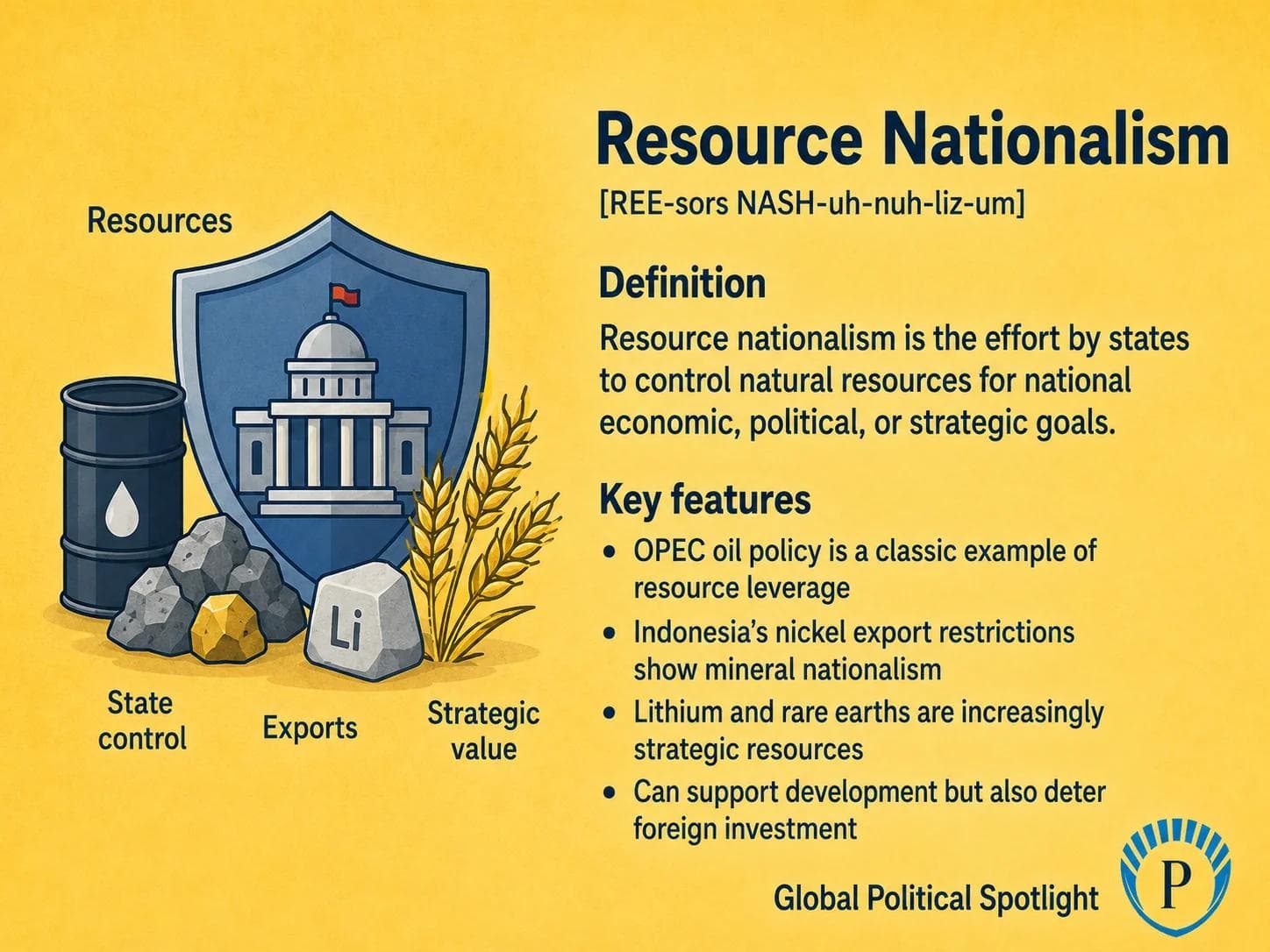
Definition
Resource nationalism refers to state efforts to control natural resources within national territory for economic, political, or strategic purposes. It can involve public ownership, higher royalties, export restrictions, local-processing requirements, nationalization, licensing rules, taxation, or limits on foreign ownership.
The concept is often associated with oil, gas, minerals, lithium, nickel, copper, rare earth elements, agricultural commodities, and other strategic resources. Governments may use resource policy to increase public revenue, build domestic industry, strengthen bargaining power, protect security interests, or reduce dependence on foreign companies.
Resource nationalism can support development when it captures more value for domestic economies, but it can also deter investment if rules become unpredictable, contracts are weakened, or foreign firms face sudden restrictions.
Why It Matters
Resource nationalism matters because natural resources are central to state revenue, industrial policy, military supply chains, energy security, and geopolitical leverage. When states restrict or redirect resource flows, the effects can reach global markets.
The concept is especially important in the energy transition. Lithium, nickel, cobalt, copper, and rare earths are essential for batteries, electric vehicles, wind turbines, electronics, and defense technologies, making control over resource supply chains a strategic issue.
For investors and governments, resource nationalism creates a tradeoff between national value capture and market confidence. Policies that build domestic capacity can strengthen long-term development, but abrupt restrictions can increase supply risk, prices, and diplomatic friction.
Resource nationalism is a key GPS concept for tracking how states use oil, gas, minerals, food, and critical raw materials as tools of development, bargaining power, and strategic leverage. GPS should watch export restrictions, nationalization moves, royalty changes, local-processing rules, critical-mineral partnerships, OPEC policy, investor-state disputes, and supply-chain diversification efforts.
Key Facts
- Type
- Energy, resources, and economic statecraft concept
- Core idea
- States seek greater control over natural resources to advance national economic, political, or strategic goals
- Common tools
- Export restrictions, nationalization, royalties, taxation, local-processing rules, licensing limits, and state ownership
- Common resources
- Oil, gas, coal, nickel, lithium, cobalt, copper, rare earths, wheat, water, and strategic minerals
- Classic example
- OPEC oil policy shows how producer states can coordinate resource supply and influence global energy markets
- Modern example
- Indonesia's nickel export restrictions aimed to encourage domestic processing and capture more value from battery supply chains
- Strategic role
- Resource control can shape energy security, industrial policy, foreign investment, sanctions resilience, and supply-chain leverage
- Main risk
- Unpredictable resource policy can deter investment, trigger disputes, raise prices, and encourage buyers to diversify supply
FAQ
What is resource nationalism?
Resource nationalism is the effort by states to control, tax, restrict, nationalize, or direct natural resources within their borders to advance national economic, political, or strategic goals.
Why do countries use resource nationalism?
Countries may use resource nationalism to increase public revenue, build domestic industry, protect strategic resources, reduce foreign corporate control, create jobs, strengthen bargaining power, or support national security.
What are examples of resource nationalism?
OPEC oil policy is a classic example of producer-state resource leverage. Indonesia's nickel export restrictions are a modern example linked to domestic processing, battery minerals, and electric-vehicle supply chains.
How does resource nationalism affect global markets?
It can change supply, prices, investment flows, processing capacity, and buyer behavior. Export bans or tighter state control can create shortages or uncertainty, while long-term industrial policy can reshape supply chains.
Is resource nationalism always bad for investment?
No. Some policies can create clearer domestic value chains and stable public revenue. But sudden nationalization, contract changes, or export restrictions can make investors view a country as riskier.
Why is resource nationalism important for critical minerals?
Critical minerals such as lithium, nickel, cobalt, copper, and rare earths are needed for batteries, renewable energy, electronics, and defense systems. States that control these resources can gain strategic leverage in the energy transition.
Recent Developments
Indonesia implemented a nickel ore export ban to support domestic processing
Indonesia's nickel export restrictions became a major example of resource nationalism linked to battery minerals, industrial policy, and efforts to move up the electric-vehicle supply chain.
World Trade OrganizationEU proposed a Critical Raw Materials Act
The European Commission proposed the Critical Raw Materials Act to strengthen EU access to strategic raw materials, reflecting growing concern about resource security, supply-chain concentration, and critical-mineral dependency.
European CommissionSources6 references
- OPEC
Official background on OPEC and producer-state cooperation in oil markets.
- World Trade Organization
WTO dispute page on Indonesia's measures relating to raw materials, including nickel-related export restrictions.
- International Energy Agency
Institutional source on critical minerals, energy transition technologies, and supply-chain security.
- European Commission
Official EU source on critical raw materials policy and efforts to secure strategic resource supply.
- U.S. Geological Survey
Official U.S. source on critical minerals, mineral supply, and resource security.
- World Bank
Institutional background on extractive industries, resource governance, and development.

GPSNews App
Read GPSNews on iPhone
Daily geopolitical briefings, government updates, and prediction signals in one focused app.
Newsletter
Stay Ahead Of The Next Signal
Get briefings in your inbox when new analysis and reports are published.