
Irredentism
A political claim to territory outside a state’s borders based on identity, history, or national ties
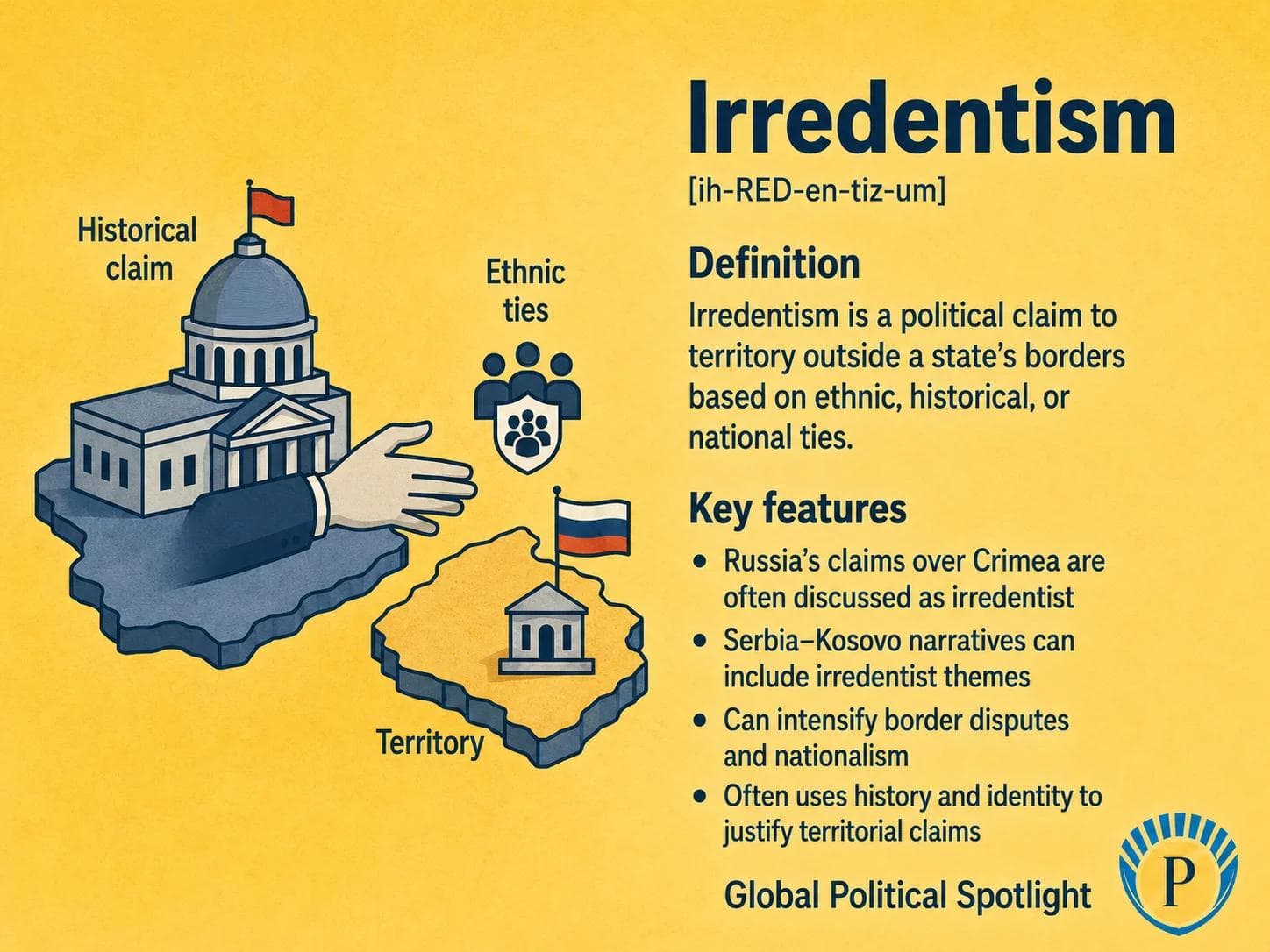
Irredentism is a political claim that territory outside a state’s current borders should be joined to that state because of ethnic, historical, cultural, linguistic, or national ties.
Definition
Irredentism is a political claim that territory outside a state’s current borders should belong to that state because of alleged ethnic, historical, cultural, linguistic, religious, or national ties. It is often linked to the idea that a nation is divided by borders and should be politically reunited.
Irredentist claims can be made by governments, nationalist parties, diaspora movements, armed groups, or political leaders. They may focus on populations described as co-nationals abroad, historic homelands, former imperial territories, sacred sites, or regions lost through war, treaties, decolonization, or state collapse.
The concept is politically sensitive because it can challenge internationally recognized borders and the sovereignty of existing states. Russia’s claims over Crimea and Serbian narratives around Kosovo are commonly discussed examples of how historical memory, identity, and territorial politics can interact.
Why It Matters
Irredentism matters because it can turn identity politics into territorial conflict. When a state or movement claims land beyond existing borders, it can intensify nationalism, undermine diplomatic settlements, and increase the risk of war.
It is closely connected to sovereignty, self-determination, border disputes, minority rights, separatism, and great-power politics. Irredentist arguments often compete with the principle that international borders should not be changed by force.
For policymakers, irredentism is difficult because it can be framed as protecting a population, correcting a historical injustice, or restoring national unity, while also threatening territorial integrity and regional stability.
Irredentism is a key GPS concept for tracking territorial disputes where identity, history, and nationalism are used to justify claims beyond recognized borders. GPS should watch official rhetoric, constitutional claims, maps, school curricula, diaspora politics, military deployments, minority-rights narratives, and whether political language moves from symbolic claims toward coercive action.
Key Facts
- Type
- Territorial and nationalist political concept
- Core idea
- A claim that territory outside a state’s borders should be joined to it because of identity, history, or national ties
- Common bases
- Ethnicity, language, religion, historical rule, cultural identity, national mythology, or diaspora populations
- Main tension
- Irredentist claims often conflict with sovereignty, territorial integrity, and internationally recognized borders
- Common actors
- States, nationalist parties, diaspora groups, separatist movements, and political leaders
- Related concepts
- Nationalism, self-determination, territorial disputes, separatism, annexation, and revanchism
- Common example
- Russia’s claims over Crimea are widely discussed as an irredentist case involving history, identity, and territorial control
- Strategic risk
- Irredentism can escalate border disputes, justify military pressure, and complicate peace settlements
FAQ
What is irredentism?
Irredentism is a political claim that territory outside a state’s current borders should be joined to that state because of ethnic, historical, cultural, linguistic, or national ties.
What is an example of irredentism?
Russia’s claims over Crimea are often discussed as an irredentist example because they involve arguments about history, identity, Russian-speaking populations, and territorial belonging. Serbian narratives around Kosovo are another commonly discussed case.
How is irredentism different from separatism?
Separatism usually involves a group seeking independence from an existing state. Irredentism involves a claim that territory should join another state, often because the territory is seen as part of a larger nation or historic homeland.
Why is irredentism dangerous?
It can be dangerous because it challenges borders and sovereignty. When political leaders claim territory across borders, it can intensify nationalism, militarize disputes, and make diplomatic compromise harder.
Is irredentism always violent?
No. Irredentist claims can remain symbolic, rhetorical, or electoral. They become more dangerous when linked to military mobilization, annexation, coercive diplomacy, armed groups, or efforts to change borders by force.
What does international law say about irredentism?
International law generally emphasizes state sovereignty, territorial integrity, and limits on the threat or use of force. Irredentist claims become especially problematic when they are used to justify coercion, intervention, annexation, or changes to borders without lawful consent.
Recent Developments
UN General Assembly reaffirmed Ukraine’s territorial integrity
The UN General Assembly demanded that Russia withdraw from Ukraine and reaffirmed Ukraine’s sovereignty and territorial integrity, underscoring the international legal tension around territorial claims and changes by force.
United NationsUN General Assembly established a Srebrenica remembrance day
The UN General Assembly adopted a resolution designating an international day of reflection and commemoration for the 1995 Srebrenica genocide, reflecting the continuing sensitivity of historical memory, identity, and territorial politics in the Balkans.
United NationsSources6 references
- Encyclopaedia Britannica
Reference definition and background for the concept of irredentism.
- United Nations Charter
Primary source for principles of sovereignty, territorial integrity, peaceful settlement of disputes, and limits on force.
- United Nations
UN General Assembly coverage of the 2022 resolution on Ukraine’s sovereignty and territorial integrity.
- International Court of Justice
Advisory proceedings on Kosovo’s declaration of independence, relevant to debates over sovereignty, self-determination, and territorial claims.
- OSCE
Institutional background on national minorities, minority rights, and conflict prevention in ethnically sensitive disputes.
- Council of Europe
Institutional source on minority protections, relevant to disputes where ethnic or linguistic ties are invoked politically.

GPSNews App
Read GPSNews on iPhone
Daily geopolitical briefings, government updates, and prediction signals in one focused app.
Newsletter
Stay Ahead Of The Next Signal
Get briefings in your inbox when new analysis and reports are published.