
OSCE
A regional security forum for conflict prevention, election observation, arms-control confidence measures, and dialogue
The OSCE is a 57-state regional security organization spanning Europe, North America, and Eurasia, focused on conflict prevention, election observation, human rights, arms-control confidence measures, and political dialogue.
Definition
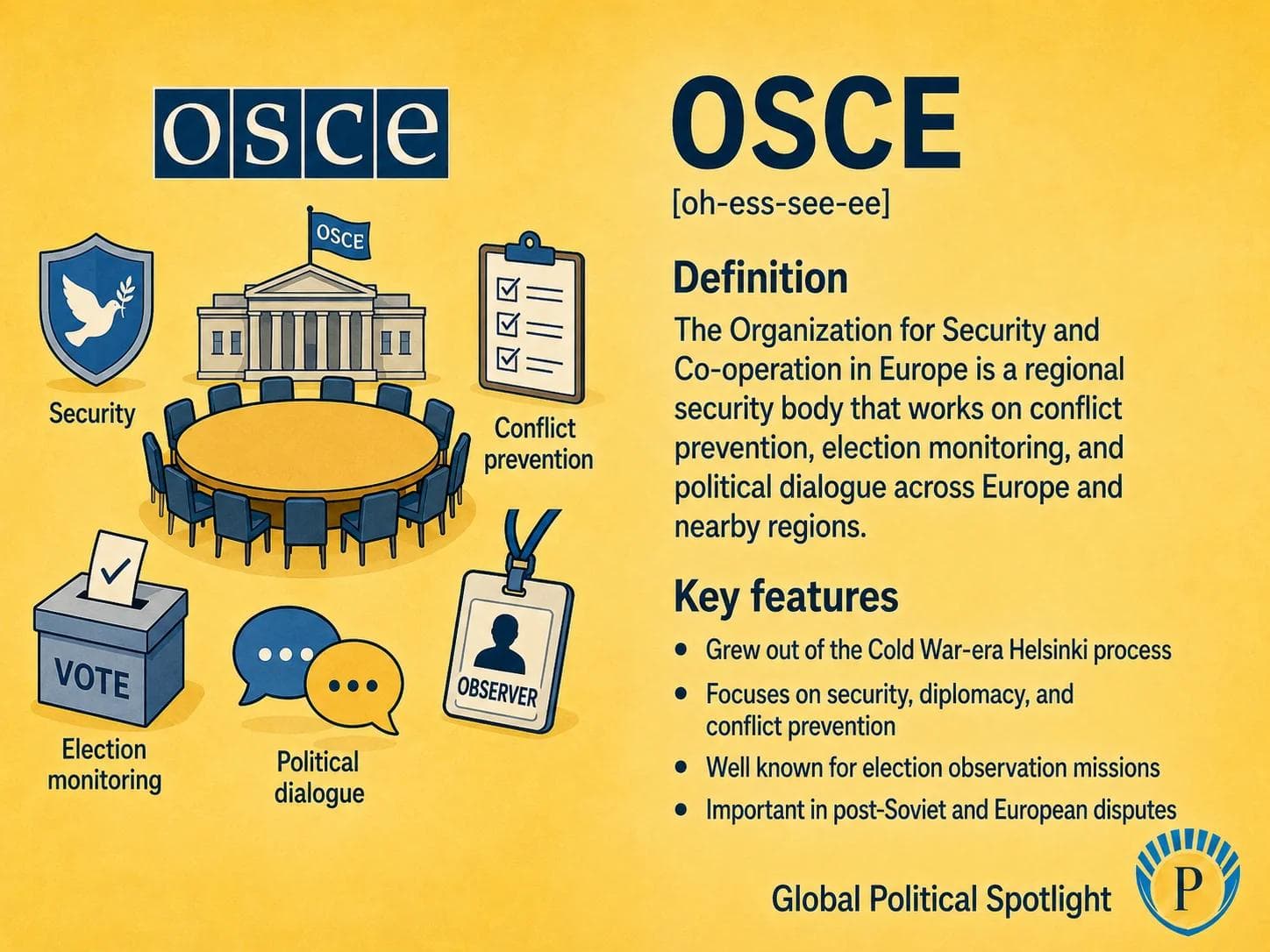
The Organization for Security and Co-operation in Europe, or OSCE, is a regional security organization with participating states across Europe, North America, the South Caucasus, Central Asia, and Russia. It grew out of the Cold War-era Conference on Security and Co-operation in Europe and became the OSCE in 1995.
The OSCE uses a broad concept of security that links military stability, political dialogue, human rights, democratic governance, election observation, media freedom, policing, border management, and conflict prevention. Its institutions include the Permanent Council, the Office for Democratic Institutions and Human Rights, the High Commissioner on National Minorities, and the Representative on Freedom of the Media.
Unlike a military alliance, the OSCE does not provide collective defense guarantees. Its authority depends largely on political commitments, field activity, monitoring, reporting, and consensus among participating states, which makes it useful for dialogue but vulnerable to great-power disagreement.
Why It Matters
The OSCE matters because it is one of the few security forums that includes the United States, Canada, European states, Russia, Central Asian states, and other Eurasian actors in the same institutional framework. This gives it diplomatic relevance even when relations between major powers are strained.
Its election observation missions, field missions, and human rights institutions help assess political conditions inside states, while its arms-control and confidence-building measures aim to reduce the risk of military miscalculation. These functions are especially important in regions affected by frozen conflicts, democratic backsliding, or military escalation.
The OSCE also illustrates the limits of consensus-based security organizations. Because major decisions normally require agreement among participating states, geopolitical confrontation can block budgets, mandates, appointments, and missions, reducing the organization's ability to respond to crises.
GPS should track the OSCE as a persistent indicator of European and Eurasian security dialogue, election integrity monitoring, arms-control confidence measures, human rights disputes, and conflict-management capacity. The most important watchpoints are whether consensus rules block core functions, how field missions operate in contested regions, how the OSCE remains relevant to Ukraine and other conflicts, and whether participating states preserve space for dialogue despite wider great-power confrontation.
Key Facts
- Type
- Regional security organization and political dialogue forum
- Full name
- Organization for Security and Co-operation in Europe
- Participating states
- 57 participating states across Europe, North America, and Eurasia
- Origins
- Developed from the Conference on Security and Co-operation in Europe and the 1975 Helsinki Final Act
- Headquarters
- Vienna, Austria
- Decision rule
- Major decisions are generally made by consensus, giving participating states significant blocking power
- Main tools
- Election observation, field missions, conflict prevention, arms-control confidence measures, human rights work, and diplomatic dialogue
- Strategic limit
- The OSCE is not a military alliance and has no collective defense guarantee or independent enforcement power
FAQ
What is the OSCE?
The OSCE is the Organization for Security and Co-operation in Europe. It is a 57-state regional security organization that works on conflict prevention, political dialogue, election observation, human rights, arms-control confidence measures, and field missions.
Is the OSCE a military alliance?
No. The OSCE is not a military alliance and does not provide collective defense guarantees like NATO. It is a political and diplomatic security organization that relies on commitments, monitoring, reporting, field activity, and consensus among participating states.
Why does the OSCE matter for Ukraine?
Ukraine has been central to OSCE relevance because the organization has been involved in monitoring, dialogue, and conflict-related diplomacy connected to the war and earlier conflict in eastern Ukraine. The closure of the Special Monitoring Mission in 2022 also highlighted the limits of OSCE consensus rules during major geopolitical confrontation.
What does the OSCE do in elections?
The OSCE, especially through its Office for Democratic Institutions and Human Rights, observes elections and assesses them against democratic commitments. Its reports can influence international perceptions of electoral integrity, even though the OSCE does not run elections or impose legal outcomes.
Why is consensus important in the OSCE?
Consensus gives the OSCE broad political legitimacy because participating states must agree on major decisions. It also creates a major limitation: one or more states can block budgets, mandates, appointments, or field missions, especially during periods of great-power disagreement.
How is the OSCE different from the EU or NATO?
The OSCE is broader than the EU or NATO and includes states that are outside both institutions, including Russia, the United States, Canada, and Central Asian states. It does not make EU law, manage economic integration, or provide NATO-style collective defense.
Recent Developments
The OSCE Special Monitoring Mission to Ukraine closed after consensus was not renewed
The OSCE announced the closure of its Special Monitoring Mission to Ukraine after consensus on extending the mandate was not reached. The episode showed how the organization's consensus rule can limit field operations during major conflict.
OSCEOSCE participating states agreed on Malta as the 2024 Chair-in-Office
At the OSCE Ministerial Council in Skopje, participating states agreed that Malta would hold the 2024 Chairpersonship. The decision demonstrated both the difficulty and continued importance of consensus-based institutional management during a period of deep geopolitical division.
OSCESources6 references
- OSCE
Official OSCE overview of the organization's role, participating states, and security concept.
- OSCE
Official list and overview of OSCE participating states.
- OSCE
Official background on the Helsinki Final Act, the foundational document behind the OSCE process.
- OSCE Office for Democratic Institutions and Human Rights
Official page for the OSCE institution responsible for elections, human rights, democracy, tolerance, and rule-of-law work.
- OSCE
Official overview of OSCE field operations and conflict-prevention activities.
- OSCE
Official page for the Forum for Security Co-operation, which addresses politico-military security and confidence-building measures.

GPSNews App
Read GPSNews on iPhone
Daily geopolitical briefings, government updates, and prediction signals in one focused app.
Newsletter
Stay Ahead Of The Next Signal
Get briefings in your inbox when new analysis and reports are published.