
OECD
A policy forum for economic analysis, standards, peer review, and global governance benchmarks
The OECD is a policy forum of mostly advanced economies that produces economic analysis, standards, data, tax rules, and peer reviews that shape governance beyond formal enforcement.
Definition
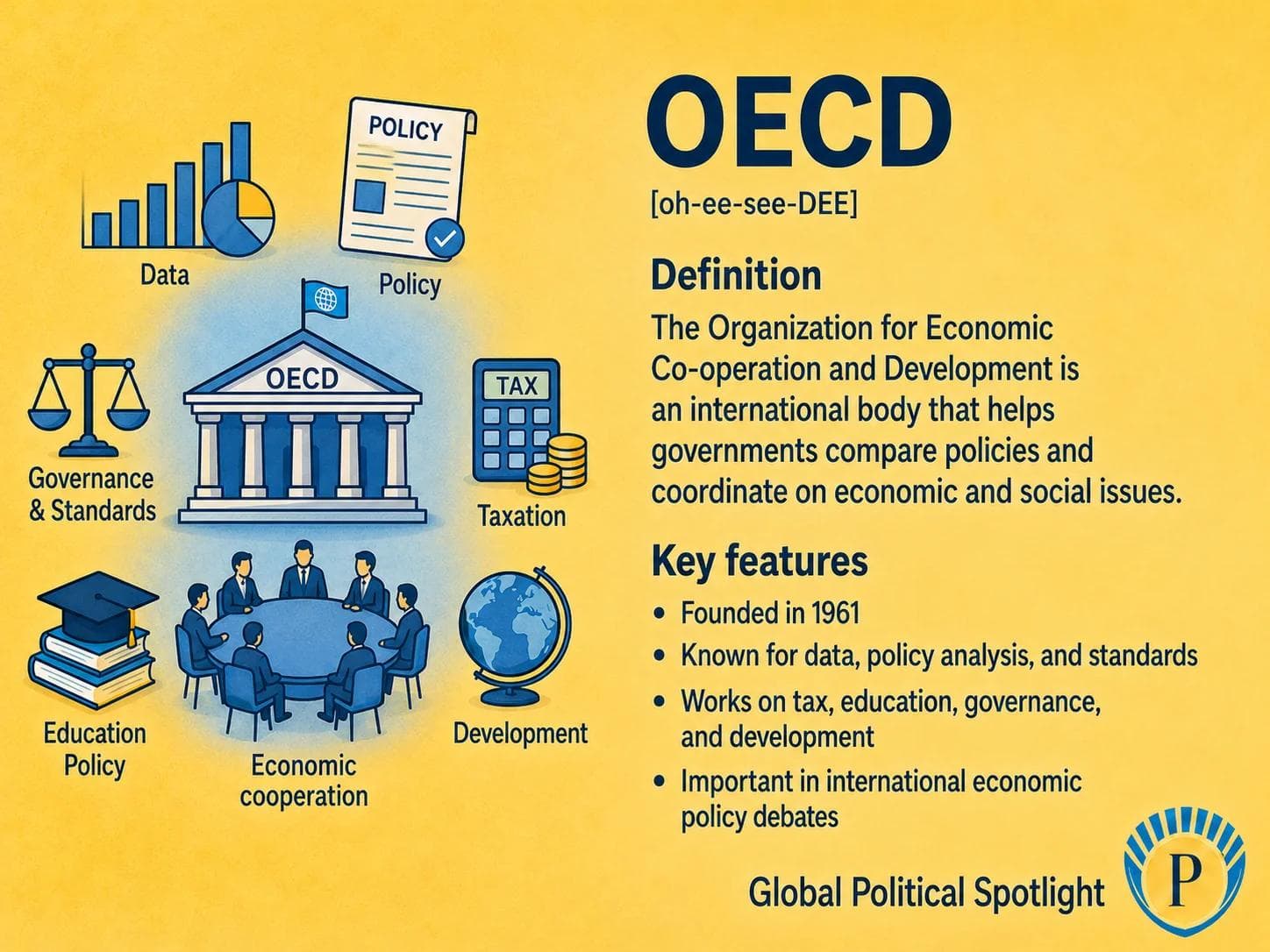
The OECD, or Organisation for Economic Co-operation and Development, is an intergovernmental policy forum founded in 1961 and headquartered in Paris. It brings together member countries to compare evidence, coordinate standards, publish economic analysis, and develop policy recommendations across taxation, trade, education, governance, environment, development, digital policy, and public finance.
The OECD is not a world government and does not normally enforce rules through sanctions. Its influence comes from peer review, technical expertise, comparative data, policy benchmarking, model rules, soft-law standards, and the reputational value of being assessed against advanced-economy norms.
Although often associated with high-income democracies, the OECD works with many non-member economies and has become influential beyond its formal membership. Its tax work, anti-bribery standards, corporate governance principles, education assessments, and economic forecasts shape national policy debates and global regulatory coordination.
Why It Matters
The OECD matters because it turns policy comparison into geopolitical influence. Countries use OECD data, peer reviews, and standards to evaluate reforms, signal credibility to investors, and align with governance expectations in taxation, competition policy, public administration, education, and economic management.
Its global tax work is especially important. The OECD/G20 Inclusive Framework on BEPS has shaped international rules on profit shifting, digitalization, tax transparency, and the global minimum tax, affecting multinational companies, national tax bases, investment incentives, and fiscal sovereignty.
Geopolitically, OECD enlargement and partnerships are signals of institutional alignment. Accession candidates often adapt laws and institutions to meet OECD standards, while existing members use the organization to coordinate policy positions in a changing global economy.
GPS should track the OECD as a standard-setting and policy-benchmarking institution whose influence extends beyond formal enforcement. Key watchpoints include global tax negotiations, implementation of the 15% global minimum tax, enlargement talks with candidate countries, anti-bribery and corporate governance standards, economic forecasts, peer reviews, and how OECD norms interact with G20, EU, UN, and emerging-economy policy agendas.
Key Facts
- Type
- Intergovernmental economic policy forum and standard-setting organization
- Full name
- Organisation for Economic Co-operation and Development
- Founded
- 1961, succeeding the Organisation for European Economic Co-operation
- Headquarters
- Paris, France
- Membership
- 38 member countries as of the OECD's current accession overview
- Main tools
- Peer review, economic data, policy recommendations, model rules, standards, country surveys, and comparative benchmarking
- Tax role
- Hosts the OECD/G20 Inclusive Framework on BEPS and develops global tax standards including the Pillar Two global minimum tax rules
- Strategic limit
- The OECD generally relies on soft-law influence, reputation, peer pressure, and national implementation rather than direct enforcement power
FAQ
What is the OECD?
The OECD is the Organisation for Economic Co-operation and Development, an intergovernmental policy forum that produces economic analysis, standards, policy recommendations, data, and peer reviews for member countries and many partner economies.
What does the OECD do?
The OECD compares policies across countries, publishes economic forecasts and country surveys, develops standards and model rules, supports tax cooperation, conducts peer reviews, and provides policy advice on areas such as education, governance, trade, digital policy, development, environment, and public finance.
Does the OECD enforce laws?
The OECD usually does not enforce laws directly. Its influence comes from soft-law standards, peer pressure, reputation, data, expert analysis, and the fact that member states and partners often implement OECD recommendations through national law or international agreements.
Why does the OECD matter for global tax rules?
The OECD has been central to international tax coordination through the OECD/G20 Inclusive Framework on BEPS. Its work on profit shifting, tax transparency, digital taxation, and the Pillar Two global minimum tax influences how countries tax multinational companies.
Why do countries want to join the OECD?
OECD accession can signal policy credibility, institutional reform, and closer alignment with advanced-economy standards. Candidate countries are reviewed across many policy areas and may adapt laws, regulations, and governance practices during the accession process.
What are the limits of the OECD?
The OECD's limits come from its reliance on voluntary implementation, soft-law influence, member consensus, and national political choices. Its standards can be powerful, but countries decide how far and how quickly to implement them.
Recent Developments
The OECD opened accession discussions with Indonesia
The OECD opened accession discussions with Indonesia, making it the first Southeast Asian country to begin an OECD accession process. The step illustrates how OECD enlargement is increasingly linked to emerging-economy reform agendas and wider Indo-Pacific economic governance.
OECDThe OECD opened accession discussions with Thailand
The OECD opened accession discussions with Thailand, adding another major Southeast Asian economy to the accession track. The decision reinforced the organization's enlargement beyond its traditional advanced-economy core and its role as a benchmark for policy reform.
OECDSources6 references
- OECD
Official OECD overview of the organization's purpose, work, and institutional role.
- OECD
Official OECD information on member countries and partner engagement.
- OECD
Official description of the OECD accession process and current accession discussions.
- OECD
Official OECD data portal for economic, social, environmental, and governance indicators.
- OECD
Official OECD overview of the global minimum tax and Pillar Two framework.
- OECD
Official OECD corporate governance topic page, reflecting the organization's standard-setting role.

GPSNews App
Read GPSNews on iPhone
Daily geopolitical briefings, government updates, and prediction signals in one focused app.
Newsletter
Stay Ahead Of The Next Signal
Get briefings in your inbox when new analysis and reports are published.