
Shanghai Cooperation Organisation
A Eurasian regional organization shaped by China-Russia influence, security cooperation, counterterrorism, and Central Asian diplomacy
The Shanghai Cooperation Organisation is a Eurasian regional organization led by China and Russia that focuses on security cooperation, counterterrorism, regional diplomacy, economic coordination, and political dialogue across Central and South Asia.
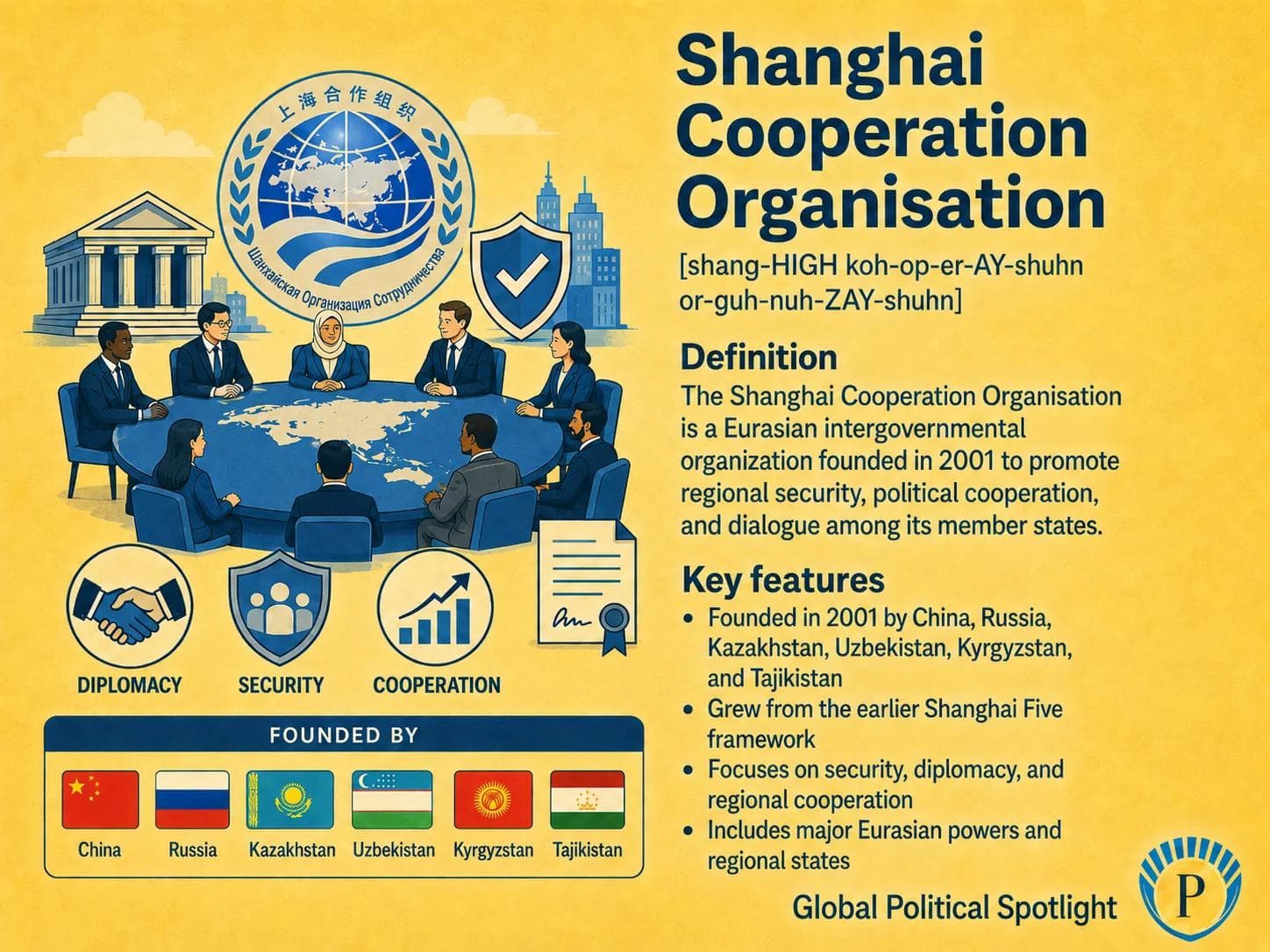
Definition
The Shanghai Cooperation Organisation, or SCO, is a Eurasian regional organization founded in 2001 by China, Russia, Kazakhstan, Kyrgyzstan, Tajikistan, and Uzbekistan. It grew out of earlier border-security cooperation known as the Shanghai Five and has expanded into a broader forum for security, diplomacy, economic coordination, and regional connectivity.
The SCO is often associated with counterterrorism and internal security cooperation. Its Regional Anti-Terrorist Structure, based in Tashkent, supports coordination among member states against terrorism, separatism, and extremism, often described in SCO language as the 'three evils'.
Although China and Russia are the most influential powers in the organization, the SCO also includes Central Asian states, India, Pakistan, Iran, and Belarus. This gives it broad Eurasian reach but also creates limits because members have competing interests, border disputes, different alignments, and divergent views of regional order.
Why It Matters
The SCO matters because it provides a major Eurasian forum outside Western-led institutions. It allows China, Russia, Central Asian states, and other members to coordinate on security language, regional diplomacy, counterterrorism, economic initiatives, infrastructure, energy, and opposition to perceived external interference.
Central Asia is especially important to the SCO because the organization began around border stability and security cooperation in the region. For Central Asian governments, the SCO offers a way to engage both China and Russia while also managing security risks, connectivity projects, migration, water, energy, and sovereignty concerns.
The SCO also illustrates the limits of broad anti-Western or multipolar platforms. India and Pakistan are rivals, India and China have border tensions, Iran faces sanctions pressure, and Central Asian states avoid overdependence on any one power. These internal differences constrain the SCO's ability to act as a unified bloc.
GPS should track the Shanghai Cooperation Organisation as a key Eurasian forum for China-Russia influence, Central Asian diplomacy, counterterrorism cooperation, and alternative global-governance messaging. Key watchpoints include expansion, India-China and India-Pakistan tensions inside the forum, Iran and Belarus participation, Central Asian balancing between China and Russia, SCO economic and payment-system proposals, Regional Anti-Terrorist Structure activity, and whether the organization becomes more operational or remains primarily a diplomatic platform.
Key Facts
- Type
- Eurasian regional security and diplomatic organization
- Founded
- 2001, in Shanghai
- Origins
- Developed from the Shanghai Five border-security process among China, Russia, Kazakhstan, Kyrgyzstan, and Tajikistan
- Headquarters
- SCO Secretariat in Beijing, China
- Security body
- Regional Anti-Terrorist Structure based in Tashkent, Uzbekistan
- Members
- China, Russia, Kazakhstan, Kyrgyzstan, Tajikistan, Uzbekistan, India, Pakistan, Iran, and Belarus
- Core agenda
- Counterterrorism, separatism, extremism, regional security, diplomacy, economic cooperation, connectivity, and cultural exchange
- Strategic limit
- The SCO includes rival members and has no NATO-style collective defense commitment or unified military command
FAQ
What is the Shanghai Cooperation Organisation?
The Shanghai Cooperation Organisation is a Eurasian regional organization founded in 2001. It brings together China, Russia, Central Asian states, India, Pakistan, Iran, and Belarus for cooperation on security, counterterrorism, diplomacy, economic coordination, and regional issues.
Who are the members of the SCO?
The SCO's full members are China, Russia, Kazakhstan, Kyrgyzstan, Tajikistan, Uzbekistan, India, Pakistan, Iran, and Belarus. The organization also engages observers and dialogue partners, giving it a wider diplomatic network across Eurasia and beyond.
Is the SCO a military alliance?
No. The SCO is not a NATO-style military alliance and does not provide a collective defense guarantee. It conducts security cooperation and exercises, especially around counterterrorism, but it does not operate as a unified military command.
Why does the SCO matter for China and Russia?
The SCO gives China and Russia a major Eurasian platform for regional diplomacy, security coordination, and messaging about multipolarity and opposition to external interference. It also helps both powers engage Central Asian states in an institutional setting.
Why is Central Asia important to the SCO?
Central Asia is central to the SCO's origins and purpose. The organization began with border-security and confidence-building among China, Russia, and Central Asian states, and it continues to address regional security, counterterrorism, connectivity, energy, and diplomatic balancing.
What are the limits of the Shanghai Cooperation Organisation?
The SCO's limits come from divergent member interests. India and Pakistan are rivals, India and China have border tensions, China and Russia have overlapping but not identical regional goals, and Central Asian states seek autonomy. These divisions limit unified action.
Recent Developments
Belarus became the SCO's tenth full member
At the Astana summit, Belarus was admitted as a full member of the Shanghai Cooperation Organisation, expanding the SCO's membership and reinforcing its identity as a broader Eurasian forum beyond its original Central Asian core.
Shanghai Cooperation OrganisationThe Astana Declaration emphasized regional security and Eurasian cooperation
SCO leaders adopted the Astana Declaration, presenting the organization as a contributor to regional security, political dialogue, economic cooperation, and a more multipolar international order. The document reflected the SCO's mix of security priorities and broader geopolitical messaging.
Shanghai Cooperation OrganisationSources6 references
- Shanghai Cooperation Organisation
Official English-language website of the Shanghai Cooperation Organisation.
- Shanghai Cooperation Organisation
Official Astana Declaration adopted by SCO heads of state in 2024.
- SCO Regional Anti-Terrorist Structure
Official site of the SCO Regional Anti-Terrorist Structure, focused on cooperation against terrorism, separatism, and extremism.
- SCO Regional Anti-Terrorist Structure
Official RATS page listing SCO member states.
- Ministry of External Affairs, Government of India
Official Indian publication of the Astana Declaration, useful for cross-checking summit language.
- Shanghai Cooperation Organisation
Official SCO description of the Regional Anti-Terrorist Structure and its legal and practical cooperation role.

GPSNews App
Read GPSNews on iPhone
Daily geopolitical briefings, government updates, and prediction signals in one focused app.
Newsletter
Stay Ahead Of The Next Signal
Get briefings in your inbox when new analysis and reports are published.