
Council of Europe
Europe's human rights, democracy, and rule-of-law organization
The Council of Europe is a Strasbourg-based international organization that promotes human rights, democracy, and the rule of law across Europe through treaties, monitoring bodies, and the European Court of Human Rights.
Definition
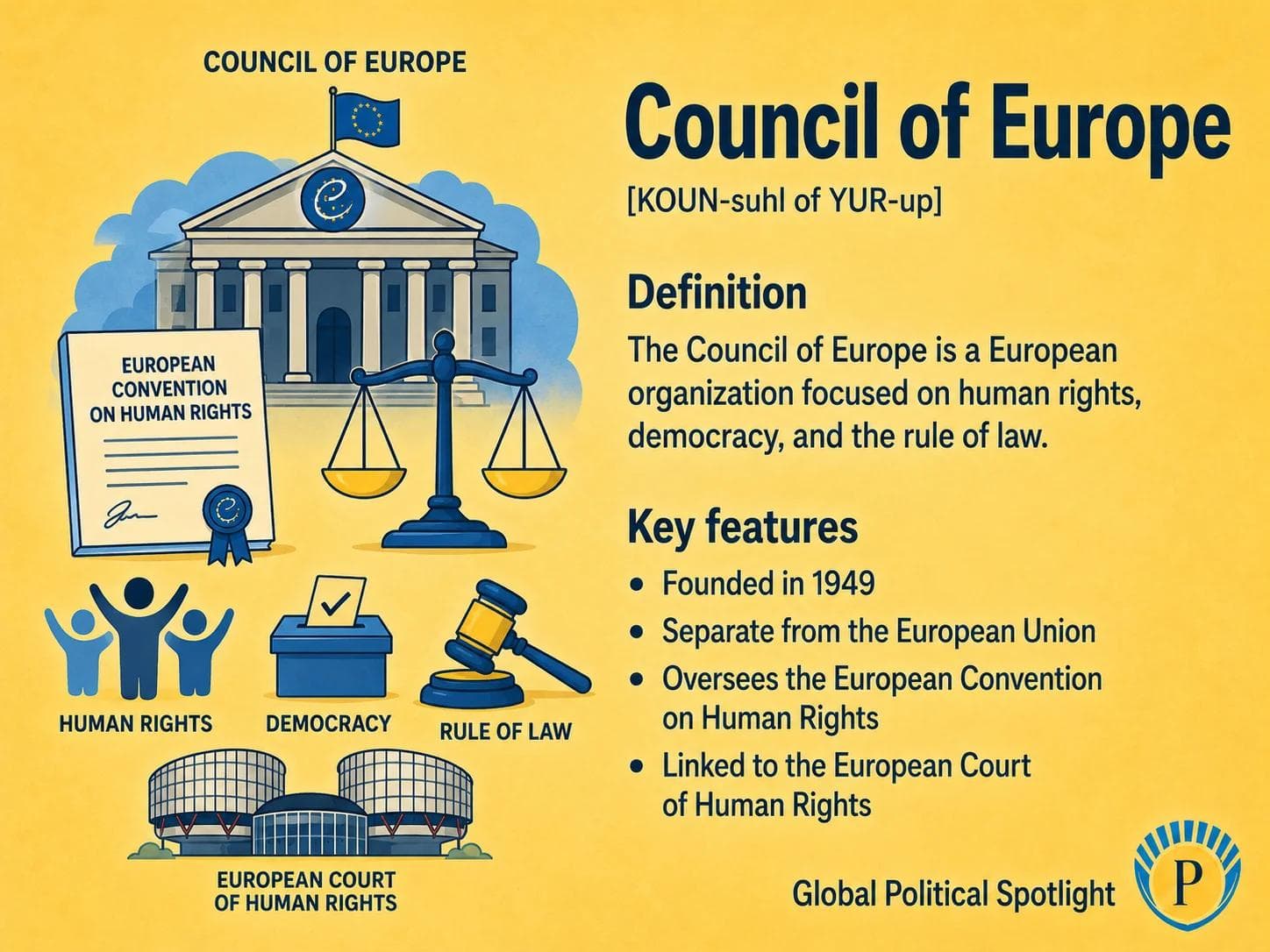
The Council of Europe is an international organization founded after the Second World War to promote human rights, democracy, and the rule of law in Europe. It is headquartered in Strasbourg, France, and is institutionally separate from the European Union.
Its best-known legal framework is the European Convention on Human Rights, a treaty that protects civil and political rights. The European Court of Human Rights, also based in Strasbourg, hears cases alleging violations of the Convention by member states.
The organization also works through parliamentary, ministerial, monitoring, and advisory bodies that assess democratic standards, judicial independence, anti-corruption rules, minority rights, media freedom, and other rule-of-law issues.
Why It Matters
The Council of Europe matters because it provides a regional legal and political framework for holding European states to common human rights and democratic standards. Its court judgments can require governments to change laws, compensate applicants, or address systemic legal problems.
Geopolitically, the organization is a benchmark for European political legitimacy. Membership signals acceptance of the European Convention on Human Rights system, while suspension or exclusion can mark a major rupture between a state and Europe's rule-of-law order.
It is often confused with the European Union, but it has a wider membership and a different mandate. The Council of Europe does not make EU law, run the euro, or set EU trade policy; its core role is human rights, democracy, and rule-of-law oversight.
GPS should track the Council of Europe as a durable institutional indicator of European human rights politics, democratic backsliding, judicial independence, migration-law disputes, wartime accountability, and state compliance with regional rule-of-law standards. The key long-term questions are how member states implement European Court of Human Rights judgments, how political pressure affects the Convention system, and how the organization distinguishes itself from but interacts with EU institutions.
Key Facts
- Type
- International human rights, democracy, and rule-of-law organization
- Founded
- 1949, under the Statute of the Council of Europe
- Headquarters
- Strasbourg, France
- Core treaty
- European Convention on Human Rights
- Court
- European Court of Human Rights, which hears individual and inter-state applications under the Convention
- Membership
- 46 member states after Russia ceased to be a member in March 2022
- Not the EU
- Separate from the European Union and not responsible for EU legislation, the euro, or EU institutions
- Strategic role
- Sets and monitors regional standards on human rights, democracy, judicial independence, and the rule of law
FAQ
What is the Council of Europe?
The Council of Europe is an international organization that promotes human rights, democracy, and the rule of law in Europe. It is based in Strasbourg and operates through treaties, monitoring bodies, a parliamentary assembly, a committee of ministers, and the European Court of Human Rights.
Is the Council of Europe part of the European Union?
No. The Council of Europe is separate from the European Union. It has a different membership, mandate, and institutional structure. It does not make EU law, manage the EU budget, run the euro, or act as an EU institution.
What is the European Convention on Human Rights?
The European Convention on Human Rights is a treaty that protects civil and political rights, including rights related to life, liberty, fair trial, expression, privacy, and freedom from torture. Council of Europe member states are expected to be parties to the Convention system.
What does the European Court of Human Rights do?
The European Court of Human Rights hears applications alleging that a state has violated rights protected by the European Convention on Human Rights. Individuals, groups, and states can bring cases under the rules of the Convention system.
Why does the Council of Europe matter geopolitically?
It matters because it defines and monitors European democratic and human rights standards. Its judgments, reports, and membership decisions can influence constitutional law, migration policy, judicial reform, minority rights, wartime accountability, and a state's standing within Europe's institutional order.
What are the limits of the Council of Europe?
The Council of Europe depends heavily on treaty commitments, court compliance, political pressure, and peer monitoring. It does not have the same economic or regulatory powers as the European Union, and implementation of judgments ultimately depends on member-state action and supervision by the Committee of Ministers.
Recent Developments
Russia ceased to be a member of the Council of Europe
The Council of Europe's Committee of Ministers decided that the Russian Federation ceased to be a member after 26 years, following the procedure under Article 8 of the organization's statute. The decision became a major example of how membership can be affected by serious breaches of the organization's core principles.
Council of EuropeRussia ceased to be a party to the European Convention on Human Rights
Following its exclusion from the Council of Europe, Russia ceased to be a High Contracting Party to the European Convention on Human Rights. The change affected the scope of the Convention system while preserving the Court's handling of certain applications connected to earlier events.
Council of EuropeSources6 references
- Council of Europe
Official institutional website for the Council of Europe.
- Council of Europe Treaty Office
Official treaty information for the Statute of the Council of Europe.
- Council of Europe
Official overview of the European Convention on Human Rights.
- European Court of Human Rights
Official website of the European Court of Human Rights.
- European Court of Human Rights
Official text of the European Convention on Human Rights.
- Council of Europe
Official announcement on Russia ceasing to be a member of the Council of Europe in 2022.

GPSNews App
Read GPSNews on iPhone
Daily geopolitical briefings, government updates, and prediction signals in one focused app.
Newsletter
Stay Ahead Of The Next Signal
Get briefings in your inbox when new analysis and reports are published.