
Organization of American States
The main inter-American organization for democracy, human rights, security, and regional diplomacy
The Organization of American States is a regional organization of states in the Americas focused on democracy, human rights, multidimensional security, development, election observation, and inter-American diplomacy.
Definition
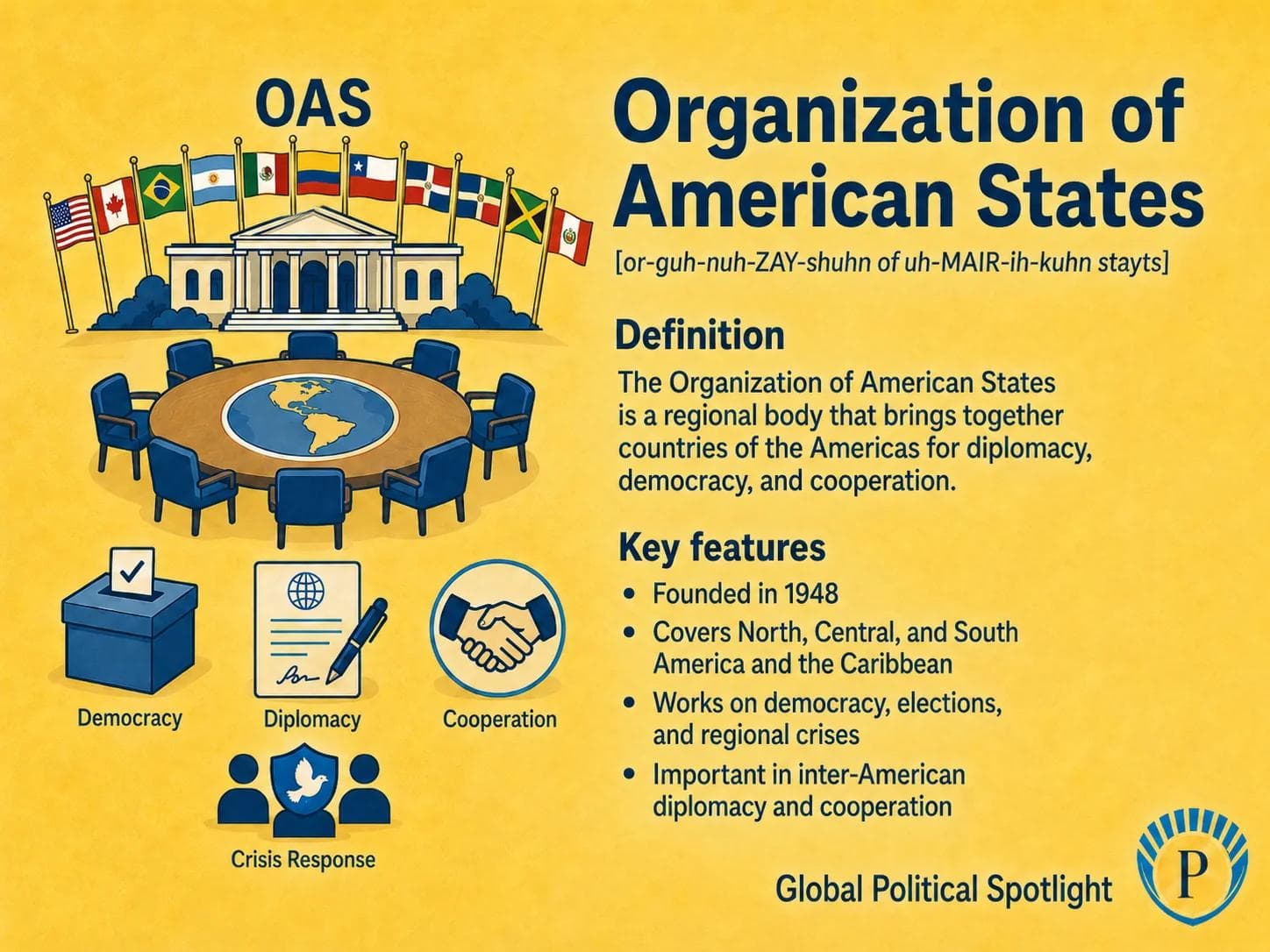
The Organization of American States, or OAS, is a regional intergovernmental organization that brings together states of the Americas for diplomacy, democracy promotion, human rights protection, security cooperation, and development. Its modern charter was signed in Bogotá in 1948, and its headquarters are in Washington, D.C.
The OAS operates through political bodies such as the General Assembly and Permanent Council, as well as specialized institutions including the Inter-American Commission on Human Rights, the Inter-American Court of Human Rights system, and election observation missions. Its work is shaped by inter-American treaties, political commitments, and regional diplomacy.
The organization is especially associated with the Inter-American Democratic Charter, adopted in 2001, which states that the peoples of the Americas have a right to democracy and that governments have an obligation to promote and defend it. The Charter provides a framework for collective responses to democratic breakdowns, though its use remains politically contested.
Why It Matters
The OAS matters because it is the main regional institution where governments in North America, Latin America, and the Caribbean debate democracy, human rights, election integrity, security threats, migration, corruption, and constitutional crises. Its resolutions, observation reports, and diplomatic actions can shape regional legitimacy.
Its election observation missions and human rights bodies provide external scrutiny of political processes and state conduct. These mechanisms can support democratic accountability, but they also generate controversy when governments accuse the organization of bias, politicization, or excessive U.S. influence.
Geopolitically, the OAS reflects the tension between inter-American cooperation and hemispheric power asymmetry. The United States is a major actor in the organization, while many Latin American and Caribbean states use the OAS both as a diplomatic platform and as a venue to contest external pressure.
GPS should track the Organization of American States as a durable arena for inter-American diplomacy, democratic legitimacy disputes, election observation, human rights accountability, and U.S.-Latin America relations. Key watchpoints include how the OAS applies the Inter-American Democratic Charter, how governments respond to election observation reports, how the human rights system handles state abuses, and whether institutional controversy weakens or reinforces regional cooperation.
Key Facts
- Type
- Regional intergovernmental organization
- Full name
- Organization of American States
- Founded
- Charter signed in Bogotá in 1948; entered into force in 1951
- Headquarters
- Washington, D.C., United States
- Membership
- Includes the independent states of the Americas, with participation and representation affected in some cases by political disputes and institutional decisions
- Core democracy framework
- Inter-American Democratic Charter, adopted in 2001
- Human rights system
- Includes the Inter-American Commission on Human Rights and the Inter-American Court of Human Rights system
- Strategic limit
- The OAS has diplomatic and monitoring tools but limited enforcement power, and its legitimacy is often contested in politically polarized crises
FAQ
What is the Organization of American States?
The Organization of American States is a regional organization of states in the Americas. It works on democracy, human rights, election observation, regional security, legal cooperation, development, and inter-American diplomacy.
What does the OAS do?
The OAS hosts diplomatic negotiations, adopts regional resolutions, sends election observation missions, supports anti-corruption and security cooperation, and works through the Inter-American human rights system to monitor and address human rights issues.
What is the Inter-American Democratic Charter?
The Inter-American Democratic Charter is a 2001 OAS document stating that the peoples of the Americas have a right to democracy and that governments have an obligation to promote and defend it. It provides a framework for collective responses when democratic order is seriously threatened or interrupted.
How does the OAS observe elections?
The OAS sends election observation missions at the invitation of member states. These missions assess electoral conditions, observe voting and counting processes, and issue reports with findings and recommendations. They do not run elections or replace national electoral authorities.
Why is the OAS controversial?
The OAS is controversial because its democracy and human rights work often intersects with domestic political crises and U.S.-Latin America tensions. Some governments view it as a useful regional accountability forum, while others accuse it of politicization, selective enforcement, or excessive U.S. influence.
What are the limits of the OAS?
The OAS relies mainly on diplomacy, monitoring, reporting, political pressure, and member-state cooperation. It does not have strong independent enforcement power, and its effectiveness depends on political consensus, funding, government cooperation, and the perceived legitimacy of its actions.
Recent Developments
The Inter-American Democratic Charter was adopted
OAS member states adopted the Inter-American Democratic Charter in Lima, establishing a regional political framework that links representative democracy to membership legitimacy, collective diplomacy, and responses to interruptions of democratic order.
Organization of American StatesThe OAS continued election observation work across the Americas
The OAS has continued to deploy electoral observation missions across member states, reinforcing its long-standing role in assessing electoral processes, issuing recommendations, and shaping regional debate over democratic standards.
Organization of American StatesSources6 references
- Organization of American States
Official OAS overview of the organization's identity, purposes, and institutional role.
- Organization of American States
Official OAS treaty page for the Charter of the Organization of American States.
- Organization of American States
Official text of the Inter-American Democratic Charter.
- Organization of American States
Official OAS information on electoral observation missions.
- Inter-American Commission on Human Rights
Official website of the Inter-American Commission on Human Rights.
- Inter-American Court of Human Rights
Official website of the Inter-American Court of Human Rights.

GPSNews App
Read GPSNews on iPhone
Daily geopolitical briefings, government updates, and prediction signals in one focused app.
Newsletter
Stay Ahead Of The Next Signal
Get briefings in your inbox when new analysis and reports are published.