
Collective Security Treaty Organization
A Russia-led post-Soviet security alliance with contested collective-defense credibility
The Collective Security Treaty Organization is a Russia-led security alliance of several post-Soviet states that claims collective-defense functions but has faced credibility tests over crises and member tensions.
Definition
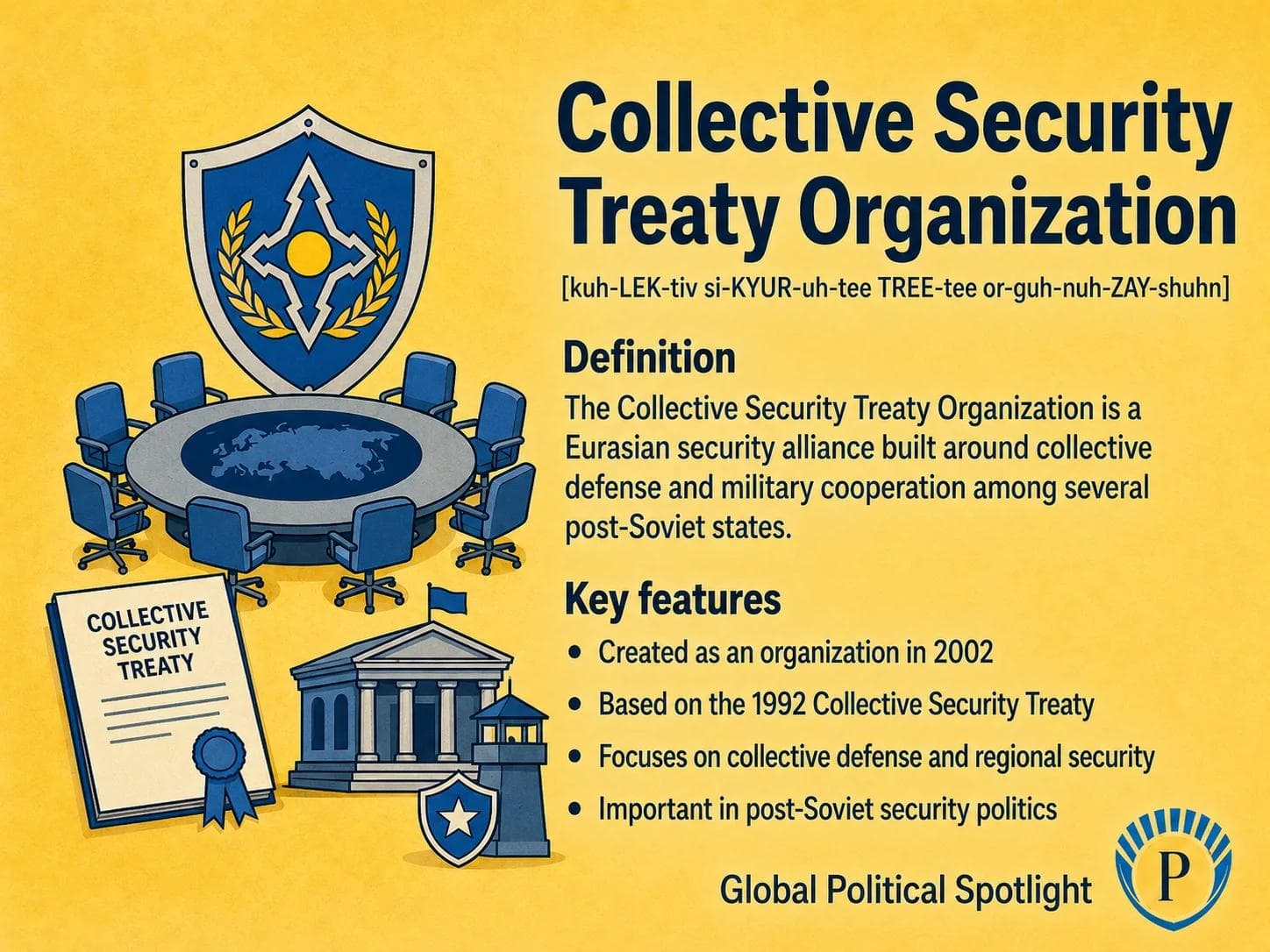
The Collective Security Treaty Organization, or CSTO, is a Russia-led security alliance made up of several post-Soviet states. It grew out of the 1992 Collective Security Treaty and became a formal organization in 2002, with a stated purpose of collective defense, military cooperation, counterterrorism coordination, and regional security management.
The CSTO is often compared to NATO because it includes a collective-defense clause, but its political structure, military integration, decision-making practice, and credibility are different. Russia is the dominant military and political actor, while other members balance alliance benefits against sovereignty concerns, regional threats, and relations with outside powers.
Why It Matters
The CSTO matters because it is one of Russia's main institutional tools for maintaining security influence across parts of the former Soviet space. Its exercises, bases, peacekeeping claims, and crisis-response mechanisms shape security politics in Central Asia, the South Caucasus, and Russia's broader regional strategy.
Its limits also matter. The alliance has faced questions over whether it can respond consistently to member-state crises, especially after tensions involving Armenia and Azerbaijan, unrest in Kazakhstan, and the pressures created by Russia's war in Ukraine. These cases affect perceptions of CSTO reliability and Russian security guarantees.
GPS should track the CSTO as a Russia-led security alliance where collective-defense claims, Russian influence, Central Asian regime security, Armenia's dissatisfaction, military exercises, crisis-response credibility, and post-Soviet alignment politics intersect. Key watchpoints include Armenian participation or non-participation, CSTO summit language, Russian force availability, Central Asian security cooperation, Kazakhstan and Kyrgyzstan positions, joint exercises, and how member states compare CSTO commitments with NATO, bilateral Russian guarantees, or alternative security partnerships.
Key Facts
- Type
- Regional security alliance and collective-defense organization
- Origins
- Based on the 1992 Collective Security Treaty and formalized as an organization in 2002
- Headquarters
- Moscow, Russia
- Dominant actor
- Russia is the alliance's central military and political power
- Core members
- Russia, Belarus, Kazakhstan, Kyrgyzstan, Tajikistan, and Armenia, though Armenia's participation has become politically strained
- Claimed role
- Collective defense, military cooperation, counterterrorism, peacekeeping, border security, and crisis response
- Credibility issue
- Member confidence depends on whether the alliance responds to crises in ways members view as timely, neutral, and reliable
- Strategic relevance
- Russian regional influence, Central Asian security, South Caucasus tensions, post-Soviet military integration, and alliance credibility
FAQ
What is the Collective Security Treaty Organization?
The Collective Security Treaty Organization, or CSTO, is a Russia-led security alliance of several post-Soviet states. It claims collective-defense, military cooperation, counterterrorism, peacekeeping, and regional security functions.
Which countries are in the CSTO?
The CSTO has included Russia, Belarus, Kazakhstan, Kyrgyzstan, Tajikistan, and Armenia. Armenia's relationship with the organization has become strained, with Armenian leaders criticizing its response to security threats.
Is the CSTO like NATO?
The CSTO is often compared with NATO because both have collective-defense language, but they differ in structure, political credibility, military integration, and decision-making. Russia dominates the CSTO more than any single state dominates NATO.
Why is Russia important in the CSTO?
Russia is the CSTO's dominant military power, host of the headquarters, and main security patron for the alliance. The organization's credibility and capacity are closely tied to Russian resources, political will, and regional influence.
Why has Armenia criticized the CSTO?
Armenia has criticized the CSTO for not providing the level of support it expected during security crises involving Azerbaijan. This has raised broader questions about whether CSTO guarantees are reliable when member interests conflict with Russian calculations.
Why does the CSTO matter for Central Asia?
The CSTO matters in Central Asia because several members are located there and the alliance addresses issues such as border security, extremism, military exercises, instability risks, and Russia's role as a regional security provider.
Recent Developments
The CSTO deployed forces to Kazakhstan during unrest
The CSTO sent a peacekeeping contingent to Kazakhstan after the Kazakh government requested assistance during domestic unrest. The deployment became the alliance's most visible crisis-response operation and a reference point for debates over regime security and collective action.
Collective Security Treaty OrganizationArmenia said it had frozen participation in the CSTO
Armenian leaders said Armenia had effectively frozen participation in the CSTO after criticizing the alliance's response to security threats involving Azerbaijan. The dispute highlighted the organization's credibility challenges and the limits of Russia-led security guarantees.
Government of ArmeniaSources6 references
- Collective Security Treaty Organization
Official CSTO website with institutional background, member information, statements, and documents.
- CSTO Charter
Official CSTO Charter text describing the organization's legal and institutional framework.
- CSTO Collective Security Treaty
Official text of the Collective Security Treaty, the treaty basis for the alliance.
- NATO
Official NATO explanation of collective defence under Article 5, useful for comparing alliance-commitment models.
- Government of Armenia
Official Armenian government source for statements relevant to Armenia's relations with the CSTO.
- Encyclopaedia Britannica
Reference overview of the CSTO's origins, membership, and security role.

GPSNews App
Read GPSNews on iPhone
Daily geopolitical briefings, government updates, and prediction signals in one focused app.
Newsletter
Stay Ahead Of The Next Signal
Get briefings in your inbox when new analysis and reports are published.