
G20
A forum of major advanced and emerging economies coordinating on global economic stability, finance, debt, climate, and trade
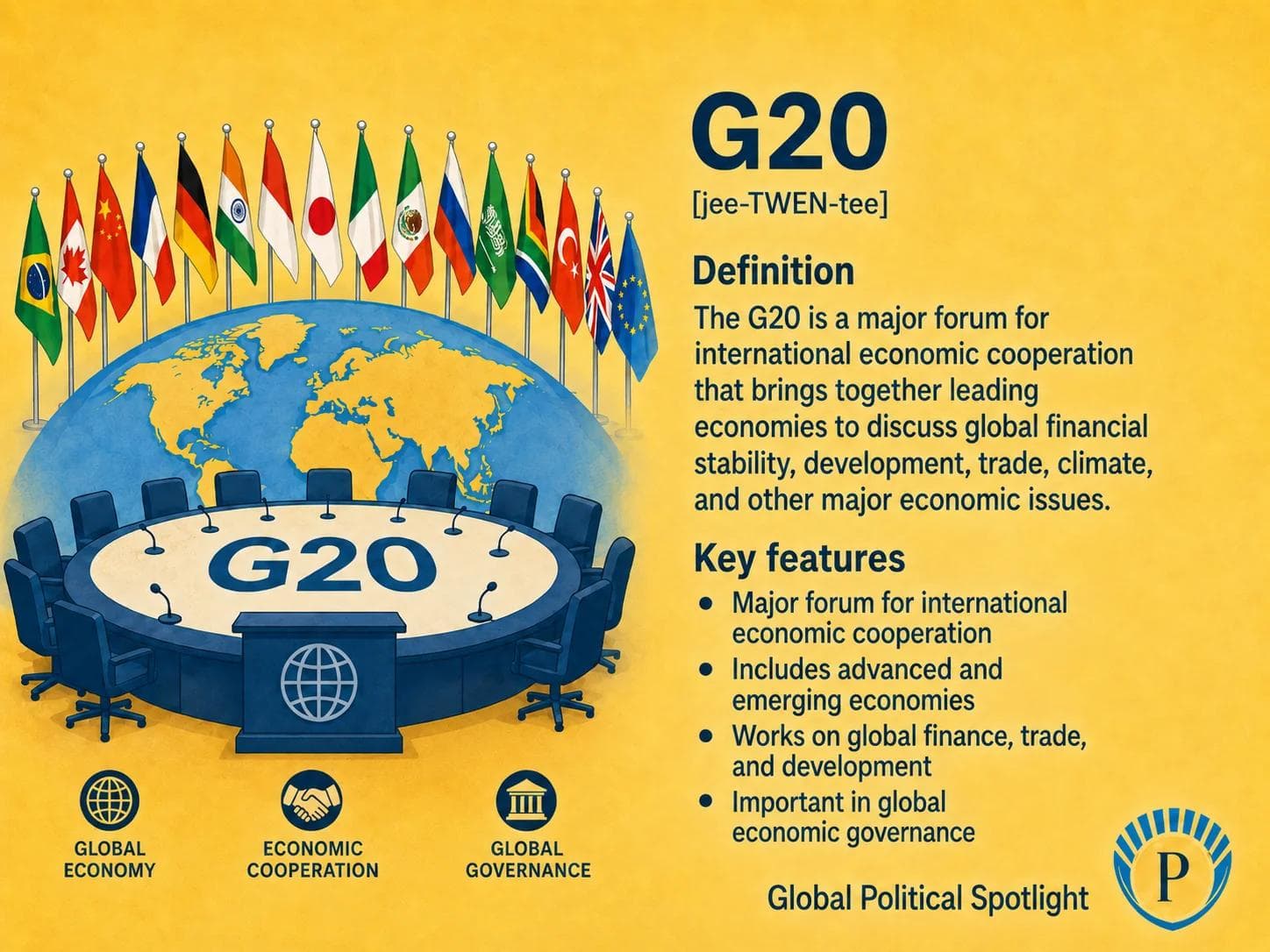
The G20 is a forum of major advanced and emerging economies that coordinates on global economic stability, finance, debt, climate, trade, development, and crisis response.
Definition
The G20, or Group of Twenty, is an informal forum that brings together major advanced and emerging economies to discuss global economic governance. Its members include large national economies, the European Union, and the African Union, giving it wider representation than the G7.
The forum began in 1999 at the level of finance ministers and central bank governors after financial crises in the 1990s. It was elevated to a leaders' summit during the 2008 global financial crisis, when major economies needed broader coordination on banking stability, stimulus, financial regulation, and recovery.
The G20 is not a treaty organization and does not directly enforce its decisions. Its influence comes from political coordination among systemically important economies, support from international institutions, and the ability of members to shape rules through national policy, central banks, finance ministries, and multilateral bodies.
Why It Matters
The G20 matters because its members represent a large share of global GDP, trade, investment, population, emissions, and financial activity. When G20 members coordinate, they can influence interest-rate spillovers, financial regulation, debt restructuring, climate finance, development lending, trade policy, and crisis response.
Its finance track is especially important. Finance ministers and central bank governors discuss macroeconomic risks, inflation, debt vulnerabilities, international tax, financial stability, development finance, and reforms to institutions such as the IMF and World Bank.
Geopolitically, the G20 exposes the tension between developed and emerging powers. It is more representative than the G7, but that wider membership also makes consensus harder on war, sanctions, debt relief, climate responsibility, trade rules, and reform of global financial institutions.
GPS should track the G20 as a central arena for global economic coordination between advanced and emerging powers. Key watchpoints include finance-minister and central-bank coordination, debt restructuring, IMF and World Bank reform, climate finance, trade fragmentation, food and energy shocks, digital economy rules, development finance, and how geopolitical disputes affect consensus among the United States, China, India, the EU, Russia, and major emerging economies.
Key Facts
- Type
- Informal forum of major advanced and emerging economies
- Full name
- Group of Twenty
- Founded
- 1999 as a finance ministers and central bank governors forum
- Leaders' summit
- Elevated to leaders' level in 2008 during the global financial crisis
- Members
- Includes 19 countries plus the European Union and the African Union
- Core tracks
- Finance Track for finance ministries and central banks; Sherpa Track for broader policy coordination
- Main agenda
- Global financial stability, macroeconomic policy, debt, development, climate, trade, health, digital economy, and institutional reform
- Institutional limit
- The G20 has no treaty-based enforcement power and depends on political consensus and national implementation
FAQ
What is the G20?
The G20 is an informal forum of major advanced and emerging economies that coordinates on global economic stability, finance, debt, trade, climate, development, health, and other cross-border policy issues.
Who is in the G20?
The G20 includes Argentina, Australia, Brazil, Canada, China, France, Germany, India, Indonesia, Italy, Japan, Mexico, Russia, Saudi Arabia, South Africa, South Korea, Türkiye, the United Kingdom, the United States, the European Union, and the African Union.
Why does the G20 matter for financial crises?
The G20 matters because its members include major central banks, finance ministries, reserve-currency issuers, large creditors, major borrowers, and systemically important economies. During crises, it can coordinate stimulus, financial regulation, debt discussions, and support through institutions such as the IMF and World Bank.
How is the G20 different from the G7?
The G7 is a smaller forum of advanced democracies, while the G20 includes both advanced and emerging powers, including China, India, Brazil, South Africa, Indonesia, Saudi Arabia, Russia, the European Union, and the African Union. The G20 is more representative but often harder to align.
What do G20 finance ministers and central banks do?
They form the G20 Finance Track, which discusses macroeconomic risks, inflation, financial stability, debt, international tax, sustainable finance, development finance, and reform of global financial institutions. Their work often shapes the technical agenda before leaders meet.
What are the limits of the G20?
The G20's limits come from its informal structure, lack of direct enforcement power, and major political differences among members. Consensus can be difficult when economic issues overlap with war, sanctions, climate responsibility, trade disputes, or U.S.-China competition.
Recent Developments
The African Union became a permanent member of the G20
G20 leaders admitted the African Union as a permanent member at the New Delhi Summit. The decision expanded the forum's representation and gave African states a stronger collective presence in discussions on debt, climate finance, development, trade, and global economic governance.
G20 IndiaG20 leaders reaffirmed the forum's crisis-management role after overlapping global shocks
At the Bali Summit, G20 leaders addressed food and energy insecurity, inflation, debt vulnerabilities, health recovery, and global financial stability. The summit reflected the forum's continuing role as a coordination venue during periods of economic stress and geopolitical division.
G20 IndonesiaSources6 references
- G20
Official overview of the G20, its membership, structure, and role.
- G20 India
Official New Delhi Leaders' Declaration, including the African Union's admission as a permanent G20 member.
- G20 Indonesia
Official Bali Leaders' Declaration addressing global economic shocks, food and energy security, debt, health, and financial stability.
- International Monetary Fund
IMF reference page explaining the G20's role in global economic coordination.
- OECD
OECD overview of analytical support and policy work connected to G20 processes.
- World Bank
World Bank background on the G20 Common Framework for debt treatments.

GPSNews App
Read GPSNews on iPhone
Daily geopolitical briefings, government updates, and prediction signals in one focused app.
Newsletter
Stay Ahead Of The Next Signal
Get briefings in your inbox when new analysis and reports are published.