
OPEC / OPEC+
An oil-producer coordination system shaping supply policy, prices, and energy geopolitics
OPEC / OPEC+ refers to OPEC member states and non-OPEC partners such as Russia that coordinate oil supply policy through production targets, voluntary cuts, and market-stability agreements.
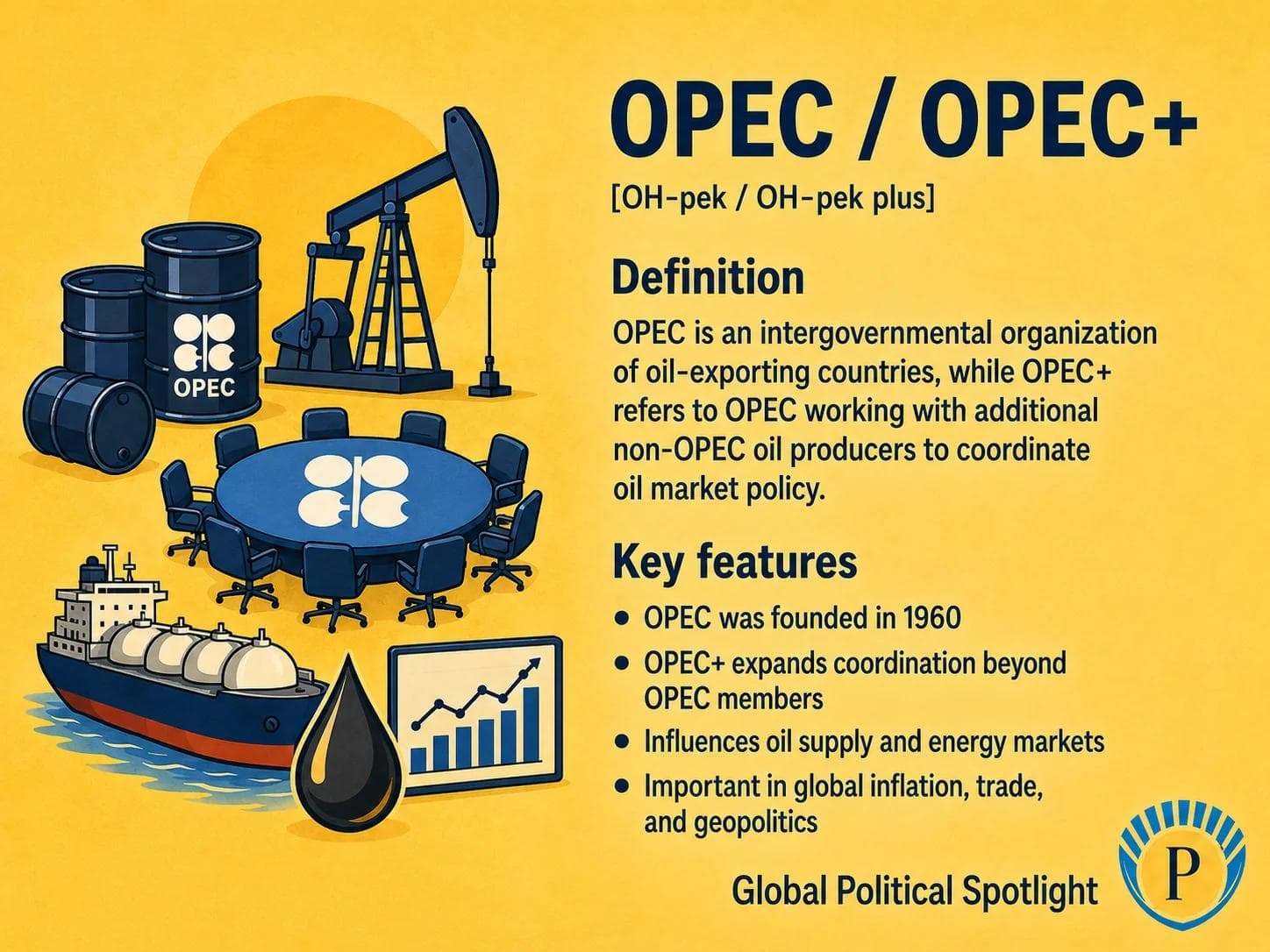
Definition
OPEC, the Organization of the Petroleum Exporting Countries, is an intergovernmental organization of oil-producing states that coordinates petroleum policy among its members. OPEC+ is the wider cooperation framework that includes OPEC members and non-OPEC oil producers, most prominently Russia, under the Declaration of Cooperation.
The grouping does not control all global oil supply, but it can influence market expectations and prices by setting production targets, announcing voluntary output adjustments, monitoring compliance, and signaling how major producers intend to respond to changes in demand, inventories, sanctions, conflict, and investment cycles.
Why It Matters
OPEC / OPEC+ matters because oil remains a core input for transport, industry, inflation, government revenue, and strategic reserves. Decisions by major producers can affect fuel prices, fiscal balances, current accounts, central-bank inflation pressures, and the energy-security policies of importing states.
The grouping also matters geopolitically because it links Saudi Arabia, Russia, Gulf producers, African producers, Latin American producers, and major consumers in a recurring negotiation over price stability, market share, investment signals, sanctions exposure, and the balance between producer revenue and consumer affordability.
GPS should track OPEC / OPEC+ as a central energy-geopolitics institution where oil supply management, Saudi-Russia coordination, Gulf fiscal strategy, sanctions, consumer inflation, and global demand expectations intersect. Key watchpoints include ministerial meetings, production baselines, voluntary cuts or increases, compliance disputes, Saudi and Russian policy alignment, spare capacity, U.S. and consumer-country responses, and the interaction between oil prices, conflicts, and energy-transition policy.
Key Facts
- Type
- Oil producer organization and wider producer-coordination framework
- Core institution
- OPEC is an intergovernmental organization of petroleum-exporting countries headquartered in Vienna
- OPEC+ framework
- OPEC+ refers to OPEC members plus cooperating non-OPEC producers under the Declaration of Cooperation
- Key non-OPEC partner
- Russia is the most important non-OPEC producer in the OPEC+ framework
- Policy tools
- Production targets, voluntary output adjustments, compensation plans, monitoring committees, and ministerial meetings
- Market role
- Influences crude oil supply expectations, price stability debates, inventories, investment signals, and producer revenues
- Strategic tension
- Producer states often prioritize revenue and market management, while consumer states often prioritize affordable fuel, supply security, and lower inflation
- Geopolitical relevance
- Saudi-Russia coordination, Gulf fiscal policy, sanctions exposure, energy security, and global inflation risk
FAQ
What is OPEC?
OPEC is the Organization of the Petroleum Exporting Countries, an intergovernmental organization of oil-producing states that coordinates petroleum policy among its members.
What is OPEC+?
OPEC+ is the wider producer-coordination framework that includes OPEC members and non-OPEC oil producers such as Russia. It emerged from the Declaration of Cooperation and is used to coordinate oil supply policy.
How does OPEC+ affect oil prices?
OPEC+ can affect oil prices by changing production targets, announcing voluntary cuts or increases, and shaping expectations about future supply. Prices also depend on demand, inventories, sanctions, wars, transport routes, financial markets, and non-OPEC production.
Why is Saudi-Russia coordination important in OPEC+?
Saudi Arabia is the leading producer inside OPEC, while Russia is the most important non-OPEC participant in OPEC+. Their alignment or disagreement can strongly shape the credibility of production policy and the market's expectations about future supply.
Does OPEC+ control the global oil market?
No. OPEC+ does not control all global production or demand. Its influence comes from the scale of its members' output, spare capacity, export importance, and ability to coordinate policy signals, but markets also respond to U.S. shale, demand cycles, sanctions, shipping risks, and inventories.
Why do consumer countries criticize OPEC+ decisions?
Consumer countries may criticize OPEC+ when supply restraint contributes to higher fuel prices, inflation, or energy-security concerns. Producer countries often argue that coordination is needed to prevent market volatility, underinvestment, and price collapses.
Recent Developments
OPEC and non-OPEC producers launched the Declaration of Cooperation
OPEC members and several non-OPEC oil producers agreed to coordinate production adjustments through what became known as the Declaration of Cooperation, creating the basis for the OPEC+ framework.
OPECOPEC+ producers continued to coordinate voluntary output adjustments
OPEC reported that participating OPEC+ countries reiterated commitments to conformity with the Declaration of Cooperation and compensation for overproduced volumes, showing how production policy remains managed through recurring coordination rather than a single fixed quota system.
OPECSources6 references
- OPEC
Official OPEC website with member information, press releases, and institutional background.
- OPEC Declaration of Cooperation
Official OPEC page explaining the Declaration of Cooperation that underpins OPEC+ coordination.
- OPEC Press Release
Official OPEC statement on participating OPEC+ countries, conformity, compensation, and voluntary production adjustments.
- International Energy Agency
IEA oil market reporting provides consumer-country and market analysis of global supply, demand, inventories, and price dynamics.
- U.S. Energy Information Administration
EIA market analysis on crude oil prices, supply, demand, inventories, and global oil-market drivers.
- OPEC Annual Statistical Bulletin
OPEC statistical reference source for production, reserves, trade, and petroleum-market data.

GPSNews App
Read GPSNews on iPhone
Daily geopolitical briefings, government updates, and prediction signals in one focused app.
Newsletter
Stay Ahead Of The Next Signal
Get briefings in your inbox when new analysis and reports are published.