What Moved the Market
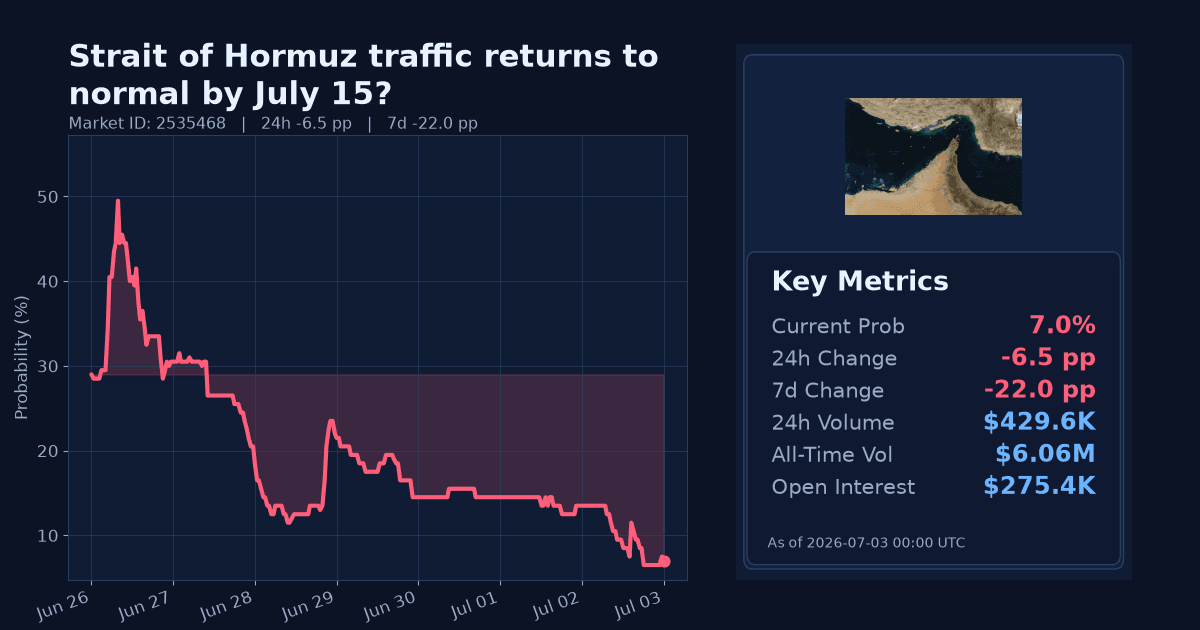
The Polymarket contract on “Strait of Hormuz traffic returns to normal by July 15?” fell sharply, with the implied probability down 6.5 percentage points over 24 hours to 7%. Over the past week, the contract has dropped 22 percentage points.
The market covers the window from creation (June 13, 2026) through July 15, 2026. It resolves Yes if the IMF Portwatch 7‑day moving average of Strait of Hormuz transit calls (“Arrivals of Ships”) reaches at least 60 on any date in that period.
Why It Likely Moved
- Repricing appears driven by Iran’s July 2 warning that oil tankers must use approved routes in the Strait of Hormuz or face a “forceful response,” signaling elevated operational constraints for shippers, per AP News.
- Markets reacted to continued ambiguity around incidents in the Strait, including reporting that a supposedly foreign ship “stuck” in the channel was tied to Tehran, according to AP News on July 2.
- The repricing follows official signaling that maintains regional vigilance. On July 2, the UK government told the UN Security Council it stands in solidarity with Gulf partners, underscoring ongoing security concerns rather than de‑escalation.
- EU energy policy signals point to stable gas security despite Middle East risks. The European Commission reported on July 2 that its Gas Coordination Group saw “no immediate concerns about security of EU gas supply,” a backdrop that may leave traders focusing on maritime constraints rather than broader energy scarcity (European Commission).
How Strong the Move Is
The 24-hour decline (−6.5pp) registers as an extreme move relative to recent trading, consistent with the market’s 24h z-score classification of “extreme” (down). The 7-day slide (−22pp) is also labeled “extreme,” indicating a sustained selloff rather than a one-day anomaly.
Taken together, this looks like a sharp continuation of a bearish trend rather than noise. High turnover alongside a tight spread suggests the move was made in liquid conditions.
Cross-Market Confirmation
- The related “Strait of Hormuz traffic returns to normal by July 31?” market fell in tandem (−4.0pp over 24h; −23.0pp over 7d to 25%), confirming a broader, time‑horizon‑agnostic downgrade in normalization odds.
- Other geopolitically themed but unrelated markets show mixed, mostly insignificant moves over 24h, offering no direct confirmation and underscoring that today’s repricing is specific to Strait traffic dynamics.
News & Real-World Context
- On July 2, Iran warned oil tankers to adhere to approved routes in the Strait of Hormuz, threatening a “forceful response” for noncompliance, highlighting operational risk for transiting vessels (AP News, July 2, 2026).
- Also on July 2, reporting indicated a ship Iran described as a foreign vessel stuck in the Strait was in fact tied to Tehran, complicating the narrative around maritime incidents (AP News, July 2, 2026).
- Government signals: The UK government (July 2, 2026) voiced solidarity with Gulf partners at the UN Security Council, indicating continued diplomatic engagement on Gulf security. Separately, the European Commission (published July 2, 2026) stated the EU Gas Coordination Group sees no immediate EU gas supply concerns.
- Macro backdrop: Brent crude is $71.57/bbl, down 4.9% over 7 days and 25.4% over 30 days as of July 2, while the VIX fell 14.5% over 7 days to 16.15. Softer energy prices and subdued equity volatility contrast with the market’s downgrade of near-term traffic normalization odds.
Bottom Line
Odds that IMF Portwatch’s 7‑day average for Strait transits will reach ≥60 by July 15 have been cut sharply. The move aligns with fresh Iranian routing warnings and a lack of clear de‑escalation signals.
Given extreme z-scores across 24h and 7d and confirmation from the July 31 market, this looks like a strong, time‑frame‑spanning bearish repricing rather than a transient blip.
Market Conditions at Time of Writing
- Current Probability: 7%
- 24h Change: -6.5pp
- 7d Change: -22.0pp
- Volume (24h): $429,613.44
- Open Interest: $275,360.95
- Spread: 1.0pp
- Z-score (24h): 24.0