What Moved the Market
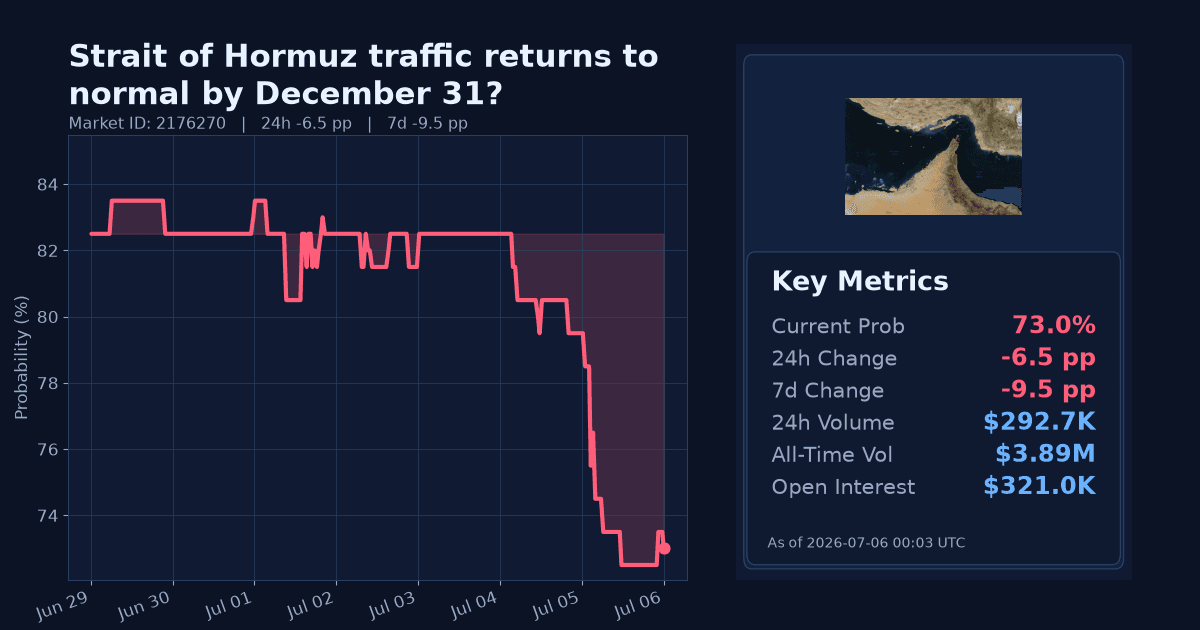
The Polymarket contract "Strait of Hormuz traffic returns to normal by December 31?" declined to 73%, down 6.5 percentage points over the past 24 hours and 9.5 points over the past week. The market prices the chance that IMF Portwatch will show a 7‑day moving average of Strait of Hormuz transit calls ("Arrivals of Ships") at or above 60 at least once between May 11, 2026 and December 31, 2026.
Both the daily and weekly moves registered as extreme relative to recent trading ranges, indicating a sharp downside repricing rather than routine noise.
Why It Likely Moved
- The repricing appears driven by renewed attention to maritime security after a cargo ship reported being under attack in the Red Sea off Yemen on July 5, according to AP News. While the incident is outside Hormuz, markets often reassess regional shipping risk in tandem.
- The UK government reiterated solidarity with Gulf partners at the UN Security Council on July 2. This official stance underscores continued diplomatic focus on Gulf security, which traders may interpret as a sign that risks remain salient.
- The European Commission’s Gas Coordination Group reported on July 2 that there are "no immediate concerns about security of EU gas supply" (European Commission). This provides a steady policy backdrop on energy availability, but it does not directly address Gulf shipping conditions, leaving room for market participants to prioritize security headlines.
- Repricing also follows alignment across related time-specific markets (see below), pointing to a broader reassessment of the timing for a return to "normal" transit levels rather than a single-market idiosyncrasy.
How Strong the Move Is
The 24-hour drop of 6.5 percentage points comes with an "extreme" 24h z-score, indicating an outsized, news-sensitive move. The 7-day decline of 9.5 points also shows an "extreme" weekly z-score, suggesting the shift is more than a brief wobble.
Taken together, this looks like a sharp downside spike extending into a week-long drawdown—best characterized as a potential trend reversal from earlier optimism, rather than simple day-to-day noise.
Cross-Market Confirmation
- Strait of Hormuz normalization by July 15: now 4.1%, down 17.45pp over 7 days (and -0.45pp in 24h). The steep weekly decline aligns with and reinforces the main market’s skepticism about near-term normalization.
- US–Iran final nuclear deal by Dec 31, 2026: 45.0% (no reported 24h/7d change). Limited signal; no confirmation or contradiction to the shipping-specific move.
- Macro: Brent crude at $71.6/bbl is down 0.5% over 7 days and 23.1% over 30 days. Softer oil prices suggest no broad-based supply panic, a divergence from the higher perceived risk around regional shipping normalization.
News & Real-World Context
- On July 5, a cargo ship reported being under attack in the Red Sea off Yemen; the British military said it was monitoring and advising vessels to take precautions, highlighting persistent risks to commercial shipping in the wider region (AP News).
- On July 2, the European Commission stated there are no immediate concerns about EU gas supply after its Gas Coordination Group review—an official signal on energy availability, though not specific to Hormuz maritime flows.
- Also on July 2, the UK government emphasized solidarity with Bahrain, Kuwait, and partners across the Gulf at the UN Security Council, underscoring ongoing diplomatic attention to Gulf security issues.
Bottom Line
Markets marked down the probability of Strait of Hormuz shipping returning to "normal" by year-end 2026, with an extreme, security-headline-sensitive decline. Cross-market signals (especially the near-term July 15 contract) confirm broader timing skepticism, while macro oil prices remain subdued, offering a mixed backdrop. Absent direct evidence of disruptions within Hormuz, the move looks news-driven and could remain sensitive to additional maritime security updates.
Market Conditions at Time of Writing
- Current Probability (%): 73.0
- 24h Change (pp): -6.5
- 7d Change (pp): -9.5
- Volume (24h, $): 292,662.78
- Open Interest ($): 321,036.18
- Spread (pp): 1.0
- Z-score (24h): 24.0