What Moved the Market
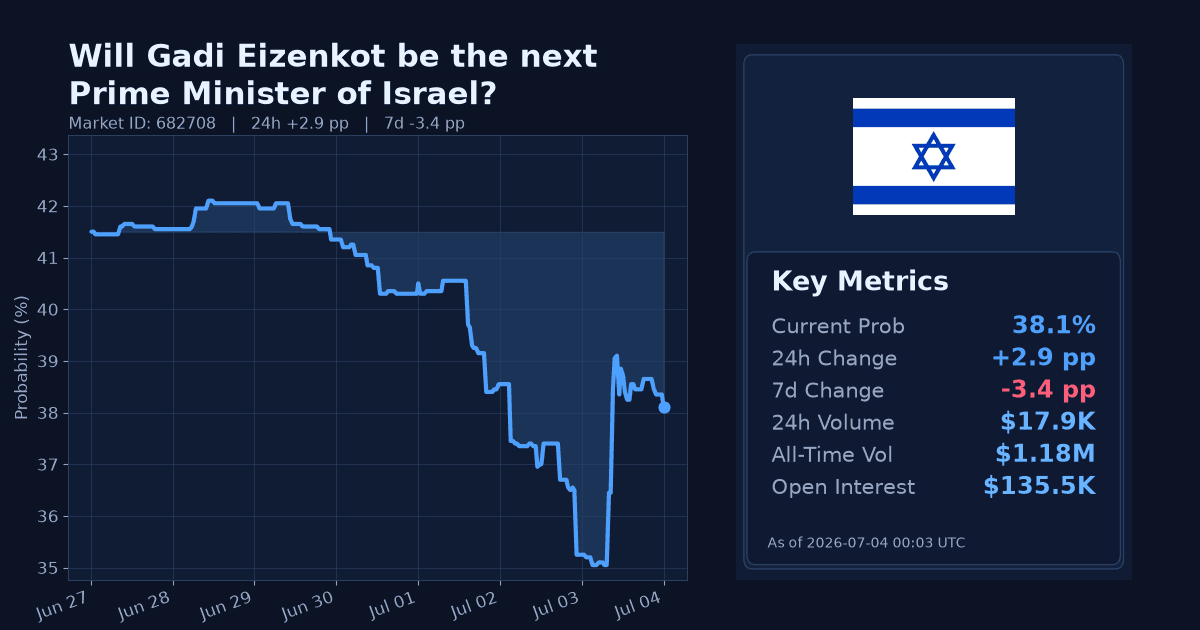
The Polymarket contract on whether Gadi Eizenkot will be the next Prime Minister of Israel moved higher over the last 24 hours, rising by a few percentage points to around the high‑30s.
This contract covers who is appointed and sworn in as prime minister following Israel’s 2026 parliamentary election (scheduled for October 27, 2026) or any earlier snap election. The market window runs from November 15, 2025 to December 31, 2026.
Why It Likely Moved
- The repricing appears driven by rotation among leading contenders: Eizenkot’s line moved up while Benjamin Netanyahu’s corresponding market ticked lower over the same 24-hour window, suggesting portfolio rebalancing among front-runners rather than a broad shift in the overall field.
- The move follows fresh official scrutiny from EU institutions: on July 3, 2026, the European Parliament published written questions regarding Israel’s actions toward a Greek trade union delegation and regional rhetoric targeting Israel, signaling elevated diplomatic attention from the EU (European Parliament, 3 Jul; European Parliament, 3 Jul). Traders may have incorporated the international context into leader‑viability assessments.
- Regional news flow kept Israel’s security environment in focus: coverage on July 3 about the passing and burial of Iran’s Supreme Leader Ayatollah Ali Khamenei highlighted potential regional implications (AP News, 3 Jul; AP News, 3 Jul). That backdrop may have marginally shifted relative preferences toward candidates perceived as strong on security.
- The shift occurred in a calm macro environment: equity volatility is subdued (VIX at 15.81, down ~14% over the week), and Brent crude is roughly flat on the day at $72.13, indicating the move was likely idiosyncratic rather than macro‑driven.
How Strong the Move Is
On a daily basis, the up-move is classified as extreme relative to the market’s recent history. The 24-hour z‑score indicates an unusually sharp repricing rather than routine noise.
Over seven days, the contract is modestly lower, an elevated but not extreme drift. Taken together, the latest action looks like a sharp daily spike against a softer weekly trend, not yet a confirmed reversal.
Cross-Market Confirmation
- Benjamin Netanyahu (related market): down over 24h (−1.0 pp) but up over 7d (+5.0 pp), a mixed signal that partially confirms a short‑term rotation yet diverges on the weekly trend.
- Avigdor Lieberman (related market): little change over 24h (−0.1 pp) and marginally higher over 7d (+0.15 pp), offering neutral confirmation.
- Naftali Bennett (related market): no 24h/7d deltas reported, providing no clear corroboration for the day’s move.
News & Real-World Context
EU institutional attention to Israel increased on July 3, 2026, via written questions from the European Parliament concerning Israel’s expulsion of a Greek trade union delegation and calls to review compliance with Article 2 of the EU‑Israel Association Agreement (European Parliament, 3 Jul). A parallel written question flagged escalating rhetoric from Turkey’s interior minister and related threats against the State of Israel (European Parliament, 3 Jul). These are official documents and indicate active EU oversight on Israel-related matters.
Regional headlines also featured Iran’s leadership transition, with reports on the burial of Ayatollah Ali Khamenei and its potential implications for the region (AP News, 3 Jul; AP News, 3 Jul). Separately, a July 3 report highlighted renewed scrutiny of Israeli-linked spyware after researchers found traces on an EU lawmaker’s phone (Ground News, 3 Jul).
Against this backdrop, broader markets were steady: the VIX stood at 15.81 (about 14% lower over the week), and Brent crude traded near $72.13. The macro tape points to stable risk appetite, reinforcing the interpretation that the Eizenkot repricing was driven more by political‑diplomatic headlines and intra‑field positioning than by cross‑asset stress.
Bottom Line
Eizenkot’s line saw a sharp, single‑session pop that looks rotational rather than a structural re‑rating. With mixed confirmation from related Israeli leadership markets and a weekly drift still lower, sustainability remains uncertain pending clearer political catalysts closer to the October 27, 2026 election window.
Market Conditions at Time of Writing
- Current Probability (%): 38.1
- 24h Change (pp): +2.85
- 7d Change (pp): −3.4
- Volume (24h, $): 17,902.49
- Open Interest ($): 135,476.37
- Spread (pp): 0.4
- Z-score (24h): 11.6