What Moved the Market
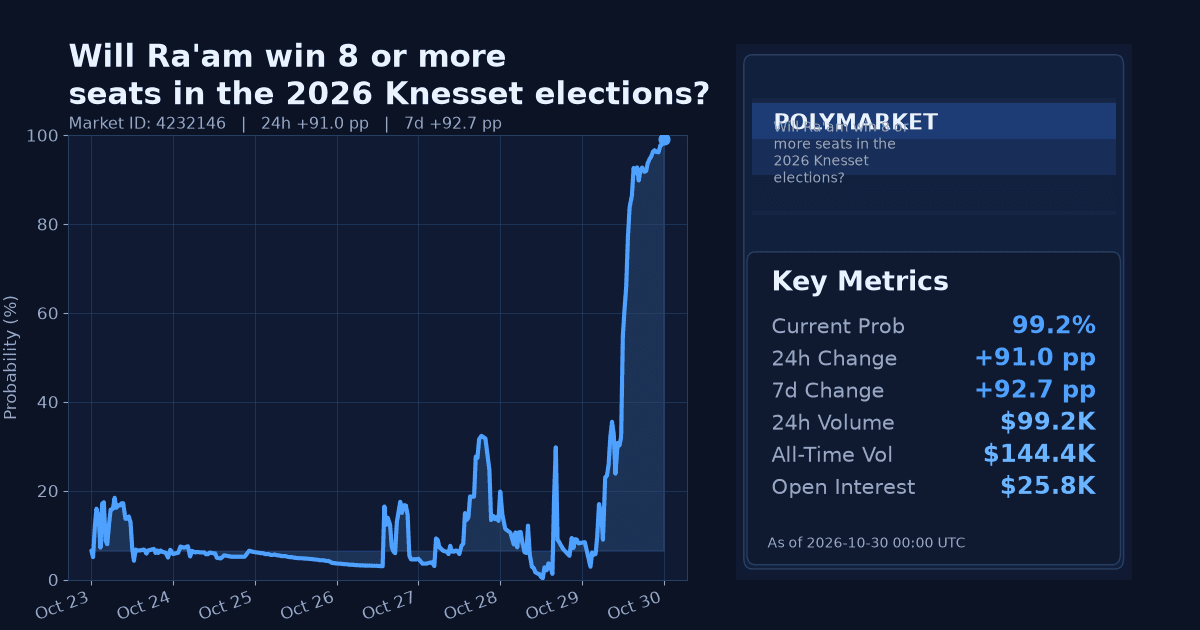
This Polymarket contract asks whether United Arab List, known as Ra’am, will win eight or more seats in Israel’s 2026 Knesset election. The contract window runs from September 4, 2026 to November 30, 2026, and resolution is based on Ra’am’s seat total, including seats from any joint list or merged party vehicle if applicable.
The market moved sharply upward from low implied odds to near-certainty. The repricing occurred as Israel’s election moved from the campaign phase into the vote-counting and coalition-assessment phase.
Why It Likely Moved
- The move appears driven by traders treating the election outcome as substantially clearer than it was earlier in the week, even though the supplied news context does not provide a specific Ra’am seat count.
- Markets reacted to reports that the broader election was deadlocked, with roughly 90% of votes counted in one NPR item, shifting attention from polling risk to actual results and coalition arithmetic.
- The repricing follows news that a majority of voters rejected Prime Minister Benjamin Netanyahu’s bloc while opposition parties still appeared unlikely to assemble a governing coalition, a setting in which smaller parties’ seat totals become more salient.
- The move does not appear to be a broad global risk shock: the VIX was 17.2 as of October 29 and down 9.62% over seven days, which weakens the case that general volatility alone explains the contract-specific jump.
How Strong the Move Is
This was an extreme upward spike. The market rose 90.95 percentage points over 24 hours and 92.7 points over seven days, while the 24-hour z-score was 358.6 and the seven-day z-score was 367.4. Both supplied interpretations label the move “extreme” relative to this market’s recent trading history.
The pattern is best classified as a spike rather than a gradual trend continuation. The market’s effective recent series begins on October 23, and the repricing concentrates around the immediate post-election information window.
Cross-Market Confirmation
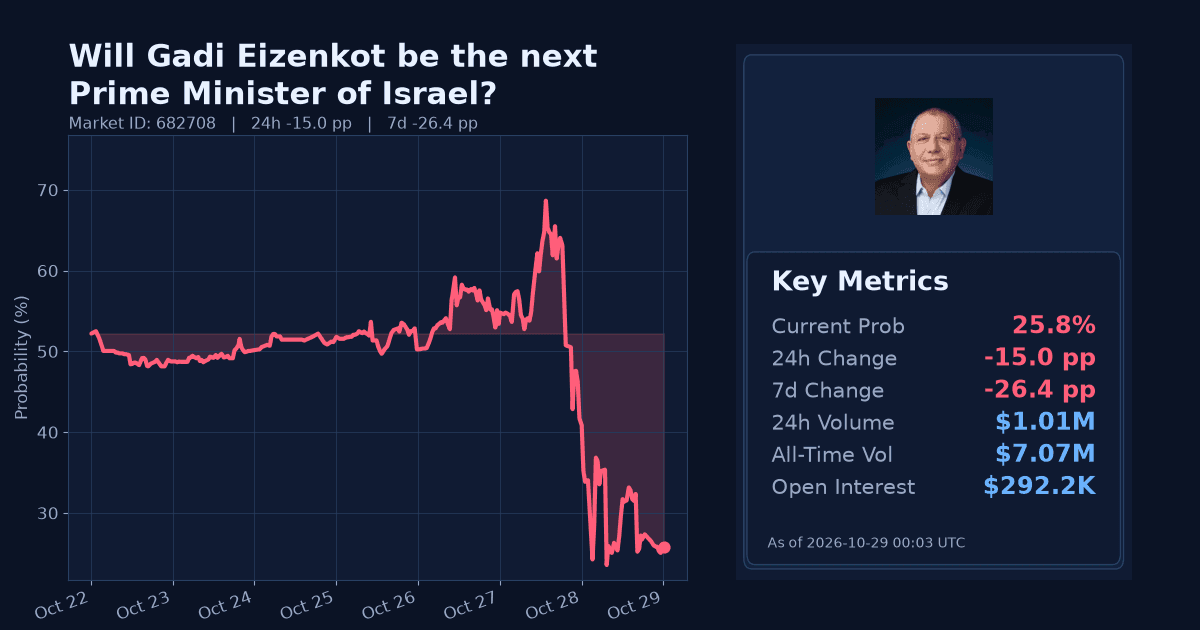
- The Gadi Eizenkot next-prime-minister market partially confirms near-term churn, rising 5.4 points over 24 hours, but diverges over the week with a 18.4-point decline.
- The Naftali Bennett next-prime-minister market also shows mild short-term alignment, up 1.15 points over 24 hours, while its seven-day move is negative at -10.35 points.
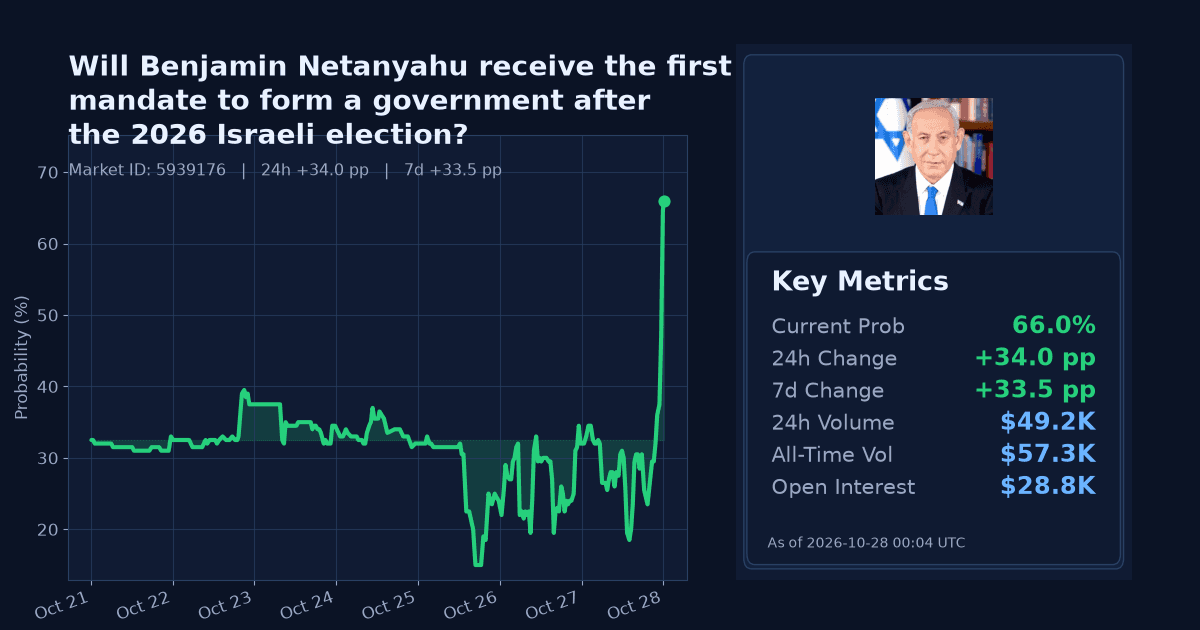
- The Benjamin Netanyahu next-prime-minister market diverges in the latest session, falling 3.5 points over 24 hours, but its seven-day move is positive at 13.5 points.
- Taken together, related leadership markets confirm that Israeli political probabilities are actively repricing, but they do not offer a clean directional read-through to Ra’am’s seat threshold.
News & Real-World Context
On October 29, NPR reported that Israel’s 2026 election had produced a political deadlock: a majority of voters rejected Netanyahu’s bloc, yet opposition parties appeared unlikely to form a governing coalition, according to NPR. A separate October 29 NPR item said that with roughly 90% of votes counted, no clear winner had emerged and the election remained deadlocked, according to NPR.
Official context also shows continued European government and parliamentary attention to Israel-related policy issues. On October 27, the European Parliament published a written question on “Funding of illegal Israeli settlements by the organisation Christians for Israel Italy,” according to the European Parliament. On October 28, the French government’s diplomacy portal published a foreign-affairs announcement carrying Jean-Noël Barrot’s France 2 interview, according to the French Ministry for Europe and Foreign Affairs. These official items are relevant diplomatic context, but they do not provide direct evidence on Ra’am’s seat total.
Bottom Line
The Ra’am threshold market has repriced as if the eight-seat outcome is now highly likely, coinciding with post-election vote-count reporting and a deadlocked national result. The move looks short-term and event-driven rather than structural, because it is tied to the immediate count and coalition phase. The key remaining uncertainty is not the direction of the market move, but the absence in the supplied evidence of a specific reported Ra’am seat figure.
Market Conditions at Time of Writing
- Current Probability (%): 99.2
- 24h Change (pp): 90.95
- 7d Change (pp): 92.7
- Volume (24h, $): 99,222.28
- Open Interest ($): 25,771.63
- Spread (pp): 1.6
- Z-score (24h): 358.6