What Moved the Market
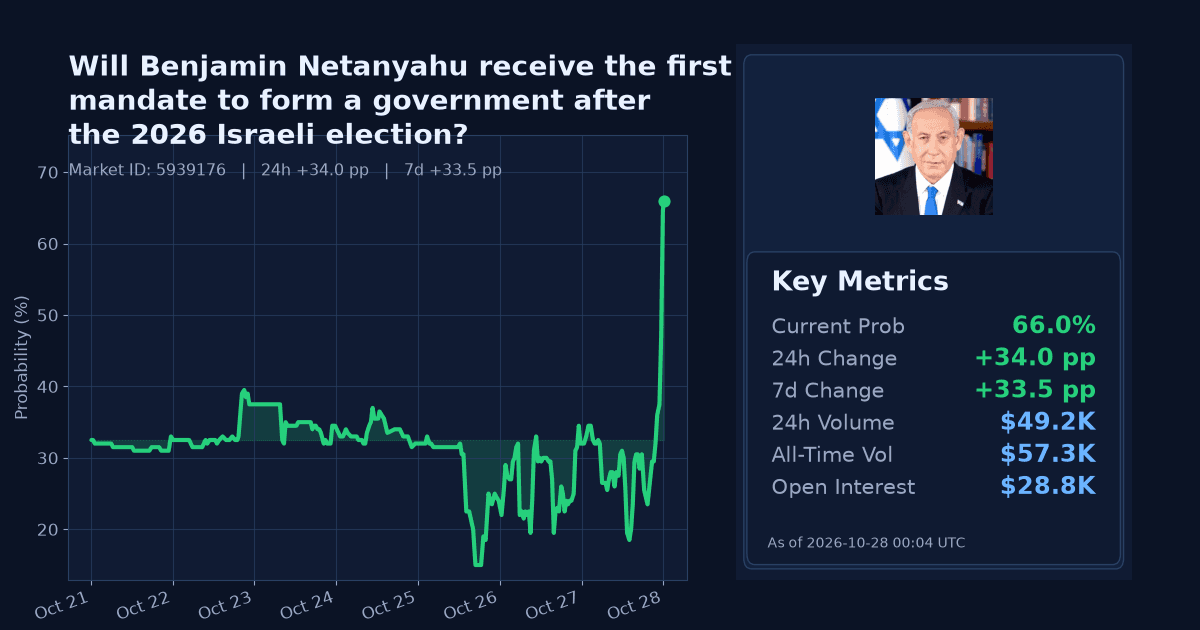
The Polymarket contract asks whether Benjamin Netanyahu will be the first person formally tasked by Israel’s president with forming a government after the 2026 parliamentary election. The listed market window runs from October 19 to October 28, 2026, with resolution tied not to party recommendations or consultations, but to the president’s formal mandate decision.
Netanyahu’s probability moved sharply higher into the end of that window, reaching 66.0% at the time of writing. The move places the market well above its recent trading range and shifts the contract from competitive pricing toward Netanyahu as the clear market favorite.
Why It Likely Moved
- The repricing appears driven by the election moving from campaign phase into vote-counting and coalition-formation expectations. NPR reported on October 27 that Israelis were casting ballots and that the immediate next steps were counting votes and likely coalition negotiations.
- Markets reacted to the fact that this contract resolves on the president’s first formal mandate, not on who wins the most votes or who is recommended during consultations. That makes perceived coalition arithmetic central as soon as election-day information begins arriving.
- The move follows heavy media framing of the election around Netanyahu personally. AP described the vote as a test of Netanyahu’s legacy and political standing, while separate AP coverage said the election was being seen as a referendum on Netanyahu.
- The security and diplomatic backdrop remained prominent in the supplied context. News coverage emphasized Gaza, regional tensions and Israel’s international relations, while official European Parliament questions on settlements and Gaza-related ceasefire concerns show that external policy scrutiny was active during the same period.
- Cross-market pricing suggests the move was not isolated to this individual contract: Netanyahu-linked exposure rose while rival or alternative leadership outcomes weakened.
How Strong the Move Is
This was an extreme upward move by the market’s own recent trading history. The 24-hour change was +34.0 percentage points and the 7-day change was +33.5 percentage points, with a 24-hour z-score of 118.0 and a 7-day z-score of 116.0.
The move is best classified as a spike rather than ordinary noise. Both the 24-hour and 7-day z-score interpretations are labeled “extreme” and upward, indicating a major repricing during the final listed market window rather than a routine drift.
Cross-Market Confirmation
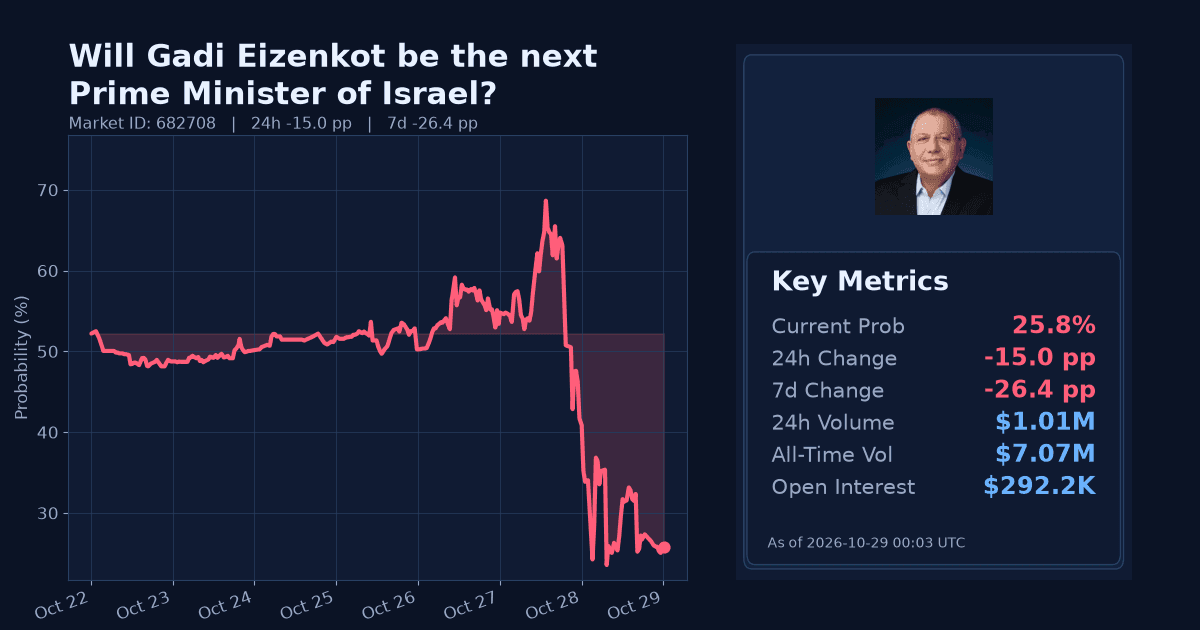
- Gadi Eizenkot’s parallel first-mandate market diverged sharply from Netanyahu’s move, falling 26.0 pp over 24 hours and 25.5 pp over 7 days. That confirms a rotation away from an alternative mandate recipient.
- The broader “Netanyahu next Prime Minister of Israel” market also moved in the same direction, rising 15.0 pp over 24 hours and 15.0 pp over 7 days. That supports the interpretation that markets were repricing Netanyahu’s governing prospects, not only this narrow mandate contract.
- Naftali Bennett’s next-prime-minister market weakened, down 3.0 pp over 24 hours and 9.0 pp over 7 days. That is directionally consistent with reduced pricing for a non-Netanyahu outcome.
News & Real-World Context
On October 27, NPR reported that Israeli voters were deciding “what kind of country to be,” with vote counting and coalition negotiations as the immediate next phase after ballots were cast NPR. NPR’s election guide the same day described the contest as Israel’s first national election since the Hamas-led attacks of 2023 and subsequent regional clashes, and highlighted security, domestic issues and coalition-building timelines NPR.
AP coverage on October 26 framed the election around Netanyahu’s standing, his handling of war and national security, and the possible consequences for government composition, Gaza, wider regional tensions and foreign relations AP News. A second AP piece the same day said the election was seen as a referendum on Netanyahu and listed security, Gaza, economic pressures, judicial overhaul, religious-secular tensions and coalition prospects with right-wing and ultra-Orthodox parties among the main issues AP News.
Official policy context also remained active. On October 27, 2026, the European Parliament published a written question on funding of illegal Israeli settlements by Christians for Israel Italy European Parliament. On October 26, 2026, the European Parliament published a written question on Gaza, alleged ongoing ceasefire violations and the Foreign Affairs Council meeting of October 12 European Parliament. Separately, the European Commission stated on October 27 that EU gas storage was 75% filled and noted that summer 2026 LNG disruptions linked to the Middle East conflict had contributed to tighter supply and higher EU gas prices European Commission. In the macro data supplied, Brent crude stood at $109.55 per barrel, up 5.013421% over 30 days, underscoring the energy-market relevance of the regional backdrop.
Bottom Line
The move appears to be an election-to-coalition repricing centered on Netanyahu’s chances of receiving the first presidential mandate. Cross-market signals broadly confirm the direction, with Netanyahu-linked markets higher and rival outcomes lower. The durability of the move remains uncertain until vote-counting and formal coalition consultations translate into the president’s mandate decision.
Market Conditions at Time of Writing
- Current Probability (%): 66.0
- 24h Change (pp): +34.0
- 7d Change (pp): +33.5
- Volume (24h, $): 49,185.58
- Open Interest ($): 28,793.81
- Spread (pp): 5.0
- Z-score (24h): 118.0