What Moved the Market
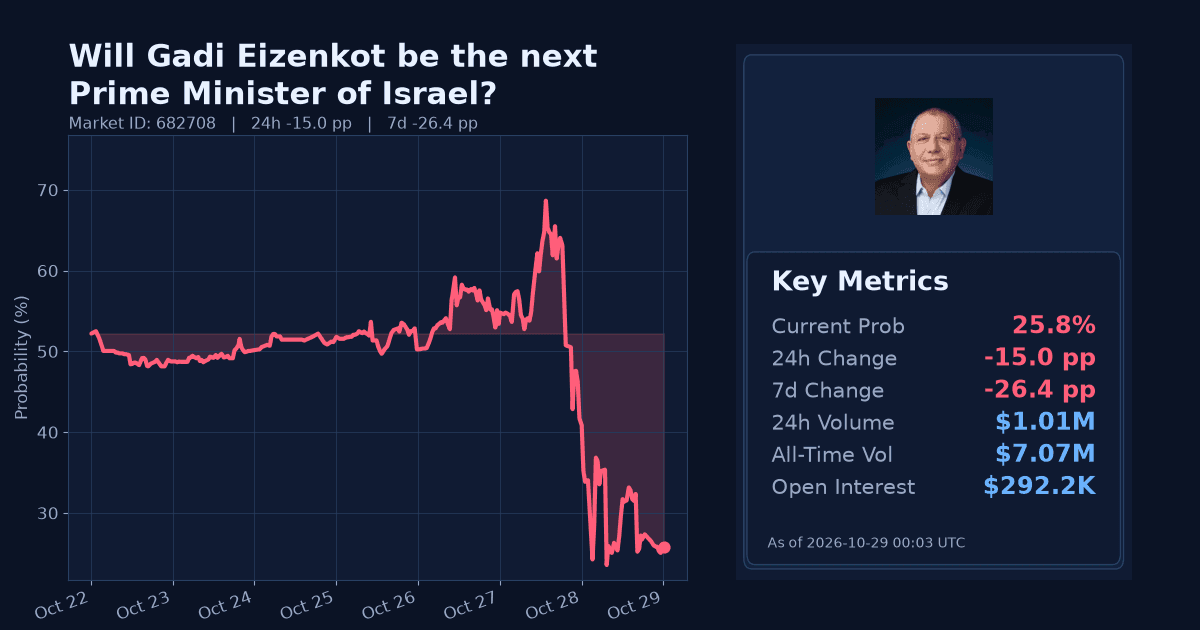
Polymarket’s contract on whether Gadi Eizenkot will be the next prime minister of Israel moved sharply lower. The market covers the individual officially appointed and sworn in as prime minister after Israel’s parliamentary election, with the contract window running from November 15, 2025 to October 28, 2026.
At the time of writing, Eizenkot was priced at 25.8%. That represents a large downward repricing over the past day and week, coming as the market reached the election-period end date and traders adjusted to reported post-vote coalition arithmetic.
Why It Likely Moved
- The move appears driven by early election reporting showing no clear winner, with Benjamin Netanyahu’s right-wing bloc leading Eizenkot’s opposition camp in partial results.
- Markets reacted to coalition uncertainty: the contract resolves only when a prime minister is formally sworn in, so a deadlocked Knesset reduces the value of a simple election-night lead narrative.
- Repricing follows reporting that Arab parties performed strongly, making coalition formation a central question for any Eizenkot path to office.
- The decline also appears tied to cross-market rotation toward Netanyahu rather than a broad selloff in all Israeli next-prime-minister candidates.
- Official and diplomatic context remains focused on Israel-related security and policy issues, but the supplied government sources do not report a direct appointment or coalition agreement.
How Strong the Move Is
The move is an extreme downward repricing. Eizenkot’s probability fell 15.05 percentage points in 24 hours and 26.4 percentage points over seven days. The 24-hour z-score is 63.6, and the seven-day z-score is 4.55; both are labeled extreme relative to this market’s recent trading history.
This is best classified as a sharp reversal rather than routine noise. The market had enough liquidity to make the move meaningful, and the direction aligns with election-result reporting that weakened Eizenkot’s apparent path to being sworn in.
Cross-Market Confirmation
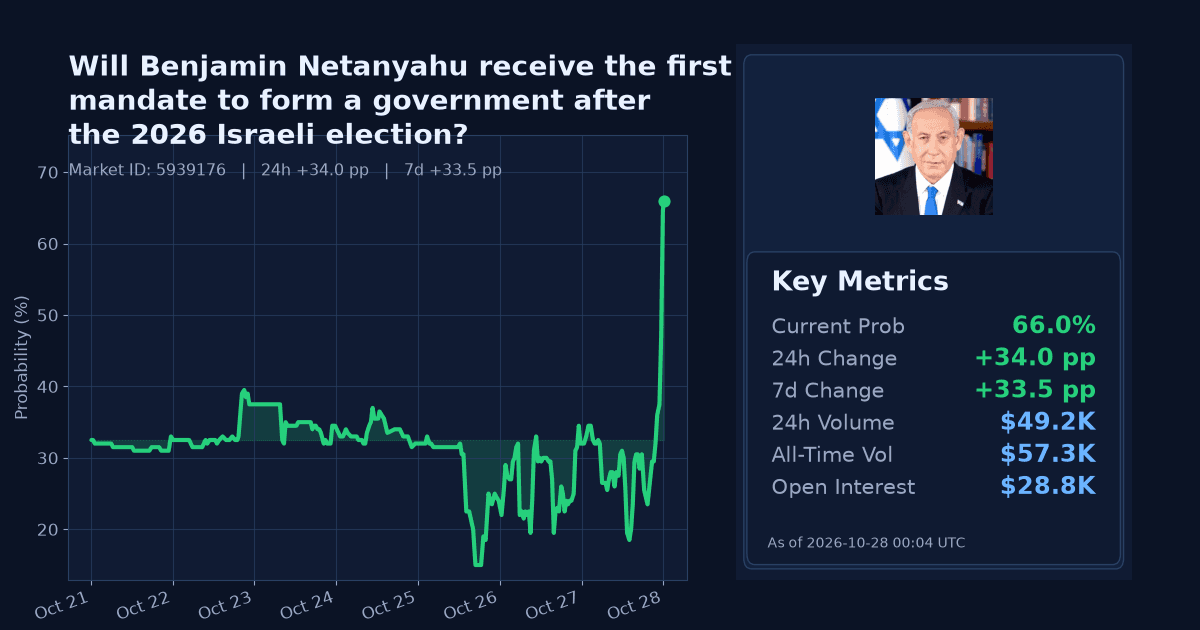
- Benjamin Netanyahu’s corresponding next-prime-minister market confirms the rotation: it rose 1.5 percentage points over 24 hours and 19.5 percentage points over seven days, reaching 46.0%.
- Naftali Bennett’s market also moved lower, down 2.0 percentage points over 24 hours and 10.5 percentage points over seven days, suggesting the repricing was not limited to Eizenkot alone.
- Avigdor Lieberman’s market showed only a small decline, down 0.6 percentage points over 24 hours and 0.65 percentage points over seven days, indicating limited confirmation from lower-probability alternatives.
News & Real-World Context
NPR reported on October 28 that partial Israeli election results showed no clear winner, with Netanyahu’s right-wing bloc leading Eizenkot in early counts and Arab parties posting a strong showing that could affect coalition options NPR. A separate NPR report the same day described the election as deadlocked, leaving governing negotiations and policy direction uncertain after Israel’s first national vote since the October 7, 2023 Hamas-led attacks NPR.
Official context also points to continued international focus on Israel and the wider regional conflict. On October 27, the European Parliament published a written question to the European Commission on alleged funding of illegal Israeli settlements by Christians for Israel Italy, an Israel-related foreign-affairs item European Parliament. Also on October 27, the European Commission said EU gas storage was 75% filled and noted that summer LNG disruptions linked to the Middle East conflict had tightened supply and pushed EU gas prices higher European Commission. In macro markets, WTI crude was at $101.86 per barrel and up 4.85% over seven days as of October 28, reinforcing that Middle East risk remained economically salient during the election period.
Bottom Line
The Eizenkot selloff appears tied to election-result uncertainty and a stronger relative market bid for Netanyahu. The move is extreme by this market’s own history, but its durability depends on coalition formation and the eventual swearing-in process rather than the partial count alone.
Market Conditions at Time of Writing
- Current Probability (%): 25.8
- 24h Change (pp): -15.05
- 7d Change (pp): -26.4
- Volume (24h, $): 1,011,961.68
- Open Interest ($): 292,203.24
- Spread (pp): 1.3
- Z-score (24h): 63.6