What Moved the Market
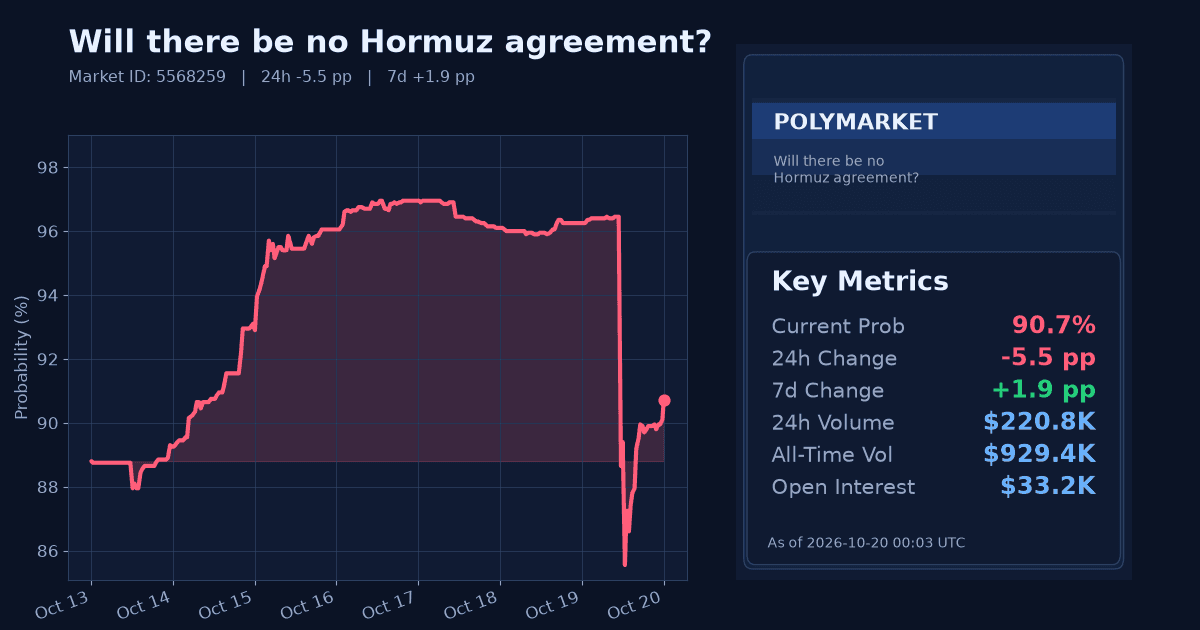
Polymarket’s “Will there be no Hormuz agreement?” market prices the outcome that no qualifying U.S.-Iran diplomatic agreement over traffic in the Strait of Hormuz is announced by October 23, 2026, 11:59 PM ET. The listed market window runs from October 11, 2026 to November 4, 2026, with the broader structure also tied to which party controls the U.S. Senate after the 2026 midterms.
The No Hormuz Agreement outcome moved lower over the past day, falling 5.55 percentage points to 90.7%. Over the past week, however, it remains 1.9 points higher, leaving the market still heavily priced toward no qualifying agreement.
Why It Likely Moved
- The move appears driven by a direct rotation out of the no-agreement outcome and into the two agreement-linked branches, both of which rose over the same 24-hour window.
- Markets reacted to policy attention around Hormuz disruption risk, including an official European Parliament written question on supply-chain impacts, though that document does not indicate a U.S.-Iran agreement.
- Repricing follows a broader risk and energy backdrop: WTI crude was at $98.24/bbl and up 4.80% over seven days, while the VIX was 18.44 and up 21.24% over seven days. Those figures support attention to shipping and escalation risks, not evidence of a deal.
- The Senate-linked component does not appear to be the main driver from the supplied evidence. Recent election-related reporting centers on House races, rural voters, and vote-counting mechanics rather than a decisive Senate-control signal.
How Strong the Move Is
The 24-hour drop is significant and best classified as an extreme short-term reversal. The supplied z-score interpretation labels the 24-hour move “extreme” to the downside, with a z-score of 24.6 relative to this market’s recent trading history.
The weekly pattern is more restrained. The seven-day move is still positive for No Hormuz Agreement and is labeled “normal,” with a z-score of 0.7641. That combination points to a sharp one-day repricing rather than a confirmed multi-day trend change.
Cross-Market Confirmation
- “Hormuz agreement and Republicans win the Senate” rose 1.6 points over 24 hours, confirming the main move’s direction, but is down 2.1 points over seven days, diverging from the one-day shift.
- “Hormuz agreement and Democrats win the Senate” rose 2.8 points over 24 hours, also confirming rotation toward agreement-linked outcomes, while falling 1.75 points over seven days.
- “US announces end of Iranian blockade by October 31, 2026?” rose 4.5 points over 24 hours, directionally supporting greater pricing of a Hormuz-related de-escalation path, though it is down 3.0 points over seven days.
News & Real-World Context
On October 16, the European Parliament published a written question titled “Impact of disruptions in the Strait of Hormuz on supply chains,” an official EU policy signal that lawmakers were focusing on Hormuz-related supply-chain exposure (European Parliament). On October 19, the European Parliament also announced and opened its 19–22 October plenary session, including foreign-affairs-related proceedings, but those notices did not report a U.S.-Iran Hormuz agreement (European Parliament, European Parliament).
Other official government items in the supplied context do not confirm a qualifying Hormuz agreement. Australia’s Assistant Minister for Foreign Affairs and Trade discussed foreign-policy principles and Ukraine in an October 19 interview, not Hormuz negotiations (Australian DFAT ministers). China’s foreign ministry reported Li Qiang’s meeting with Tajik President Emomali Rahmon on October 19, but that announcement likewise does not provide evidence of a U.S.-Iran Strait of Hormuz deal (Chinese Foreign Ministry).
Election-related news provides limited direct support for the Senate branch of this market. AP reported on October 19 that Hakeem Jeffries was campaigning in Ohio and discussing Democrats’ House prospects, while separate AP coverage examined Democratic efforts in rural Iowa; neither article establishes a Senate-control shift for this contract (AP News, AP News). NPR’s October 19 explainer on delayed vote counts is relevant to election-resolution mechanics, but not to Hormuz diplomacy itself (NPR).
Bottom Line
The market’s one-day move is real and unusually large, but the supplied evidence points to short-term repricing rather than confirmation of a qualifying Hormuz agreement. Cross-market action supports a rotation toward agreement-linked outcomes, while official sources cited here do not report the required U.S.-Iran acceptance of a diplomatic agreement.
Market Conditions at Time of Writing
- Current Probability (%): 90.7
- 24h Change (pp): -5.55
- 7d Change (pp): +1.9
- Volume (24h, $): 220,833.58
- Open Interest ($): 33,226.90
- Spread (pp): 0.8
- Z-score (24h): 24.6