What Moved the Market
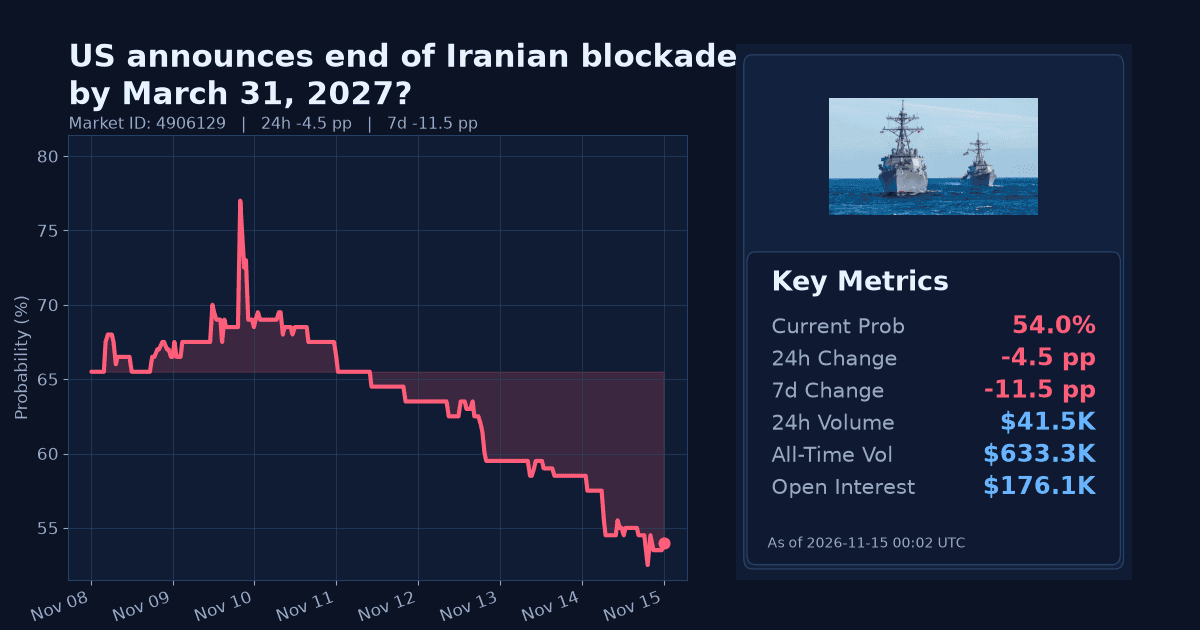
The market asks whether the United States government will publicly and officially announce the end, lifting, termination, or suspension of its naval blockade on Iranian ships and customers by March 31, 2027. The contract window runs from market creation on September 24, 2026 through March 31, 2027, with resolution tied to an official U.S. government announcement rather than whether the blockade actually ends in practice.
The Yes side moved lower over both the daily and weekly windows. The decline means traders reduced the implied likelihood that a qualifying U.S. announcement will occur before the contract deadline.
Why It Likely Moved
- The repricing appears driven by the absence, in the supplied evidence, of any qualifying U.S. government announcement ending or suspending the blockade. The only supplied U.S. government item is a State Department readout on Honduras, not Iran or the blockade.
- Markets reacted to official allied signals that point more toward pressure on Iran than toward a near-term relaxation. Canada’s official sanctions announcement and the UK’s UN Security Council statement on Gulf partners both sit closer to enforcement and regional-security positioning than to a U.S. policy reversal.
- The move also appears linked to regional security headlines that do not suggest de-escalation around Iran-linked maritime risks. The supplied news item on Saudi pressure for an EU Houthi terrorist designation reinforces that the regional policy environment remains security-focused.
- Repricing follows weakness in the nearer-deadline blockade markets, suggesting traders are reducing the odds of a prompt U.S. announcement first and then marking down the longer March 2027 window.
- The macro backdrop does not show a clear oil-market shock forcing an immediate policy rethink: Brent crude was listed at $95.84 per barrel and down 2.52% over seven days as of November 13, 2026, limiting evidence in the supplied data for an energy-price catalyst behind a blockade-ending announcement.
How Strong the Move Is
This is a significant downside move, not routine noise. The market fell 4.5 percentage points over 24 hours and 11.5 points over seven days, with the provided 24-hour z-score classified as extreme to the downside.
The weekly z-score is also classified as extreme to the downside, which makes the move look like a trend continuation rather than a one-off tick. The daily decline is large on its own, but the seven-day pattern is the stronger signal that traders have been steadily reducing confidence in a qualifying announcement.
Cross-Market Confirmation
- The November 30, 2026 version diverged on the day but confirms the broader weekly move: it rose 0.5 points over 24 hours while falling 11.5 points over seven days.
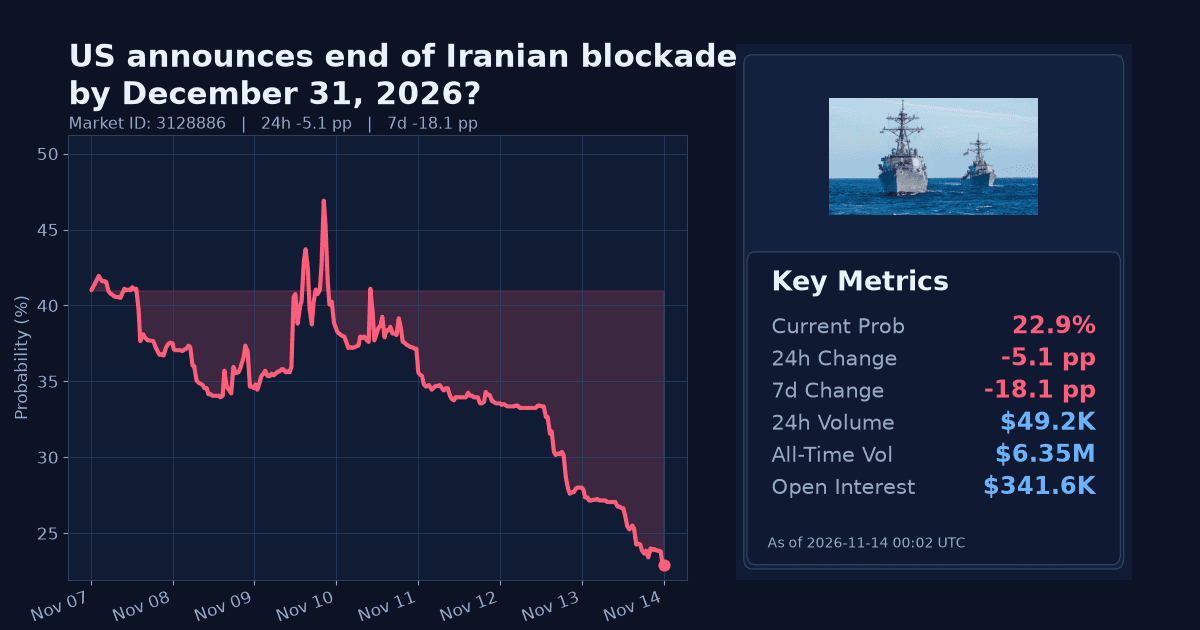
- The December 31, 2026 market confirms the main move more directly, dropping 4.0 points over 24 hours and 18.45 points over seven days.
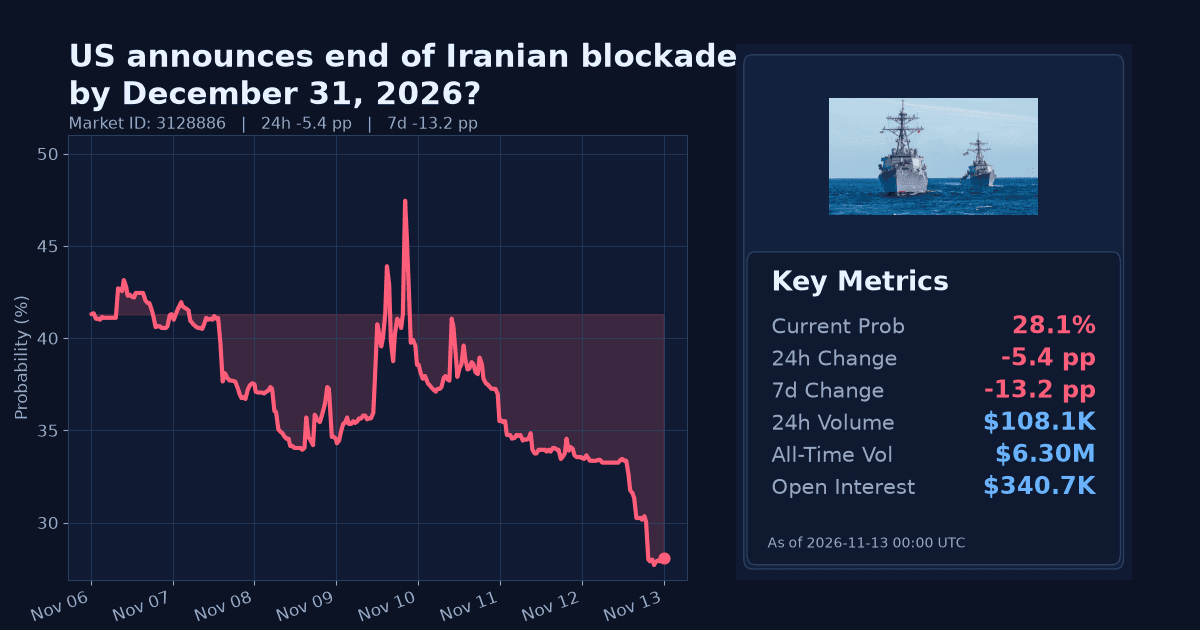
- The November 15, 2026 market also points lower, down 0.6 points over 24 hours and 4.55 points over seven days, consistent with fading expectations for an immediate qualifying announcement.
News & Real-World Context
Official government context is the clearest policy signal in the supplied evidence. On November 10, 2026, Canada announced that it had reimposed sanctions against 11 Iranian entities that had previously been delisted in 2016, according to Global Affairs Canada. On November 13, 2026, the UK government published a UN Security Council statement saying the United Kingdom stood in solidarity with Gulf partners. These are not U.S. blockade announcements, but they are official signals in the same regional security context.
The supplied U.S. government item does not support a Yes resolution: on November 13, 2026, the U.S. State Department published a readout of Secretary Rubio’s meeting with the president of Honduras, focused on defense, security, immigration, trade, and drought support in the Western Hemisphere. In news context, a November 14 report said Saudi Arabia was pressing the European Union to designate Yemen’s Houthis as a terrorist organization, according to Ground News. That headline is regional-security relevant, but it is not a qualifying U.S. statement on the blockade.
Bottom Line
The market is marking down the chance of a U.S. announcement ending the Iranian blockade by March 31, 2027 because the supplied official record shows no qualifying U.S. move and related contracts are broadly weaker. The decline is statistically extreme and cross-market supported, but whether it becomes structural is uncertain because the contract still has several months remaining.
Market Conditions at Time of Writing
- Current Probability (%): 54.0%
- 24h Change (pp): -4.5
- 7d Change (pp): -11.5
- Volume (24h, $): $41,459.14
- Open Interest ($): $176,121.94
- Spread (pp): 1.0
- Z-score (24h): 20.0