What Moved the Market
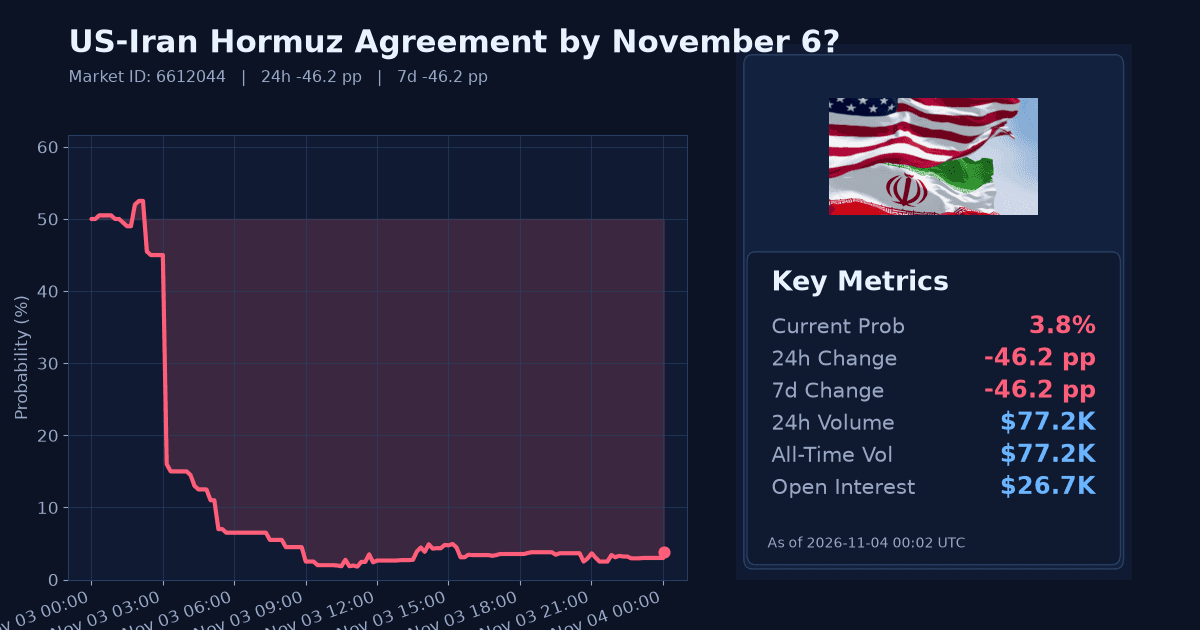
The Polymarket contract on whether the United States and Iran announce a qualifying diplomatic agreement over Strait of Hormuz traffic by the specified deadline fell to 3.8%. The market covers an agreement announced within the contract window beginning November 2, 2026 and ending November 7, 2026, with resolution tied to official US and Iranian information and credible reporting.
The move was sharply lower over the latest trading window, leaving the market priced as a low-probability outcome despite recent reporting about Iranian proposals related to reopening the strait and resuming nuclear talks.
Why It Likely Moved
- The repricing appears driven by the gap between reported diplomatic activity and the contract’s stricter requirement: both the United States and Iran must clearly announce acceptance of the same qualifying agreement.
- Markets reacted to reporting that Iran outlined a two-day plan to reopen a strait and resume nuclear talks with the United States, but that description does not itself establish a joint US-Iran agreement under the market rules.
- The move also appears to reflect time compression: the contract’s window runs only from November 2 to November 7, leaving limited time for official acceptance statements from both governments.
- Related markets moved lower on nearer-term blockade-resolution outcomes, suggesting traders broadly reduced confidence in an imminent official resolution rather than only this specific contract.
- Macro conditions supplied do not show an oil-price confirmation of a fresh Hormuz resolution: Brent crude was at $104.10/bbl as of November 3 and down 8.59% over seven days, which provides market context but not evidence of a completed agreement.
How Strong the Move Is
The market’s 46.2 percentage-point decline over 24 hours is an extreme downward move relative to its own recent trading history. The supplied 24-hour z-score is 190.0, and the interpretation explicitly classifies the move as extreme to the downside.
Over seven days, the market is also down 46.2 percentage points, but the supplied seven-day z-score is 0.0 and the interpretation classifies that horizon as normal/flat relative to available volatility history. Given the very short observed series beginning November 3, the move is best described as an extreme short-window repricing rather than a confirmed multi-day trend.
Cross-Market Confirmation
- The December 31 US-Iran Hormuz agreement market partially confirms the shift: it was down 5.0 percentage points over 24 hours, though still up 2.0 points over seven days, indicating weaker near-term confidence but not a full abandonment of a later deal.
- The market on a US announcement ending an Iranian blockade by November 15 also confirms the near-term downgrade, falling 7.5 points over 24 hours and 2.0 points over seven days.
- The November 30 blockade-announcement market shows a milder version of the same pattern, down 3.0 points over 24 hours but up 1.5 points over seven days, suggesting divergence on later timing.
News & Real-World Context
Recent reporting supplied to this brief points to activity short of a qualifying agreement. On November 2, the Associated Press reported that Iran had outlined a two-day plan to reopen a strait and resume nuclear talks with the United States, according to AP News. A separate November 2 AP roundup said Iran’s top diplomat hoped the United States would show “rationality,” according to AP News. Those items indicate diplomatic signaling, not a clearly announced bilateral acceptance of the same Hormuz agreement.
The official-government material provided does not show the required US-Iran announcement. The US State Department’s November 3 statement in the supplied context concerned Panama National Day and US-Panama cooperation, not Hormuz or Iran, according to the US State Department. European Parliament written questions on November 3 addressed aviation regulatory certainty and EU shipowners’ Russian LNG exposure, not a US-Iran Hormuz deal, according to the European Parliament and the European Parliament.
Bottom Line
The market move reflects a sharp downgrade in the probability of a qualifying US-Iran Hormuz agreement being announced inside a narrow November 2–7 contract window. The evidence supplied supports the view that traders are distinguishing between diplomatic signals and the market’s stricter requirement for official acceptance by both governments. The move appears short-term and deadline-driven, though later-dated related markets show that expectations for a future agreement have not fully collapsed.
Market Conditions at Time of Writing
- Current Probability (%): 3.8
- 24h Change (pp): -46.2
- 7d Change (pp): -46.2
- Volume (24h, $): 77,237.48
- Open Interest ($): 26,705.25
- Spread (pp): 1.8
- Z-score (24h): 190.0