What Moved the Market
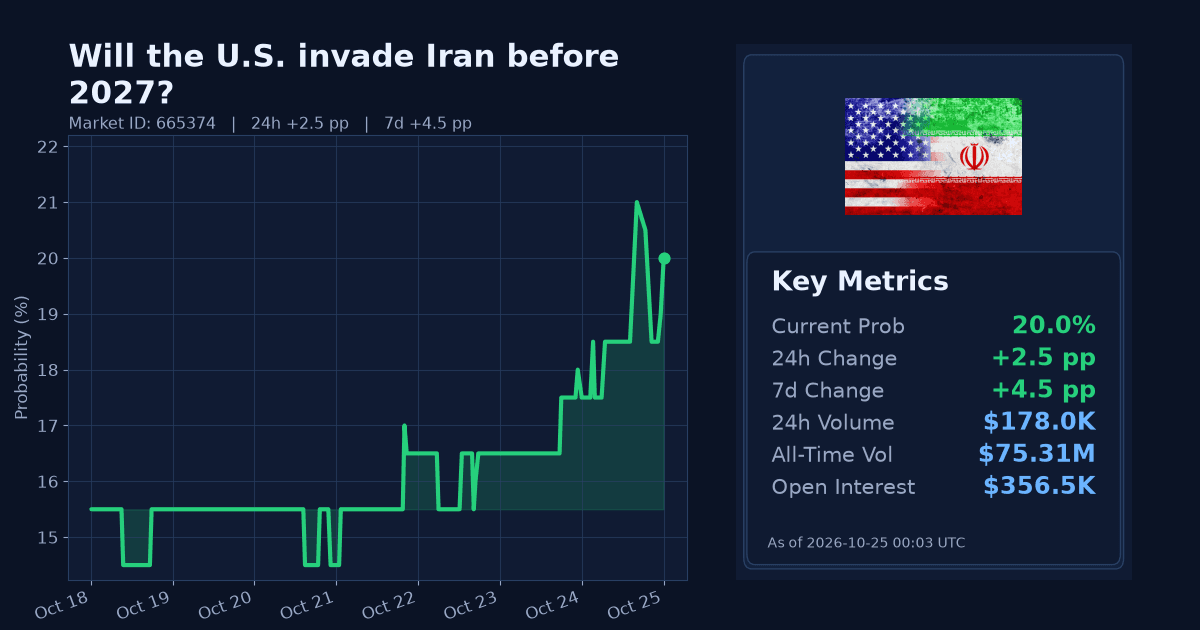
Polymarket’s contract on whether the United States will invade Iran before 2027 rose to 20.0% as of 2026-10-25. The market covers the period from 2025-11-05 through 2027-01-01 and resolves “Yes” if the U.S. begins a military offensive intended to establish control over any portion of Iran by the stated deadline.
The move was upward over both the daily and weekly windows, with trading concentrated around fresh Middle East security headlines. The contract remains a long-dated, high-threshold invasion market, not a general measure of U.S.-Iran conflict risk.
Why It Likely Moved
- The repricing appears driven by reports that Iran said seven oil tankers were attacked in the Strait of Hormuz, a development described as a major escalation and linked to fears of renewed open conflict involving the United States and Israel.
- Markets reacted to the direct relevance of Hormuz security to U.S.-Iran military-risk scenarios, even though the contract requires a U.S. offensive intended to establish territorial control inside Iran, a much narrower condition than strikes, naval clashes, or regional escalation.
- Diplomatic headlines likely tempered the move rather than reversing it: an Iranian envoy said Iran remained open to talks with the United States under a Pakistan-brokered arrangement intended to ease tensions around Hormuz.
- The repricing follows a broader policy backdrop in which European governments are visibly coordinating on defense and foreign affairs. The UK government’s 2026-10-24 publication on the R4 Ministerial Meeting in Istanbul with France, Germany, Italy, and the United Kingdom is an official signal of active diplomatic and security coordination, though it does not by itself establish a U.S.-Iran invasion pathway.
- Energy-market context supports why Hormuz headlines drew attention: Brent crude was at $111.70 per barrel as of 2026-10-23, up 1.67% over seven days despite a 4.30% one-day decline, indicating that oil-risk sensitivity remained elevated around the same news cycle.
How Strong the Move Is
This was a significant upward move rather than ordinary noise. The 24-hour change was +2.5 percentage points, while the 7-day change was +4.5 percentage points. For a market at 20.0%, that is a meaningful repricing of a low-probability but high-impact outcome.
The statistical signal is extreme on both horizons. The 24-hour z-score is 8.0, and the 7-day z-score is 20.0; the supplied interpretation classifies both as extreme upward moves relative to this market’s recent trading history. That makes the move closer to a sharp event-driven spike than a gradual trend continuation.
Cross-Market Confirmation
- The market on whether the U.S. announces an end to an Iranian blockade by December 31, 2026 moved only slightly higher, at +0.1 pp over 24h and +0.2 pp over 7d. That is directionally aligned but weak confirmation.
- The October 31, 2026 Iranian blockade market showed no available 24h change and a modest +0.5 pp over 7d. This provides limited support for a broader Iran-related repricing, but not for an invasion-specific move.
- The NATO-Russia military clash market diverged, falling -0.2 pp over 24h and -9.65 pp over 7d. That suggests the move was not a generalized bid for all major-war markets.
News & Real-World Context
On 2026-10-24, AP reported that Iran said seven oil tankers had been attacked in the Strait of Hormuz, calling the incidents a major escalation and noting that they increased fears of a return to open conflict amid wider tensions involving the United States and Israel, according to AP News. The same publication date also carried a separate AP report that an Iranian envoy said Iran remained open to talks with the U.S. under a Pakistan-brokered deal aimed at easing tensions around Hormuz, according to AP News.
Official policy context points to heightened diplomatic and defense coordination among European governments. On 2026-10-24, the UK government stated that the R4 Ministerial Meeting in Istanbul brought together counterparts from France, Germany, Italy, and the United Kingdom on defense and foreign affairs. This is relevant as an official signal of active security-policy engagement, but the supplied announcement does not state a U.S. military decision regarding Iran.
Bottom Line
The move appears to be an event-driven spike tied mainly to fresh Strait of Hormuz escalation headlines, with diplomacy and related markets offering only partial confirmation. Because the contract requires a U.S. invasion intended to establish control over Iranian territory, the market’s higher probability should be read as an elevated risk repricing, not evidence that the resolution threshold has become likely.
Market Conditions at Time of Writing
- Current Probability (%): 20.0
- 24h Change (pp): +2.5
- 7d Change (pp): +4.5
- Volume (24h, $): 177,986.88
- Open Interest ($): 356,487.78
- Spread (pp): 1.0
- Z-score (24h): 8.0