What Moved the Market
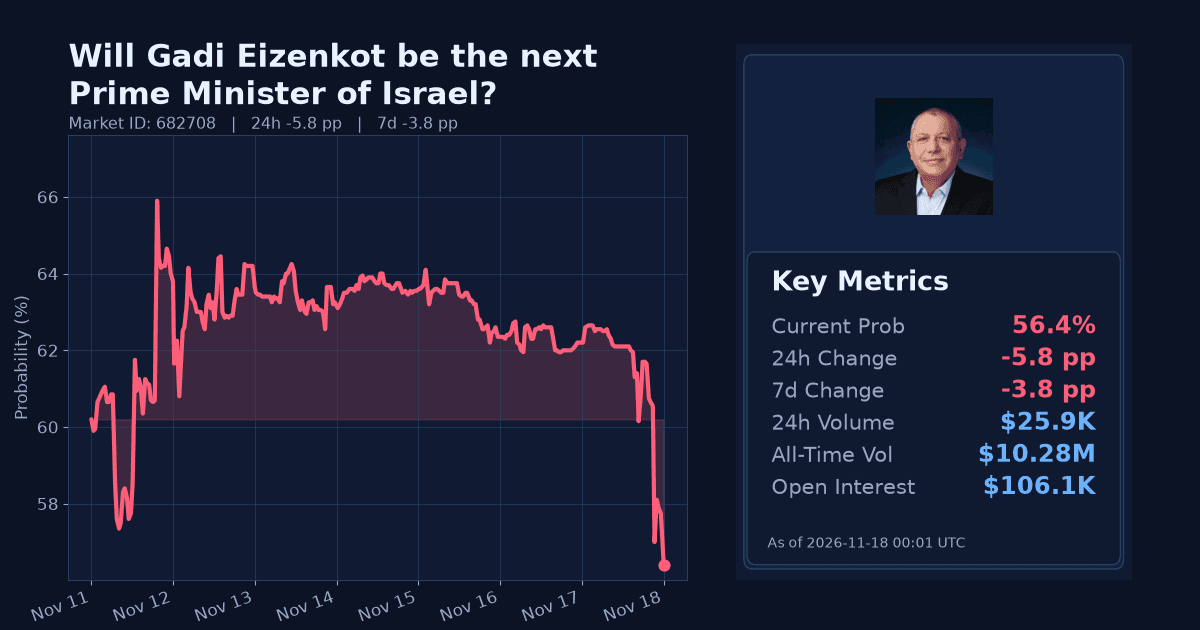
Polymarket’s contract on whether Gadi Eizenkot will be the next Prime Minister of Israel moved lower. The market asks whether Eizenkot will be the next person formally appointed and sworn in as prime minister after Israel’s 2026 parliamentary election, or after an earlier election if one is called.
The contract opened on Nov. 15, 2025, with a listed market end date of Oct. 28, 2026. At the time of writing, Eizenkot remained the leading priced outcome, but his probability fell materially over the last day.
Why It Likely Moved
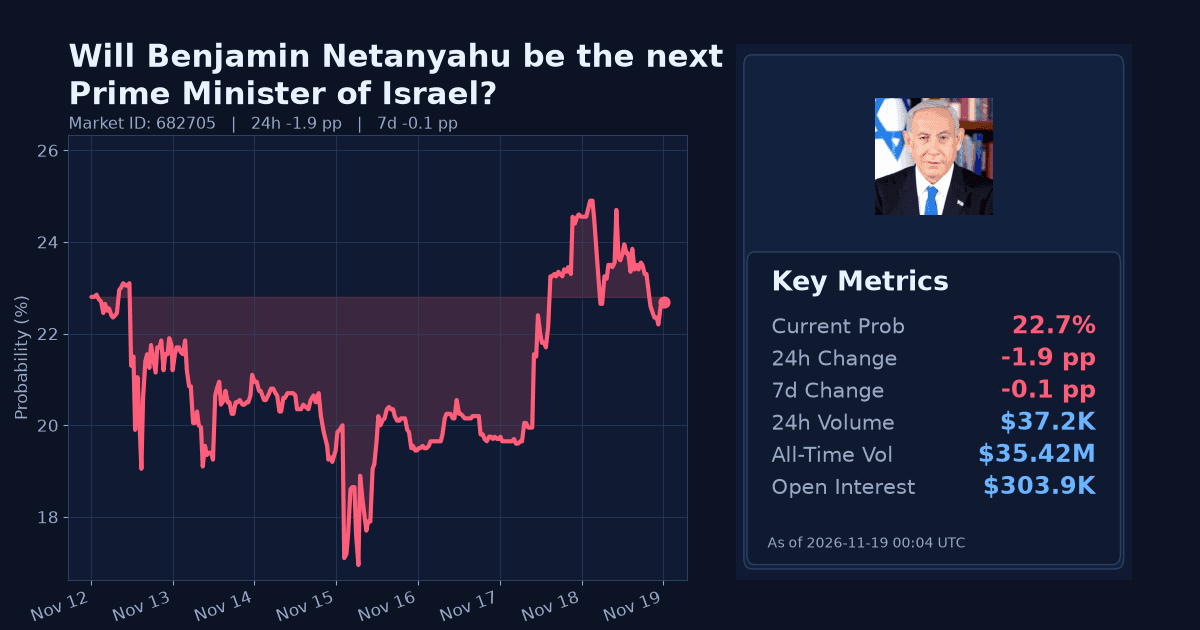
- The repricing appears driven primarily by rotation within the Israel next-prime-minister market set: Eizenkot fell while Benjamin Netanyahu’s parallel contract rose, suggesting traders reduced Eizenkot exposure and shifted probability toward Netanyahu rather than toward a broad “other” political-risk view.
- Markets reacted in an environment with continuing official focus on Israel-related policy issues, particularly Gaza and the West Bank. That provides relevant political context, though the supplied evidence does not show a direct Eizenkot-specific news trigger.
- Broader risk conditions may have amplified short-horizon moves in political markets. The VIX stood at 25.46 and was up 30.8% over seven days, indicating a more volatile cross-asset backdrop during the repricing.
- The move also appears consistent with a short-term correction after Eizenkot had been priced as the front-runner. The available context supports a relative repricing, not a confirmed change in the underlying election timetable or formal succession process.
How Strong the Move Is
The one-day move is statistically large for this market. Eizenkot’s probability declined 5.8 percentage points over 24 hours, and the 24-hour z-score was 21.4. The supplied interpretation classifies that as an extreme downward move relative to the market’s recent trading history.
Over seven days, the contract was down 3.8 percentage points, with a 7-day z-score of 1.6087. That is elevated but not extreme. Taken together, the move looks like an extreme one-day drop inside a weaker week-long trend, rather than a fully established structural reversal.
Cross-Market Confirmation
- The Benjamin Netanyahu next-prime-minister market confirms the direction of the relative repricing: it rose 4.95 percentage points over 24 hours and was up 0.05 points over seven days.
- The Iran leadership-change-by-Nov. 30 market does not directly confirm an Israel electoral rotation: it rose 0.55 points over 24 hours but was down 0.15 points over seven days.
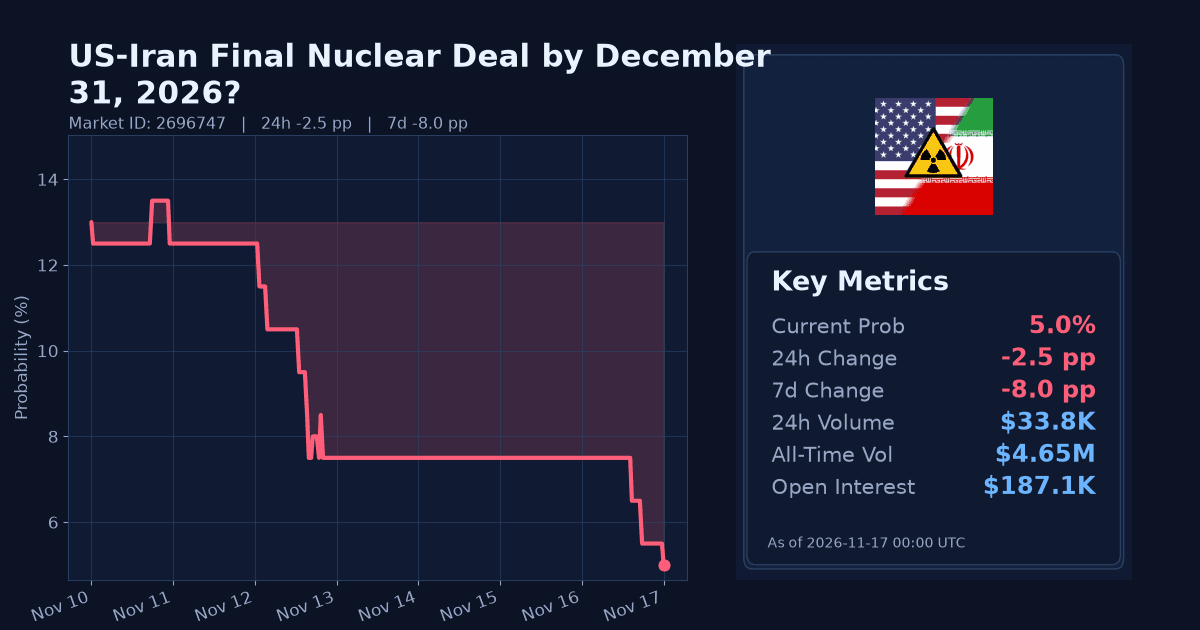
- The Iran leadership-change-by-Dec. 31 market shows some regional political-risk bid, rising 2.0 points over 24 hours and 1.0 point over seven days, but that signal is not specific to Israel’s prime-minister outcome.
News & Real-World Context
The strongest official Israel-related signal in the supplied context came from the UK government. On Nov. 17, 2026, the UK announced new sanctions on companies involved in West Bank settlement expansion and on an activist group accused of blocking aid access into Gaza, according to the UK government. This is a concrete diplomatic-policy action concerning Israel-related issues, but it does not name Eizenkot or directly address Israel’s 2026 election.
A second official signal came from Norway’s parliamentary record. On Nov. 16, 2026, a written question to Norway’s Minister of Foreign Affairs described Gaza as entering a fourth winter without shelter and cited shortages of food and reduced regional aid after the ceasefire, according to the Norwegian parliament. This reinforces that Gaza remains active in European policy debate.
The supplied news feed did not include a direct Israeli electoral development tied to Eizenkot. Its closest political-stability items concerned the Netherlands, where crisis talks kept a minority government together after a tax dispute, according to Ground News, and a separate report said the Dutch coalition would continue governing after days of talks, according to Ground News. Those articles show broader coalition-politics news flow but do not provide direct evidence about Israel’s next prime minister.
Bottom Line
Eizenkot’s market saw an extreme one-day decline, but the clearest confirmation is relative: Netanyahu’s competing contract moved higher at the same time. The available evidence supports a short-term rotation within Israel leadership pricing, while the structural implications remain uncertain because no supplied source reports an Eizenkot-specific electoral or coalition development.
Market Conditions at Time of Writing
- Current Probability (%): 56.4
- 24h Change (pp): -5.8
- 7d Change (pp): -3.8
- Volume (24h, $): 25,909.24
- Open Interest ($): 106,136.8
- Spread (pp): 0.9
- Z-score (24h): 21.4