What Moved the Market
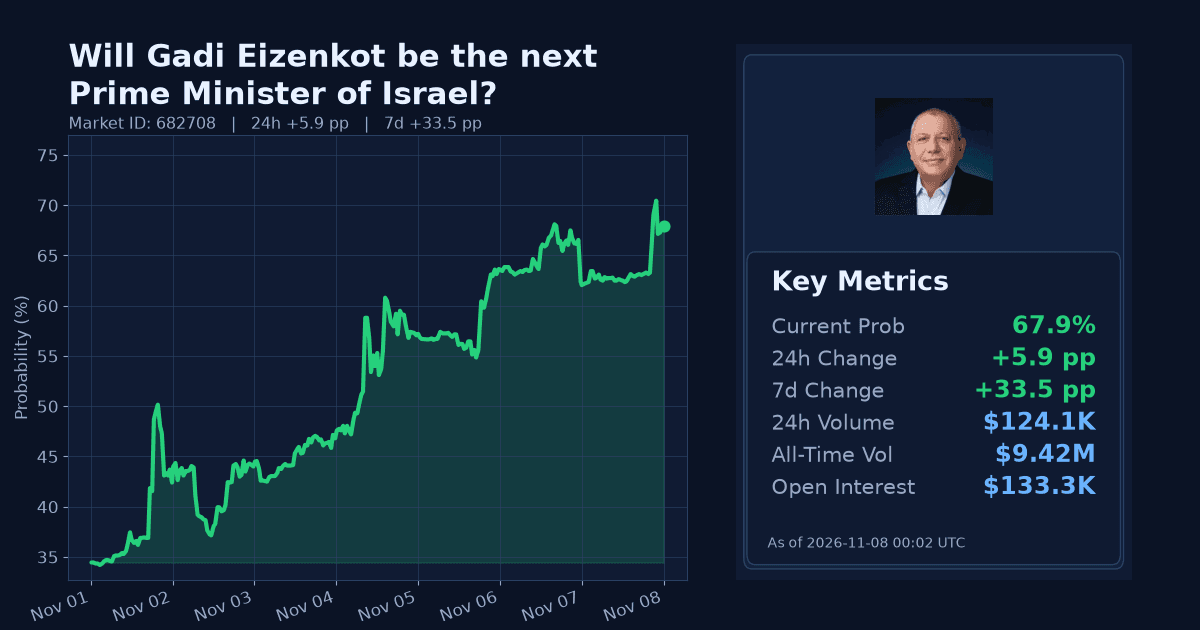
The Polymarket contract on whether Gadi Eizenkot will be the next Prime Minister of Israel moved sharply higher. The market covers the next individual formally appointed and sworn in as prime minister after the 2026 parliamentary election; interim or caretaker service does not count.
The contract was listed on Nov. 15, 2025, and is tied to the election window ending Oct. 28, 2026. As of the latest market snapshot, Eizenkot was priced as the clear favorite, with the move concentrated over the past week and reinforced during the last day.
Why It Likely Moved
- The repricing appears driven by the Nov. 7 report that Israel’s president asked Eizenkot to try to form a government after major parties recommended him, a procedural step directly relevant to the contract’s path to resolution.
- Markets reacted to the development as a setback for Benjamin Netanyahu, since the same reporting said neither Eizenkot nor Netanyahu had won a clear parliamentary majority.
- The move follows the contract’s resolution logic: receiving the opportunity to form a government is not the same as being sworn in, but it materially improves Eizenkot’s route to becoming the next formally appointed prime minister.
- Cross-market pricing suggests traders shifted probability away from Netanyahu and toward Eizenkot rather than broadly repricing all alternatives higher.
- Broader market conditions were volatile but not the main explanatory factor: the VIX stood at 25.64 and was up 32.0% over seven days as of Nov. 6, providing a risk backdrop rather than a direct Israel-specific signal.
How Strong the Move Is
This is an extreme upward move by the market’s own history. The 24-hour z-score is classified as extreme to the upside, and the seven-day z-score is also extreme to the upside, indicating the repricing is far outside recent normal trading variation.
The pattern is best classified as a spike that also extends a one-week trend. It is not merely noise: the market moved higher over both the short and weekly horizons, and the shift coincides with a concrete post-election coalition-development signal.
Cross-Market Confirmation
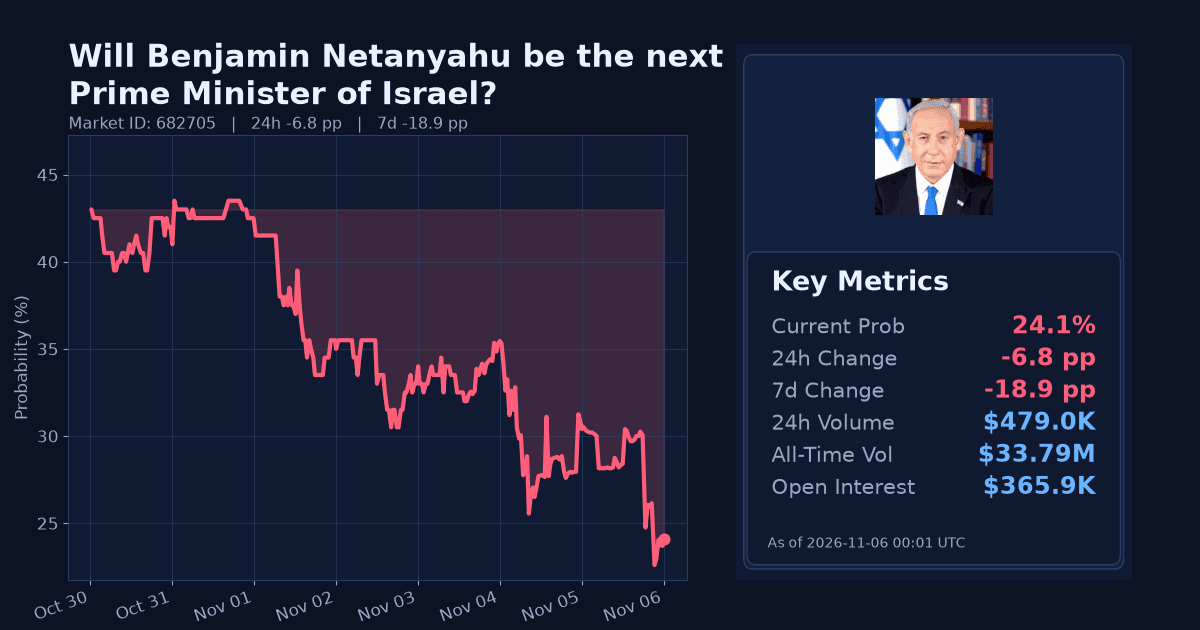
- The Netanyahu market confirms the main move directionally: Netanyahu’s next-prime-minister probability fell by 1.1 percentage points over 24 hours and by 22.5 points over seven days.
- The Eizenkot first-mandate market also confirms the repricing, rising 1.55 points over 24 hours and 32.95 points over seven days, consistent with the reported presidential mandate.
- The Avigdor Lieberman market is mixed: it fell 1.85 points over 24 hours but rose 3.7 points over seven days, suggesting some alternative-candidate interest remains but does not contradict the immediate Eizenkot rotation.
News & Real-World Context
On Nov. 7, NPR reported that Israel’s president, Isaac Herzog, asked opposition candidate Gadi Eizenkot to try to form a government after no party won a clear majority and major parties recommended Eizenkot for the task, according to NPR. A second NPR item the same day described the decision as a setback for Netanyahu and noted that coalition talks and Israel’s political future remained uncertain, according to NPR.
The supplied official government context does not include an Israeli announcement on the mandate or swearing-in. It does include broader foreign-affairs signals: on Nov. 6, the French government announced priorities for a Nov. 9-10 G7 foreign ministers’ meeting in Paris; on Nov. 6, the U.S. State Department congratulated Grenada’s prime minister on reelection; and on Nov. 6, the German Bundeswehr published a defence-related podcast item. These are official policy communications, but none directly establishes the outcome of the Israeli prime-minister market.
Bottom Line
The move appears tied to a specific procedural development: Eizenkot being asked to attempt to form a government. It is a strong short-term repricing with structural relevance, but the contract still depends on a formal swearing-in, so the outcome remains unresolved.
Market Conditions at Time of Writing
- Current Probability (%): 67.9
- 24h Change (pp): +5.85
- 7d Change (pp): +33.45
- Volume (24h, $): 124,079.84
- Open Interest ($): 133,295.75
- Spread (pp): 0.7
- Z-score (24h): 23.2