What Moved the Market
The Polymarket contract asks whether Benjamin Netanyahu will be the next individual formally appointed and sworn in as Prime Minister of Israel after the 2026 parliamentary election, or after an early election if one is called. The listed market window runs from November 15, 2025 to October 28, 2026, while the contract text allows resolution based on the eventual sworn-in prime minister and defaults to “Other” if no qualifying prime minister is sworn in by December 31, 2027.
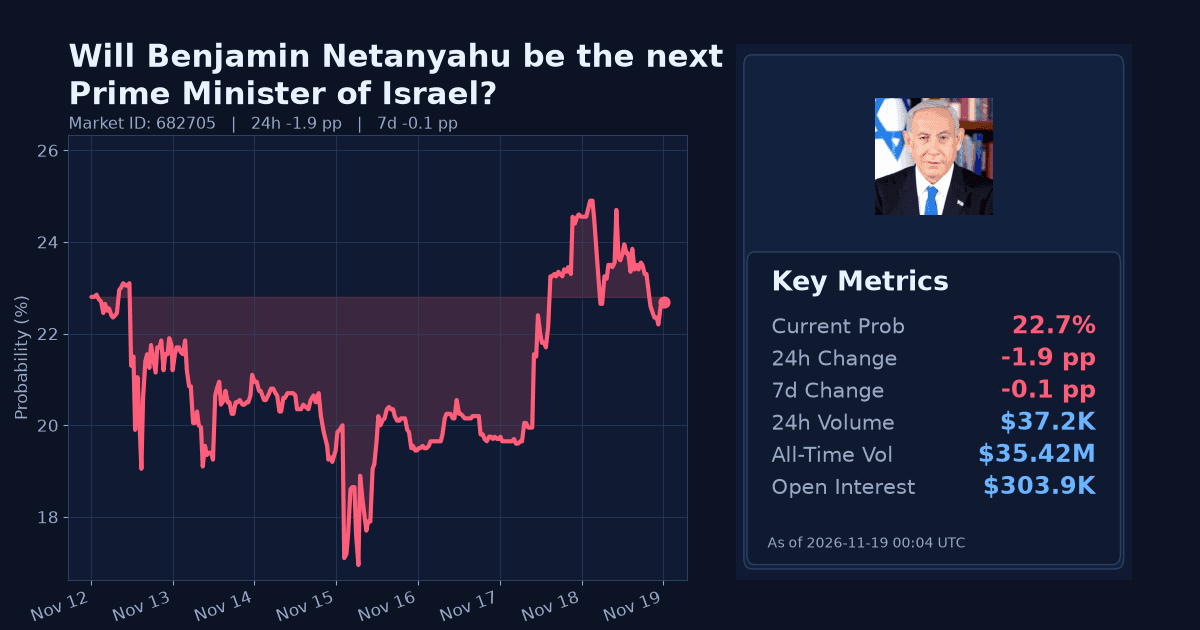
The market moved down over the latest session. Netanyahu is still priced as a material contender, but the observed move was a short-term negative repricing rather than a broad weekly collapse.
Why It Likely Moved
- The repricing appears driven by new official diplomatic pressure on the current Israeli government over settlement policy, especially Australia’s November 18 announcement that it sanctioned three individuals and four entities linked to settlement activity.
- Markets reacted to language from Australia’s foreign minister directly tying settlement expansion to the “current Israeli Government” and saying Australia would continue targeted measures against those involved in the settlement enterprise.
- The move also follows coordinated UK action. The UK government announced on November 17 that it had imposed sanctions on companies involved in expanding illegal West Bank settlements and on a group blocking aid access into Gaza.
- Australia’s foreign minister said the timing was connected to pending E1 settlement decisions due on November 19 by the caretaker Israeli government, which may have sharpened focus on Netanyahu-linked governance risk without providing direct evidence about election mechanics.
- Broader market conditions were not Israel-specific but were risk-sensitive: the VIX stood at 24.56 and was up 40.4% over seven days, supporting a backdrop in which political-risk contracts may be more reactive to official policy signals.
How Strong the Move Is
This was a significant one-day downside spike. The 24-hour change was -1.85 percentage points, and the 24-hour z-score was 9.6, which the supplied market data classifies as an extreme downward move relative to this contract’s recent trading history.
The weekly signal is much weaker. The seven-day change was only -0.1 percentage points, with a 7-day z-score of 0.2076, classified as normal. That combination points to an isolated short-term repricing rather than a confirmed trend continuation.
Cross-Market Confirmation
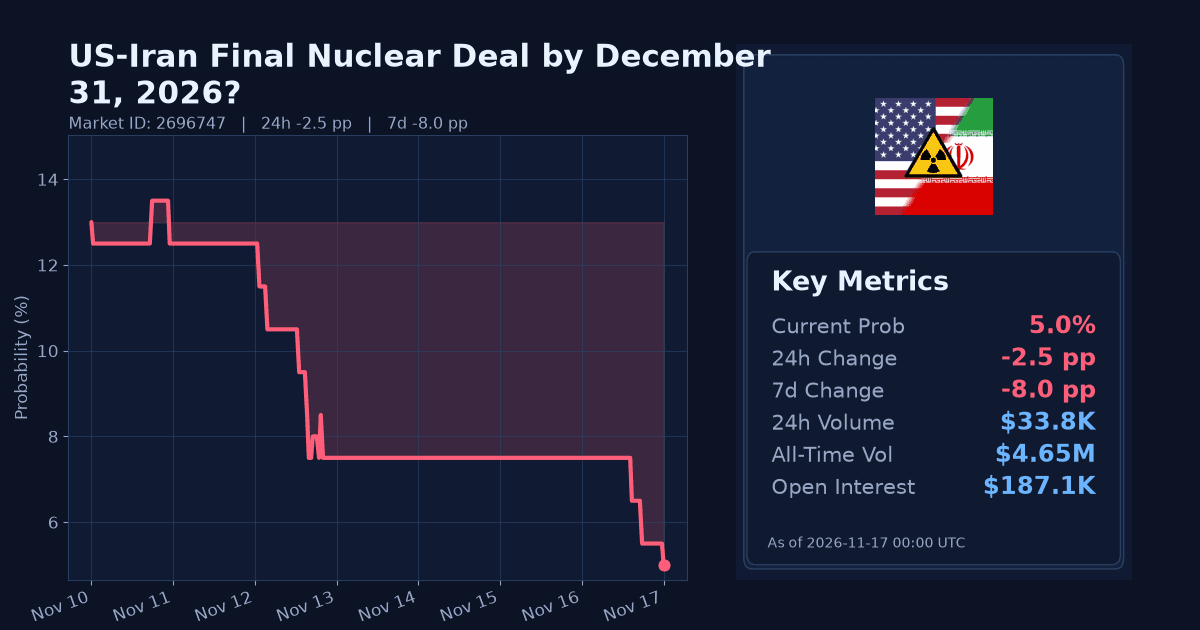
- The “Iran leadership change by December 31?” market also moved lower, with delta_24h at -2.0 percentage points. This aligns directionally with lower near-term pricing in a regional leadership-change market, though it is not Israel-specific.
- The “Iran leadership change by November 30?” contract also softened, with delta_24h at -0.9 percentage points and delta_7d at -0.7 percentage points. That is a partial cross-market confirmation of lower political-transition pricing.
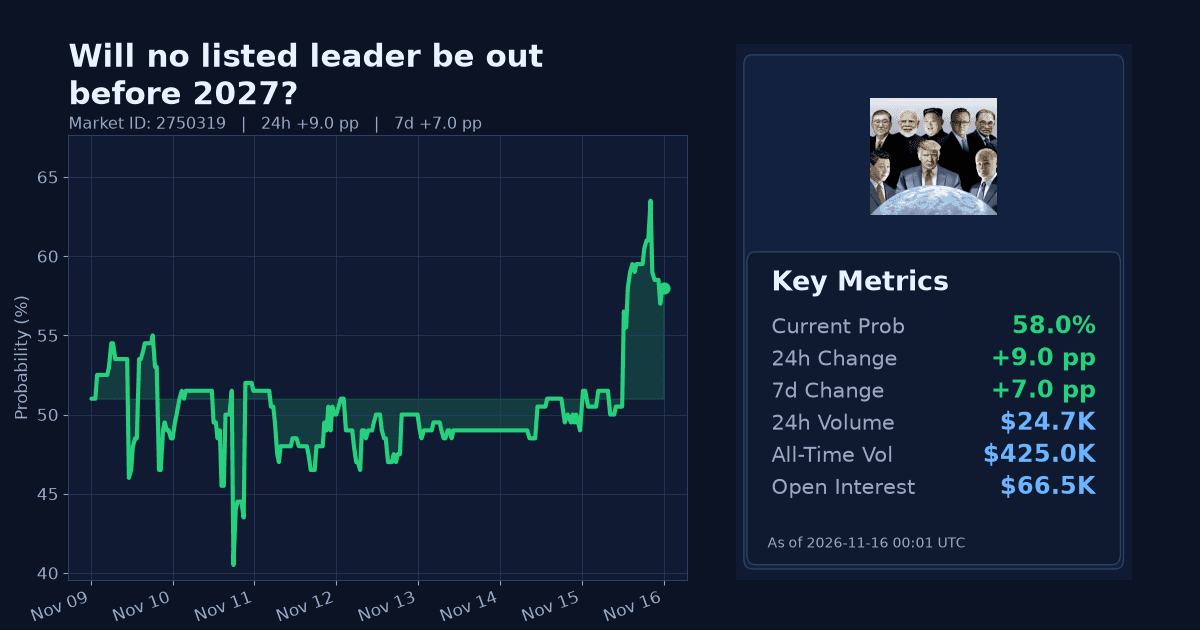
- The “Trump out as President before 2027?” market was nearly flat over 24 hours at -0.1 percentage points and slightly higher over seven days at +0.05 percentage points. That diverges from the main move on the weekly horizon and does not confirm a broad leadership-risk selloff.
News & Real-World Context
Official government material is the clearest real-world signal in the supplied evidence. On November 18, the Australian government said it had sanctioned three individuals and four entities, including a construction company, over settlement activity, and Foreign Minister Penny Wong stated that settlements are illegal under international law and contrary to a two-state outcome, according to the Australian foreign minister’s doorstop transcript. In a separate November 17 interview, Wong said the sanctions were coordinated with the United Kingdom and came ahead of final decisions on the E1 settlement by the caretaker Israeli government on November 19, according to the Australian foreign minister’s ABC interview.
The UK government also provided an official policy signal. On November 17, the UK government announced sanctions on companies building settlements in the West Bank and groups blocking aid access into Gaza. The supplied news articles did not include a directly Netanyahu-specific election report; the closest broader political-leadership item was a November 18 report that a Turkish court had imposed a political ban and prison sentence on Istanbul mayor Ekrem Imamoglu, a development in a different national context reported by Ground News.
Bottom Line
The Netanyahu market’s decline appears to be a short-term reaction to coordinated official pressure over Israeli settlement policy, not a confirmed reassessment of Israel’s post-election leadership outcome. The extreme 24-hour z-score makes the move notable, but the normal weekly reading leaves the structural direction uncertain.
Market Conditions at Time of Writing
- Current Probability (%): 22.7
- 24h Change (pp): -1.85
- 7d Change (pp): -0.1
- Volume (24h, $): 37,173.14
- Open Interest ($): 303,872.8
- Spread (pp): 0.1
- Z-score (24h): 9.6