What Moved the Market
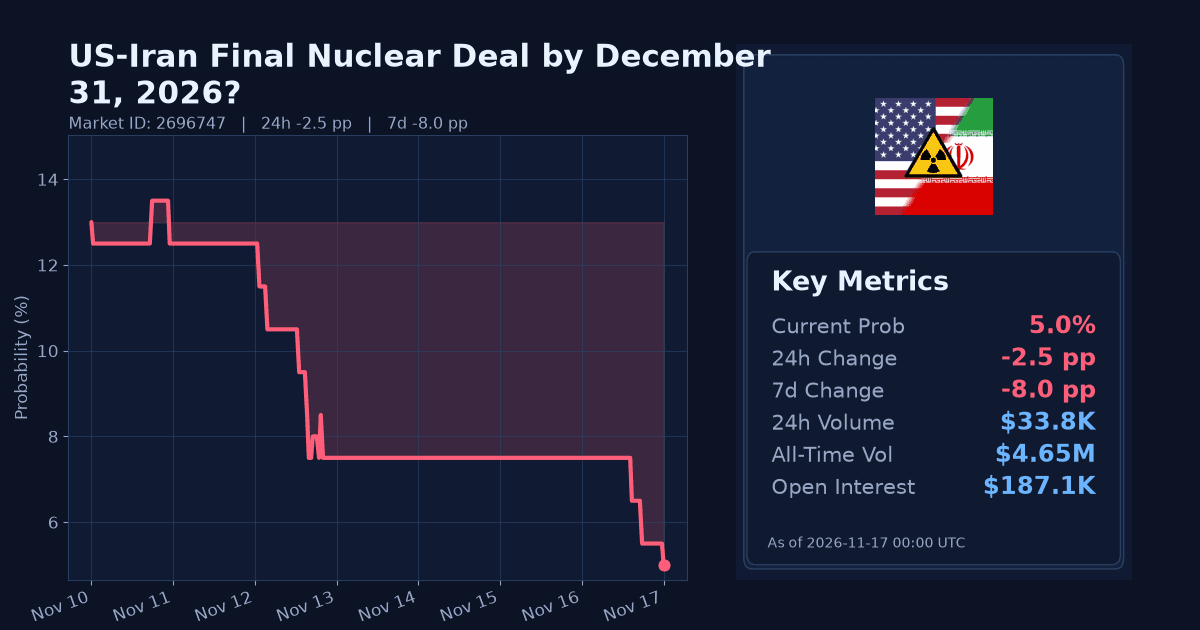
Polymarket traders marked down the contract asking whether the United States and Iran will sign or formally adopt a qualifying final nuclear deal by December 31, 2026. The market opened on June 26, 2026 and resolves against a specific year-end deadline: a written instrument must be mutually signed or formally adopted by both governments by 11:59 PM ET on December 31, 2026.
At the time of writing on November 17, the market was trading at a low single-digit probability after falling over both the past day and the past week. The move was directional and consistent: traders reduced the implied chance that a final, measurable nuclear agreement will be completed within the contract window.
Why It Likely Moved
- The repricing appears driven by deadline pressure. With the contract window ending on December 31, traders have less time to price in a qualifying final agreement that meets the market’s detailed requirements for a written, mutually accepted instrument.
- Markets reacted to the absence, in the supplied official context, of a direct US or Iranian announcement confirming signature, adoption, or release of a qualifying nuclear instrument.
- The move appears reinforced by weakness across related US-Iran markets, suggesting the repricing was not isolated to this contract.
- Official foreign-affairs signals in the provided context point to broader security and diplomatic activity, but not to a concrete US-Iran final nuclear deal. That limits positive confirmation for this market’s resolution criteria.
- Macro risk conditions may have added a cautious backdrop: the VIX stood at 22.91 and was up 15.0% over seven days, while the US Dollar Index was 103.586 and up 1.9% over the same period, according to the supplied macro data.
How Strong the Move Is
The 24-hour move was an extreme downside move: the market fell 2.5 percentage points, with a 24-hour z-score of 8.0. The supplied interpretation classifies this as extreme relative to the market’s recent trading history.
The seven-day move was also extreme, with the market down 8.0 percentage points and a seven-day z-score of 28.0. Because the one-day decline aligns with the one-week direction, this reads as a significant downside trend continuation rather than normal noise or a reversal.
Cross-Market Confirmation
- The November 30 version of the US-Iran final nuclear deal market also weakened, trading at 1.4% after falling 0.2 percentage points over 24 hours and 3.85 percentage points over seven days. That confirms the direction of the main move.
- The US-Iran Hormuz Agreement by November 30 market fell to 4.4%, down 1.2 percentage points over 24 hours and 10.2 percentage points over seven days. This points to broader weakness in related US-Iran diplomatic outcomes.
- The market on whether the US announces an end of an Iranian blockade by November 30 traded at 4.7%, down 1.85 percentage points over 24 hours and 11.85 percentage points over seven days. That is directionally aligned with reduced expectations for near-term de-escalatory announcements.
News & Real-World Context
The supplied government context contains official foreign-affairs activity but no direct US-Iran nuclear-deal confirmation. On November 16, the European Parliament published a written question titled “Refusal to engage with Reza Pahlavi,” categorized as foreign affairs. Also on November 16, the UK government released a UK-Nordic-Baltic joint statement categorized under defence and foreign affairs. These are official policy signals, but neither is evidence that the United States and Iran have signed or adopted the instrument required by this market.
Recent news in the supplied context likewise does not report a qualifying nuclear agreement. On November 16, Ars Technica reported that the Trump administration was preparing a rule to restrict remote access to high-end AI chips, with the Commerce Department saying the change was meant to close a loophole used by rivals including Iran. TechCrunch separately reported an interim rule tightening export controls on AI chips for restricted countries. These articles are relevant as broader US national-security posture, but they do not provide evidence of progress toward the market’s required final nuclear instrument.
Bottom Line
The market move reflects a sharp downgrade in expectations for a qualifying US-Iran final nuclear deal before the December 31, 2026 deadline. The decline is supported by weakness in related markets and by the lack of supplied official evidence of a signed or adopted agreement. The move appears structural within the remaining contract window, though the final outcome remains dependent on any future official US or Iranian announcement.
Market Conditions at Time of Writing
- Current Probability (%): 5.0
- 24h Change (pp): -2.5
- 7d Change (pp): -8.0
- Volume (24h, $): 33,810.14
- Open Interest ($): 187,113.01
- Spread (pp): 1.0
- Z-score (24h): 8.0