
Ras Tanura Terminal
A major Saudi oil export terminal on the Persian Gulf
Ras Tanura Terminal is a major Saudi oil export facility on the Persian Gulf, serving as a key outlet for Saudi crude exports and a critical node in the global petroleum supply chain.
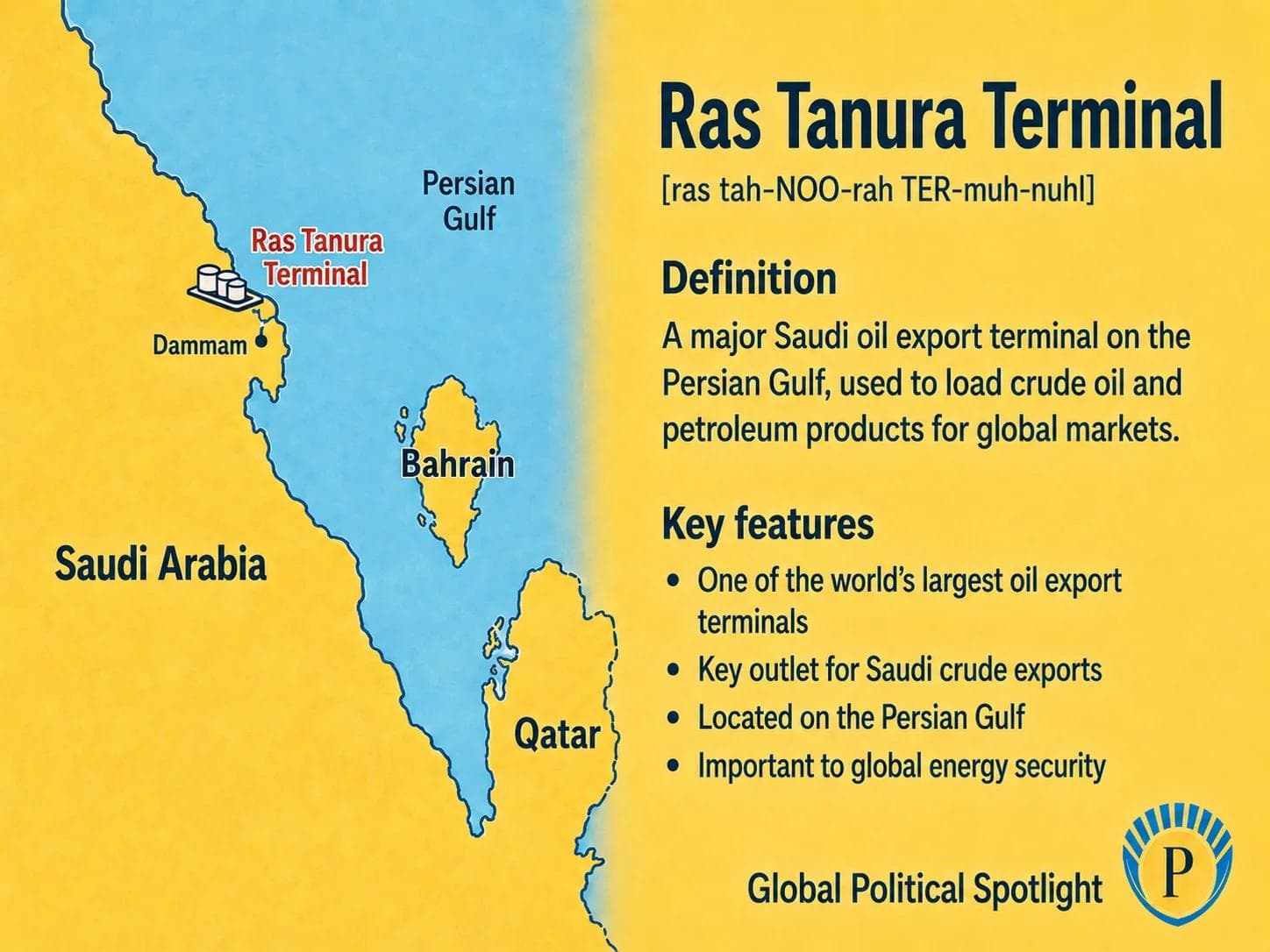
Definition
Ras Tanura Terminal is a major oil export terminal located on Saudi Arabia's eastern coast along the Persian Gulf. It is closely associated with Saudi Aramco's crude oil export system and the Kingdom's role as one of the world's most important oil producers.
The terminal functions as a large-scale maritime outlet where crude oil and petroleum products can be stored, processed for export logistics, and loaded onto tankers bound for global markets.
Why It Matters
Ras Tanura matters because it sits at the intersection of Saudi oil production, Gulf shipping routes, and global energy demand. Disruptions to major export infrastructure in this area can affect oil market expectations, tanker flows, and energy security planning.
Its location on the Persian Gulf also makes it strategically relevant to maritime security, regional tensions, and the protection of critical energy infrastructure near one of the world's most important oil transit regions.
GPS should watch Ras Tanura Terminal as a critical energy infrastructure node linking Saudi production capacity to global oil markets. Its relevance rises when analysis involves Gulf maritime security, energy price risk, tanker flows, attacks on oil infrastructure, Saudi export policy, or broader Persian Gulf stability.
Key Facts
- Type
- Major oil export terminal
- Location
- Ras Tanura, eastern Saudi Arabia, on the Persian Gulf
- Operator context
- Closely associated with Saudi Aramco's export and petroleum infrastructure network
- Strategic role
- Key maritime outlet for Saudi crude oil exports
- Market relevance
- Important to global oil supply, tanker routes, and petroleum trade flows
- Regional setting
- Located near major Persian Gulf shipping lanes and broader Gulf energy infrastructure
- Security relevance
- Critical infrastructure whose disruption could influence oil markets and regional security calculations
- Core vulnerability
- Exposure to maritime security risks, regional conflict, infrastructure attacks, market shocks, and operational bottlenecks
FAQ
What is Ras Tanura Terminal?
Ras Tanura Terminal is a major Saudi oil export terminal on the Persian Gulf. It serves as an important maritime outlet for Saudi crude oil and petroleum exports.
Why is Ras Tanura Terminal important?
It is important because it connects Saudi oil production to global markets. As a major export terminal, it plays a central role in tanker loading, petroleum trade, and global energy security.
Where is Ras Tanura Terminal located?
Ras Tanura Terminal is located on Saudi Arabia's eastern coast along the Persian Gulf, near major Gulf oil infrastructure and shipping routes.
Who operates Ras Tanura Terminal?
The terminal is part of Saudi Arabia's oil export infrastructure and is closely associated with Saudi Aramco, the state-owned energy company responsible for much of the Kingdom's oil production and export system.
How does Ras Tanura affect global oil markets?
Because it is a major export point for Saudi crude, disruptions or security concerns around Ras Tanura can influence market perceptions of supply risk, tanker flows, and oil price volatility.
What are the main risks to Ras Tanura Terminal?
Key risks include regional conflict, attacks on energy infrastructure, maritime insecurity in the Persian Gulf, operational disruptions, and wider geopolitical tensions affecting Saudi oil exports.
Sources6 references
- Saudi Aramco
Official source for Saudi Aramco's oil production, export infrastructure, and energy operations.
- U.S. Energy Information Administration - Saudi Arabia
Institutional energy analysis on Saudi Arabia's oil sector, production, exports, and global energy role.
- U.S. Energy Information Administration - World Oil Transit Chokepoints
Reference context on Persian Gulf oil transit routes and global energy chokepoints.
- International Energy Agency
Energy profile and broader context on Saudi Arabia's role in global energy markets.
- Encyclopaedia Britannica - Ras Tanura
Reference background on Ras Tanura's location and importance as a petroleum center.
- CIA World Factbook - Saudi Arabia
Reference context on Saudi Arabia's geography, economy, and regional position.

GPSNews App
Read GPSNews on iPhone
Daily geopolitical briefings, government updates, and prediction signals in one focused app.
Newsletter
Stay Ahead Of The Next Signal
Get briefings in your inbox when new analysis and reports are published.