
Taiwan
A democratically governed island central to East Asian security and global semiconductor supply chains
Taiwan is a self-governing island in East Asia officially governed by the Republic of China, claimed by the People's Republic of China, and central to regional security, U.S.-China tensions, and global technology supply chains.
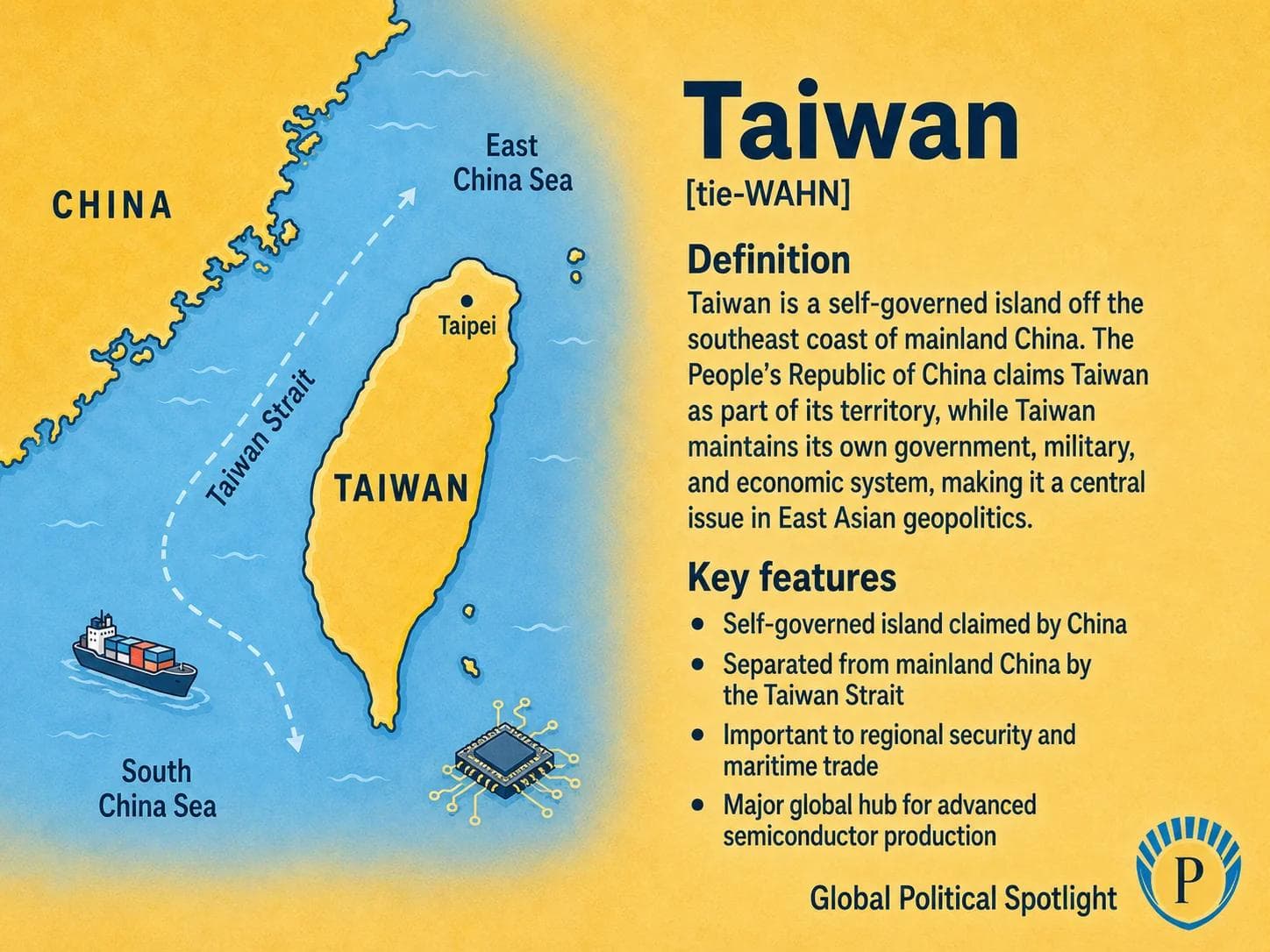
Definition
Taiwan is an island in the western Pacific, located across the Taiwan Strait from mainland China and near Japan's Ryukyu Islands and the northern Philippines. It is governed by the Republic of China, with its own elected government, military, currency, courts, and institutions.
The People's Republic of China claims Taiwan as part of its territory and opposes formal Taiwanese independence. Many states maintain unofficial relations with Taipei while recognizing Beijing diplomatically, making Taiwan's international status one of the most consequential unresolved political questions in East Asia.
Why It Matters
Taiwan matters because it sits at the intersection of sovereignty, deterrence, democracy, alliance politics, maritime access, and U.S.-China strategic competition. A major crisis around Taiwan would affect regional security across the western Pacific and could involve several major military powers.
Taiwan is also central to global technology supply chains, especially advanced semiconductor manufacturing. Disruption around the island could affect electronics, artificial intelligence infrastructure, automotive production, defense systems, and broader global markets.
GPS should track Taiwan as a core flashpoint in U.S.-China competition where sovereignty claims, deterrence, maritime geography, democratic governance, semiconductor supply chains, and alliance credibility intersect. Key watchpoints include cross-strait military activity, U.S. and allied policy statements, Taiwan elections and domestic political alignment, Chinese legal and military signaling, semiconductor export controls, and resilience planning by global technology firms.
Key Facts
- Type
- Self-governing island with disputed international status
- Location
- Western Pacific, across the Taiwan Strait from mainland China
- Government
- Governed by the Republic of China with elected national institutions
- Primary actors
- Taiwan, People's Republic of China, United States, Japan, and regional partners
- Core dispute
- Beijing claims Taiwan as part of China; Taiwan is self-governed and has not been ruled by the People's Republic of China
- Strategic geography
- Part of the first island chain, near key sea lanes linking Northeast Asia, Southeast Asia, and the wider Pacific
- Economic relevance
- Major hub for advanced semiconductor manufacturing and electronics supply chains
- Security relevance
- A central issue in U.S.-China deterrence, regional military planning, and Indo-Pacific alliance politics
FAQ
What is Taiwan?
Taiwan is a self-governing island in East Asia governed by the Republic of China. It has its own elected government, military, courts, currency, and public institutions, but its international status is disputed.
Why is Taiwan disputed?
The People's Republic of China claims Taiwan as part of its territory, while Taiwan is governed separately and has not been controlled by the PRC. The dispute reflects unresolved outcomes of the Chinese civil war, competing sovereignty claims, and modern cross-strait politics.
Is Taiwan a country?
Taiwan functions like a state in many practical ways, with its own government, military, laws, and economy. However, its formal diplomatic recognition is limited because many countries recognize the People's Republic of China and maintain unofficial relations with Taiwan.
Why does Taiwan matter to the United States and China?
For China, Taiwan is tied to sovereignty, national identity, and military strategy. For the United States, Taiwan is connected to deterrence, regional balance of power, democratic partners, semiconductor supply chains, and credibility with Indo-Pacific allies.
Why are semiconductors important to Taiwan's geopolitics?
Taiwan is a major producer of advanced semiconductors used in smartphones, data centers, artificial intelligence systems, vehicles, and defense technologies. This gives Taiwan major economic importance and makes crisis scenarios around the island globally significant.
What is the Taiwan Strait?
The Taiwan Strait is the body of water separating Taiwan from mainland China. It is a strategic maritime corridor and a central area for military signaling, naval activity, and crisis management between China, Taiwan, and outside powers.
Recent Developments
Taiwan held presidential and legislative elections
Taiwan held national elections in January 2024, reinforcing the island's democratic political process while keeping cross-strait policy, defence, economic resilience, and relations with China and the United States at the center of the political agenda.
Taiwan Central Election CommissionThe G7 emphasized peace and stability across the Taiwan Strait
G7 foreign ministers reiterated that peace and stability across the Taiwan Strait are important to international security and prosperity, reflecting the dispute's continuing relevance for major industrial democracies and Indo-Pacific policy.
G7 Foreign MinistersSources6 references
- Taiwan Ministry of Foreign Affairs
Official Taiwan foreign ministry source for Taiwan's diplomatic position, international partnerships, and government statements.
- People's Republic of China Taiwan Affairs Office
Official PRC source for Beijing's policy position on Taiwan and cross-strait affairs.
- U.S. Department of State
Official U.S. background on relations with Taiwan and the framework for unofficial U.S.-Taiwan ties.
- American Institute in Taiwan
Text and background on the Taiwan Relations Act, a central legal framework for U.S. policy toward Taiwan.
- Taiwan Central Election Commission
Official source for Taiwan election administration and results.
- Congressional Research Service
Reference overview of Taiwan, U.S.-Taiwan relations, and cross-strait policy issues.

GPSNews App
Read GPSNews on iPhone
Daily geopolitical briefings, government updates, and prediction signals in one focused app.
Newsletter
Stay Ahead Of The Next Signal
Get briefings in your inbox when new analysis and reports are published.