
Senkaku / Diaoyu Islands
Uninhabited East China Sea islands disputed by Japan, China, and Taiwan
The Senkaku / Diaoyu Islands are uninhabited East China Sea islands administered by Japan and claimed by China and Taiwan, making them a persistent flashpoint in maritime sovereignty, resources, and regional security.
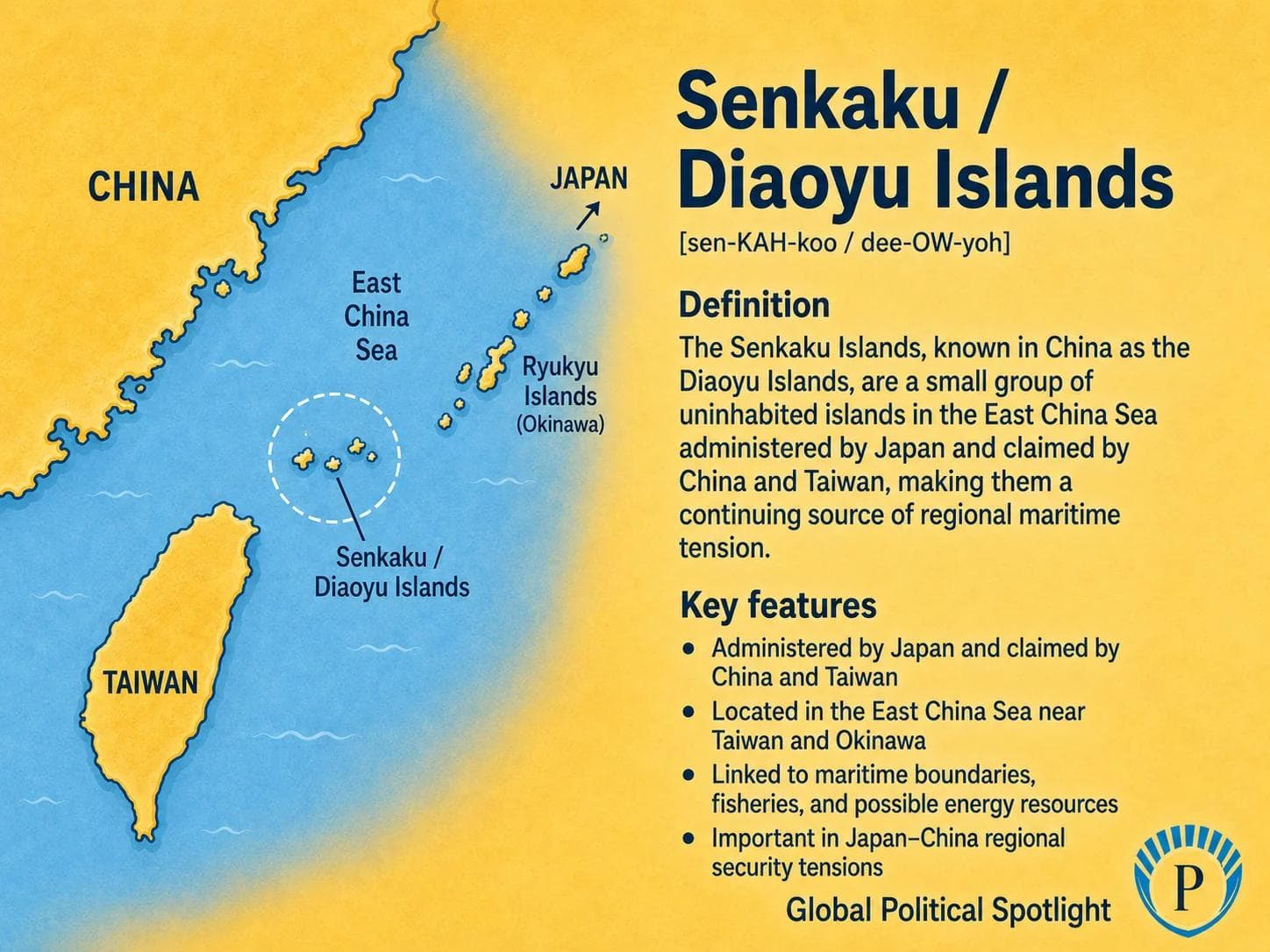
Definition
The Senkaku / Diaoyu Islands are a small group of uninhabited islands and rocks in the East China Sea, located northeast of Taiwan, west of Japan's Okinawa Prefecture, and east of mainland China. Japan administers the islands and refers to them as the Senkaku Islands, while China calls them the Diaoyu Dao and Taiwan calls them the Diaoyutai Islands.
The dispute is rooted in competing historical and legal claims over sovereignty, as well as the islands' potential implications for maritime zones, fisheries, seabed resources, and military access. The islands are not permanently inhabited, but surrounding waters are frequently patrolled by coast guard and maritime law enforcement vessels.
Why It Matters
The Senkaku / Diaoyu Islands matter because they sit at the center of a maritime sovereignty dispute between major East Asian powers. Incidents involving patrol vessels, fishing boats, aircraft, or naval activity can raise tensions between Japan and China and affect wider regional deterrence.
The dispute also matters because Japan is a U.S. treaty ally. The United States has stated that the islands fall within the scope of Article V of the U.S.-Japan Security Treaty because they are under Japanese administration, while taking no position on ultimate sovereignty.
GPS should track the Senkaku / Diaoyu Islands as a persistent East China Sea flashpoint where sovereignty claims, coast guard operations, U.S.-Japan alliance commitments, Chinese maritime pressure, Taiwanese claims, fisheries, and maritime law overlap. Key watchpoints include Chinese coast guard activity near the islands, Japan Coast Guard responses, U.S.-Japan security statements, crisis communication mechanisms, air and maritime encounters, and broader East China Sea military posture.
Key Facts
- Type
- Uninhabited disputed island group
- Location
- East China Sea, northeast of Taiwan, west of Okinawa, and east of mainland China
- Japanese name
- Senkaku Islands
- Chinese name
- Diaoyu Dao
- Taiwanese name
- Diaoyutai Islands
- Current administration
- Administered by Japan as part of Okinawa Prefecture; claimed by China and Taiwan
- Security relevance
- Recurring focus of Japan-China coast guard activity, maritime patrols, airspace monitoring, and alliance signaling
- Strategic relevance
- Linked to East China Sea maritime zones, fisheries, possible seabed resources, regional deterrence, and U.S.-Japan security commitments
FAQ
What are the Senkaku / Diaoyu Islands?
They are a small group of uninhabited islands and rocks in the East China Sea. Japan administers them as the Senkaku Islands, while China claims them as Diaoyu Dao and Taiwan claims them as the Diaoyutai Islands.
Why are the Senkaku / Diaoyu Islands disputed?
The dispute reflects competing historical and legal claims over sovereignty. The islands also matter because sovereignty can affect surrounding maritime zones, fisheries, possible seabed resources, and security control in the East China Sea.
Who controls the Senkaku / Diaoyu Islands today?
Japan administers the islands, but China and Taiwan both claim sovereignty. The dispute is managed through patrols, diplomatic statements, and security signaling rather than permanent civilian settlement.
Why do the islands matter for U.S.-Japan relations?
The United States says the islands fall within the scope of Article V of the U.S.-Japan Security Treaty because they are under Japanese administration. This makes the dispute relevant to alliance credibility and regional deterrence, even though Washington does not take a position on final sovereignty.
Are the Senkaku / Diaoyu Islands inhabited?
No. The islands are uninhabited. Their importance comes from sovereignty claims, surrounding waters, maritime enforcement, fisheries, possible resources, and their location in a strategically sensitive sea.
How does the dispute affect East China Sea security?
The dispute creates regular points of contact between Japanese and Chinese coast guard vessels, aircraft, and maritime law enforcement forces. Miscalculation or escalation around the islands could affect Japan-China relations and wider Indo-Pacific security.
Recent Developments
Japan nationalized several of the islands
Japan's purchase of three privately held islands in the Senkaku group became a major turning point in the modern dispute, triggering heightened diplomatic tension with China and more regular Chinese maritime patrol activity near the islands.
Japan Ministry of Foreign AffairsThe United States reaffirmed treaty coverage for the islands
The United States reiterated that Article V of the U.S.-Japan Security Treaty applies to the Senkaku Islands because they are under Japanese administration, while continuing to state that it does not take a position on ultimate sovereignty.
U.S. Department of StateSources6 references
- Japan Ministry of Foreign Affairs
Official Japanese government overview of Japan's position on the Senkaku Islands.
- People's Republic of China Ministry of Foreign Affairs
Official Chinese foreign ministry material presenting China's position on Diaoyu Dao.
- Republic of China Ministry of Foreign Affairs
Official Taiwan source outlining the Republic of China's position on the Diaoyutai Islands.
- U.S. Department of State
Official U.S. background on the U.S.-Japan security relationship, relevant to alliance commitments connected to the islands.
- Congressional Research Service
Reference overview of the Senkaku Islands dispute and its relevance to U.S. policy.
- Japan Coast Guard
Official Japan Coast Guard source for maritime safety and law enforcement context around Japanese-administered waters.

GPSNews App
Read GPSNews on iPhone
Daily geopolitical briefings, government updates, and prediction signals in one focused app.
Newsletter
Stay Ahead Of The Next Signal
Get briefings in your inbox when new analysis and reports are published.