
Bosphorus and Dardanelles Straits
Strategic Turkish straits linking the Black Sea to the Mediterranean route
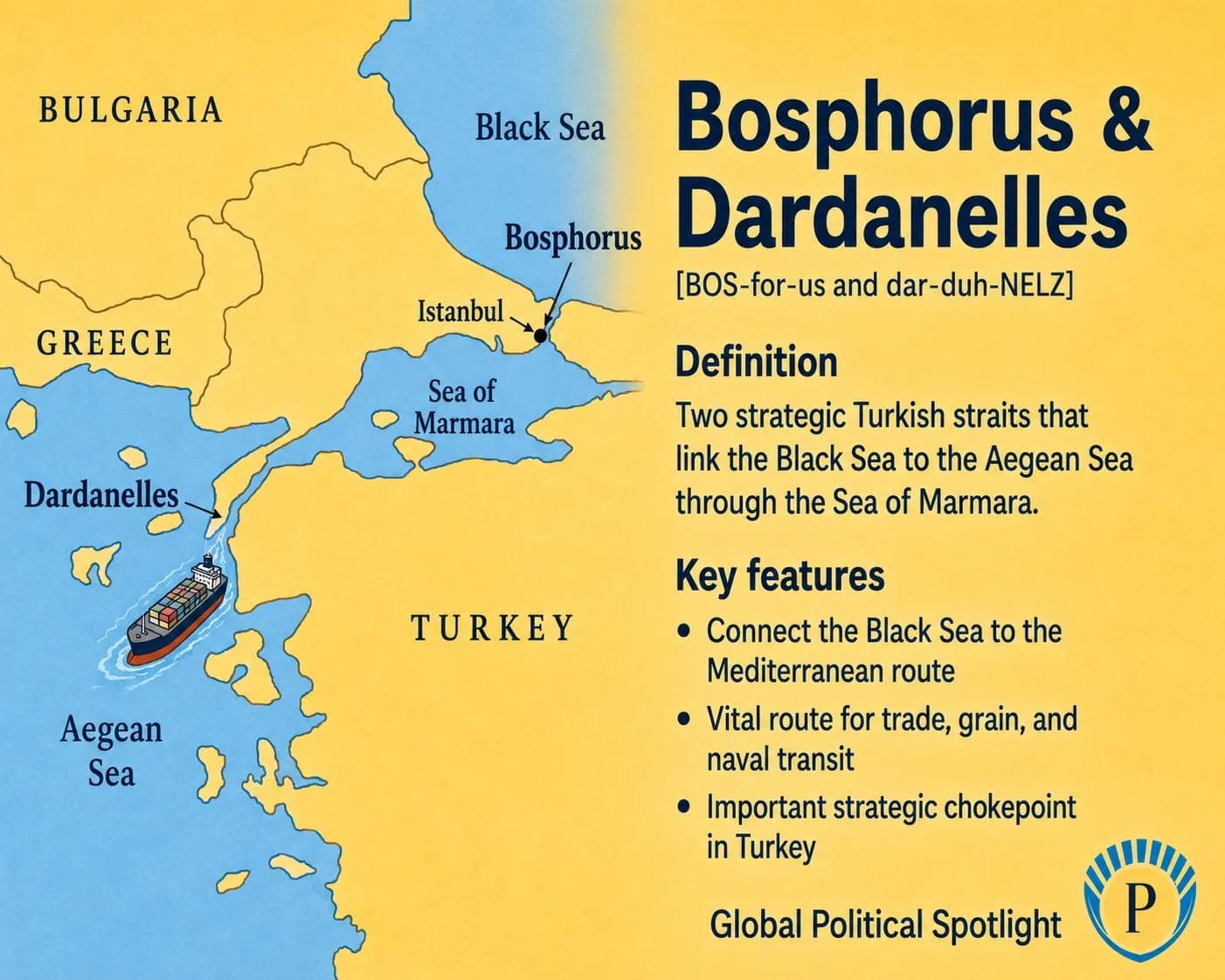
The Bosphorus and Dardanelles are Turkish straits that connect the Black Sea to the Aegean Sea through the Sea of Marmara, making them vital routes for trade, grain exports, energy flows, and naval transit.
Definition
The Bosphorus and Dardanelles are two narrow Turkish straits that form the only maritime passage between the Black Sea and the Mediterranean route. The Bosphorus links the Black Sea to the Sea of Marmara, while the Dardanelles links the Sea of Marmara to the Aegean Sea.
Together with the Sea of Marmara, the straits are often described as the Turkish Straits. Their legal and strategic importance is shaped by geography, Turkish sovereignty, commercial shipping, and the Montreux Convention, which regulates naval passage through the straits.
Why It Matters
The straits matter because they are the Black Sea's maritime gateway to wider global trade routes. Grain exports, energy-linked cargoes, container traffic, and other commercial shipping depend on predictable access through these waterways.
They also matter for security because naval access to and from the Black Sea is politically sensitive. Turkey's role as the coastal state gives it a central position in balancing treaty obligations, regional security, NATO interests, Russian access, Ukrainian trade routes, and commercial navigation.
GPS should watch the Bosphorus and Dardanelles as enduring indicators of Black Sea security, Turkish strategic leverage, maritime trade resilience, grain export routes, and the interaction between commercial navigation and naval access under the Montreux Convention.
Key Facts
- Type
- Strategic maritime straits and chokepoints
- Location
- Turkey, between the Black Sea, Sea of Marmara, and Aegean Sea
- Main route
- Black Sea to Mediterranean maritime system
- Components
- Bosphorus, Sea of Marmara, and Dardanelles
- Legal framework
- Montreux Convention Regarding the Regime of the Straits
- Primary actor
- Turkey controls the straits as the coastal state
- Strategic role
- Controls maritime access between the Black Sea and Mediterranean route
- Market relevance
- Important for shipping, grain exports, energy-linked cargoes, and regional trade
FAQ
What are the Bosphorus and Dardanelles Straits?
They are two narrow waterways in Turkey that connect the Black Sea to the Aegean Sea through the Sea of Marmara. Together, they form the main maritime passage from the Black Sea to the Mediterranean route.
Why are the Bosphorus and Dardanelles important?
They are important because they carry commercial shipping, grain exports, energy-linked cargoes, and naval traffic. They are also the only sea route connecting Black Sea states to the wider Mediterranean maritime system.
Who controls the Bosphorus and Dardanelles?
The straits are located in Turkey, and Turkey controls them as the coastal state. Their passage regime is shaped by Turkish sovereignty and the Montreux Convention.
What is the Montreux Convention?
The Montreux Convention is a 1936 treaty that governs passage through the Turkish Straits. It protects commercial navigation in peacetime while placing rules and limits on naval vessels, especially for non-Black Sea powers.
How do the straits affect Black Sea security?
They affect Black Sea security because naval access to the Black Sea depends on passage through the Turkish Straits. This makes the straits important for Turkey, Russia, Ukraine, NATO members, and other states with maritime interests.
Are there alternatives to the Bosphorus and Dardanelles?
There is no direct maritime alternative for ships moving between the Black Sea and the Mediterranean. Land routes, pipelines, rail, or river systems can move some goods, but they do not replace the straits for large-scale sea transport.
Recent Developments
Turkey applied Montreux rules during the Russia-Ukraine war
Turkey said it would implement the Montreux Convention provisions related to wartime passage, underscoring how the straits' treaty regime remains central to Black Sea naval access and regional security.
Republic of Türkiye Ministry of Foreign AffairsBlack Sea grain route risks reinforced the straits' trade importance
Disruption around Black Sea grain exports highlighted the importance of Black Sea access routes, including the Turkish Straits, for food supply chains, shipping insurance, and regional maritime security.
United NationsSources5 references
- Republic of Türkiye Ministry of Foreign Affairs
Official Turkish source for foreign policy positions, treaty context, and statements related to the Turkish Straits.
- United Nations Treaty Collection
Institutional source for treaty records, including international agreements relevant to maritime passage and straits regimes.
- Encyclopaedia Britannica
Reference source for background on the Bosphorus, Dardanelles, Sea of Marmara, and Turkish Straits geography.
- International Maritime Organization
Institutional source for maritime safety, navigation, shipping security, and international shipping governance.
- United Nations Conference on Trade and Development
Institutional source for maritime trade, shipping, transport costs, and global supply-chain context.

GPSNews App
Read GPSNews on iPhone
Daily geopolitical briefings, government updates, and prediction signals in one focused app.
Newsletter
Stay Ahead Of The Next Signal
Get briefings in your inbox when new analysis and reports are published.