
Strait of Lombok
A deep-water Indonesian passage linking regional seas to the Indian Ocean
The Strait of Lombok is a narrow deep-water passage between Bali and Lombok in Indonesia, linking waters north of the archipelago with the Indian Ocean and serving as an alternative route for large ships.
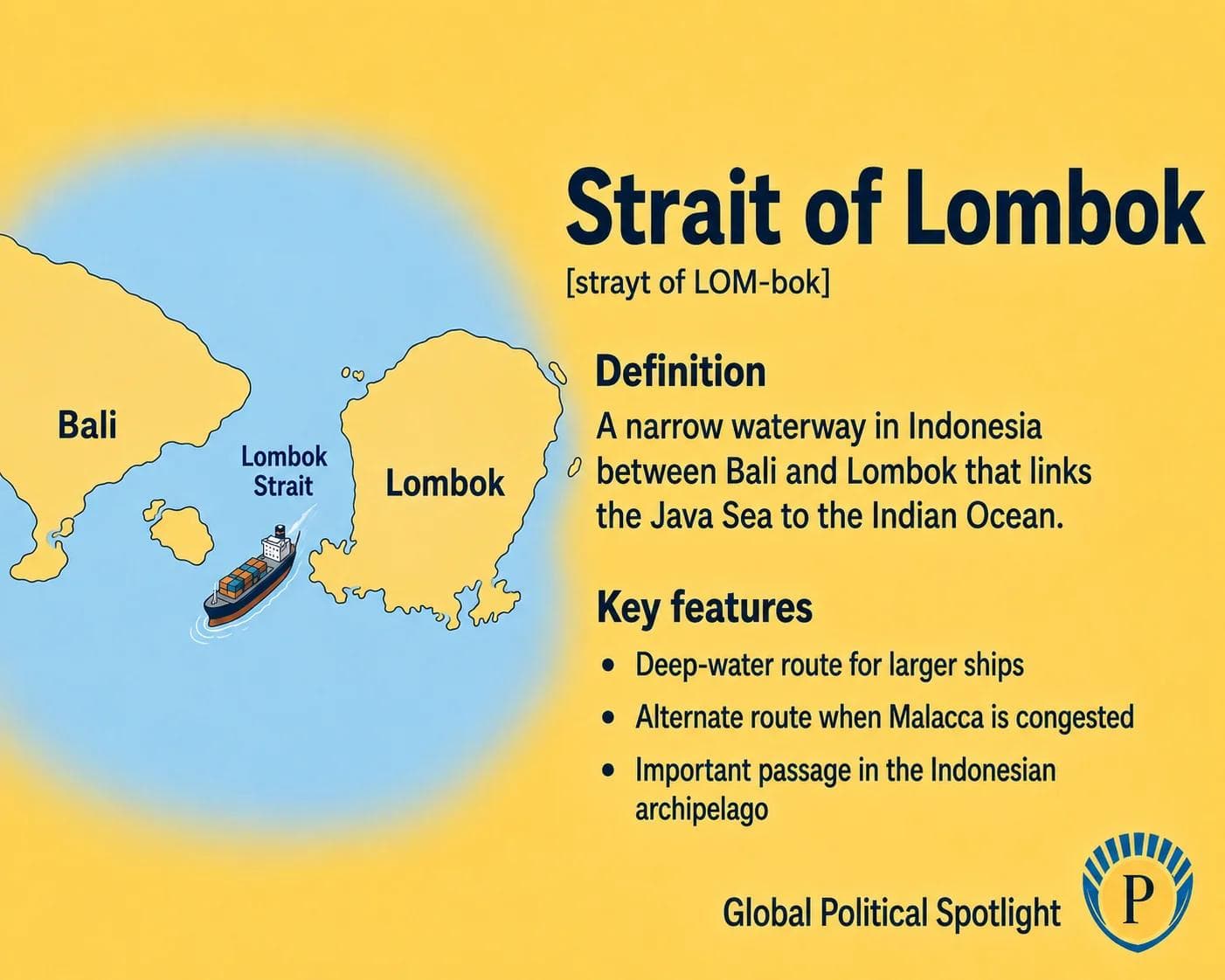
Definition
The Strait of Lombok is a maritime passage in Indonesia located between the islands of Bali and Lombok. It forms part of the Indonesian archipelago's network of sea lanes and connects waters north of the islands with the Indian Ocean.
Unlike some shallower regional passages, the Strait of Lombok is known for its deep-water profile, making it relevant for larger commercial and naval vessels that may not be able to use narrower or shallower routes as efficiently.
Why It Matters
The Strait of Lombok matters because it provides an alternative maritime route through Southeast Asia when the Malacca Strait is congested, constrained, or strategically sensitive. This gives it persistent importance for shipping resilience and naval mobility.
Its position within Indonesia also places it inside a wider geopolitical conversation about archipelagic sea lanes, freedom of navigation, maritime security, and the movement of trade between the Pacific and Indian Ocean systems.
GPS should watch the Strait of Lombok as part of the broader Indo-Pacific chokepoint system. Its relevance increases when shipping, naval planning, or regional security analysis focuses on alternatives to the Malacca Strait, Indonesian archipelagic sea lanes, and access between the Pacific and Indian Oceans.
Key Facts
- Type
- Deep-water maritime passage
- Location
- Between Bali and Lombok, Indonesia
- Connects
- Waters north of Bali and Lombok with the Indian Ocean
- Strategic role
- Alternative route for larger vessels and traffic avoiding or bypassing the Malacca Strait
- Governing state
- Indonesia
- Maritime framework
- Part of Indonesia's archipelagic sea lane geography under international maritime law
- Market relevance
- Supports redundancy in Indo-Pacific shipping routes and regional supply chains
- Core constraint
- Its importance depends on vessel size, routing economics, maritime security conditions, and regional traffic patterns
FAQ
What is the Strait of Lombok?
The Strait of Lombok is a narrow waterway in Indonesia between Bali and Lombok. It links regional waters north of the islands with the Indian Ocean and is important for maritime transit.
Why is the Strait of Lombok important?
It is important because it offers a deep-water passage for larger vessels and can function as an alternative route when the Malacca Strait is congested, constrained, or strategically sensitive.
Where is the Strait of Lombok located?
It is located in Indonesia between the island of Bali to the west and the island of Lombok to the east, within the wider Indonesian archipelago.
How does the Strait of Lombok compare with the Malacca Strait?
The Malacca Strait is one of the world's busiest shipping chokepoints, while the Strait of Lombok is generally discussed as a deeper alternative route for certain larger vessels or strategic routing needs.
Who controls the Strait of Lombok?
The strait lies within Indonesia's maritime geography. Its use is shaped by Indonesian sovereignty, international maritime law, and the rules governing archipelagic sea lanes.
What are the limits of the Strait of Lombok as a shipping route?
Although it is deep and strategically useful, it may be longer or less economically efficient for some journeys than routes through the Malacca Strait, depending on origin, destination, vessel type, fuel costs, and traffic conditions.
Sources5 references
- Encyclopaedia Britannica
Reference background on the location and geography of the Lombok Strait.
- International Maritime Organization
Institutional context for ship routing, navigation safety, and maritime passage management.
- United Nations Convention on the Law of the Sea
Legal framework relevant to archipelagic states, navigation rights, and maritime passage rules.
- CIA World Factbook - Indonesia
Reference context on Indonesia's geography and archipelagic position.
- U.S. Energy Information Administration
Reference context on global oil transit chokepoints and the role of Southeast Asian maritime routes.

GPSNews App
Read GPSNews on iPhone
Daily geopolitical briefings, government updates, and prediction signals in one focused app.
Newsletter
Stay Ahead Of The Next Signal
Get briefings in your inbox when new analysis and reports are published.