
Korean Demilitarized Zone (DMZ)
A fortified buffer zone separating North Korea and South Korea under an armistice, not a peace treaty
The Korean Demilitarized Zone is a heavily fortified buffer zone separating North Korea and South Korea near the Military Demarcation Line, created by the 1953 armistice that paused the Korean War.
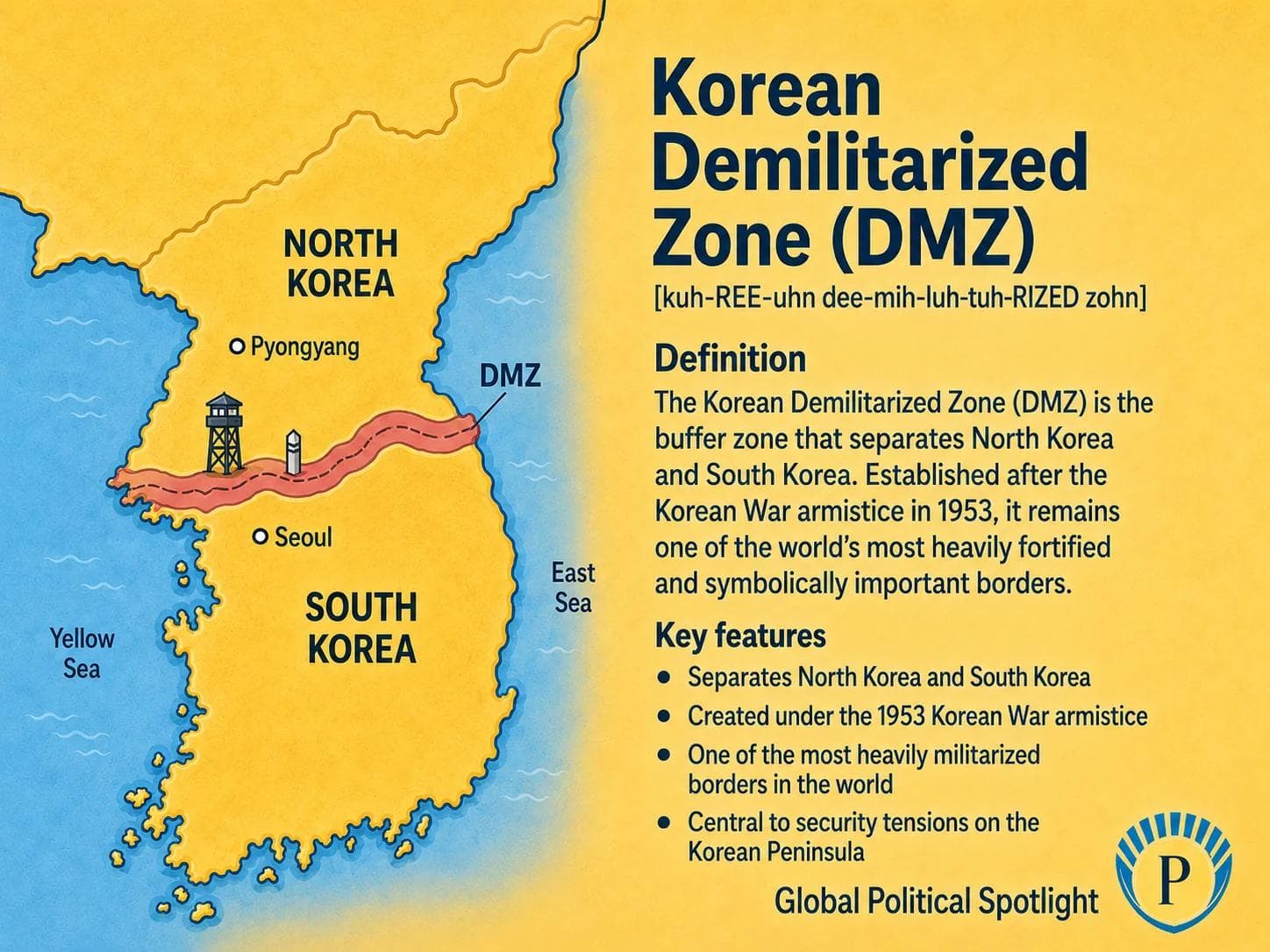
Definition
The Korean Demilitarized Zone, or DMZ, is a buffer zone that runs across the Korean Peninsula near the Military Demarcation Line separating North Korea and South Korea. It was established by the 1953 Korean Armistice Agreement, which stopped active large-scale fighting in the Korean War but did not create a final peace treaty.
Despite its name, the DMZ is one of the world's most militarized border regions because large North Korean, South Korean, and U.S.-allied forces are positioned near it. The Joint Security Area at Panmunjom is the best-known symbolic and diplomatic site inside the DMZ.
Why It Matters
The DMZ matters because the Korean War remains formally unresolved under an armistice system. The zone is a daily mechanism for deterrence, military signaling, crisis management, and separation between two states with opposing alliances and very different political systems.
It also matters because incidents near the DMZ can rapidly affect Northeast Asian security. North Korea's military posture, South Korea's readiness, U.S. alliance commitments, UN Command procedures, and diplomacy over nuclear risk all intersect around this border.
GPS should track the Korean DMZ as a durable flashpoint where armistice management, deterrence, North Korean military signaling, South Korean security policy, U.S. alliance commitments, UN Command authority, and inter-Korean diplomacy converge. Key watchpoints include changes to guard posts, border incidents, North Korean military deployments, South Korean and U.S. exercises, UN Command statements, Panmunjom diplomacy, and any movement toward or away from formal peace arrangements.
Key Facts
- Type
- Militarized buffer zone and armistice boundary
- Location
- Across the Korean Peninsula, separating North Korea and South Korea near the 38th parallel
- Legal basis
- Created by the 1953 Korean Armistice Agreement
- Core boundary
- The Military Demarcation Line runs through the center of the DMZ
- Approximate dimensions
- Roughly 250 kilometers long and about 4 kilometers wide
- Primary actors
- North Korea, South Korea, United States, United Nations Command, and allied forces on the peninsula
- Symbolic site
- Panmunjom and the Joint Security Area are key sites for armistice meetings, diplomatic symbolism, and inter-Korean contact
- Security relevance
- Deterrence, border incidents, crisis management, military readiness, and divided Korea
FAQ
What is the Korean Demilitarized Zone?
The Korean Demilitarized Zone, or DMZ, is a buffer zone separating North Korea and South Korea. It was created by the 1953 Korean Armistice Agreement and runs across the Korean Peninsula near the Military Demarcation Line.
Why is the DMZ called demilitarized if it is heavily fortified?
The DMZ itself was designed as a buffer zone with restrictions on military presence, but the areas around it are heavily fortified. Large forces, surveillance systems, artillery, and defensive positions are deployed near the zone on both sides.
Is the Korean War officially over?
No final peace treaty has ended the Korean War. The 1953 armistice stopped major fighting, but it left the peninsula divided and created an armistice system rather than a permanent peace settlement.
What is the Military Demarcation Line?
The Military Demarcation Line is the line that separates North Korean and South Korean-controlled territory inside the DMZ. The buffer zone extends on both sides of this line.
What is Panmunjom?
Panmunjom is the village area associated with the Joint Security Area inside the DMZ. It has hosted armistice meetings, inter-Korean encounters, and symbolic diplomatic events between North Korea, South Korea, the United States, and UN Command.
Why does the DMZ matter for geopolitics?
The DMZ matters because it is a front line between North Korea and South Korea, a symbol of divided Korea, and a focal point for deterrence involving North Korea, South Korea, the United States, UN Command, and wider Northeast Asian security.
Recent Developments
North Korea said it would restore military measures paused under the 2018 inter-Korean agreement
North Korea said it would restore military measures suspended under the 2018 Comprehensive Military Agreement after South Korea partially suspended the deal. The episode showed how DMZ-related confidence-building measures remain vulnerable to wider military and political tensions.
Korean Central News AgencySouth Korea fully suspended the 2018 inter-Korean military agreement
South Korea approved the full suspension of the 2018 Comprehensive Military Agreement, citing North Korean actions including balloon launches. The move underscored how border management and military restraint around the DMZ remain tied to broader inter-Korean tensions.
Republic of Korea Ministry of National DefenseSources6 references
- United Nations Command
Official UN Command source for armistice-related responsibilities and security context on the Korean Peninsula.
- United Nations Peacemaker
Official UN-hosted text of the 1953 Korean Armistice Agreement.
- Republic of Korea Ministry of National Defense
Official South Korean defense ministry source for security policy and Korean Peninsula military context.
- U.S. Forces Korea
Official source for the U.S. military presence supporting deterrence and alliance commitments on the Korean Peninsula.
- Encyclopaedia Britannica
Reference overview of the Korean Demilitarized Zone, its geography, history, and security role.
- Nuclear Threat Initiative
Reference background on North Korea's security posture and weapons programs, relevant to the broader deterrence environment around the DMZ.

GPSNews App
Read GPSNews on iPhone
Daily geopolitical briefings, government updates, and prediction signals in one focused app.
Newsletter
Stay Ahead Of The Next Signal
Get briefings in your inbox when new analysis and reports are published.