
Suwalki Gap
A narrow NATO land corridor between Kaliningrad and Belarus linking Poland and Lithuania
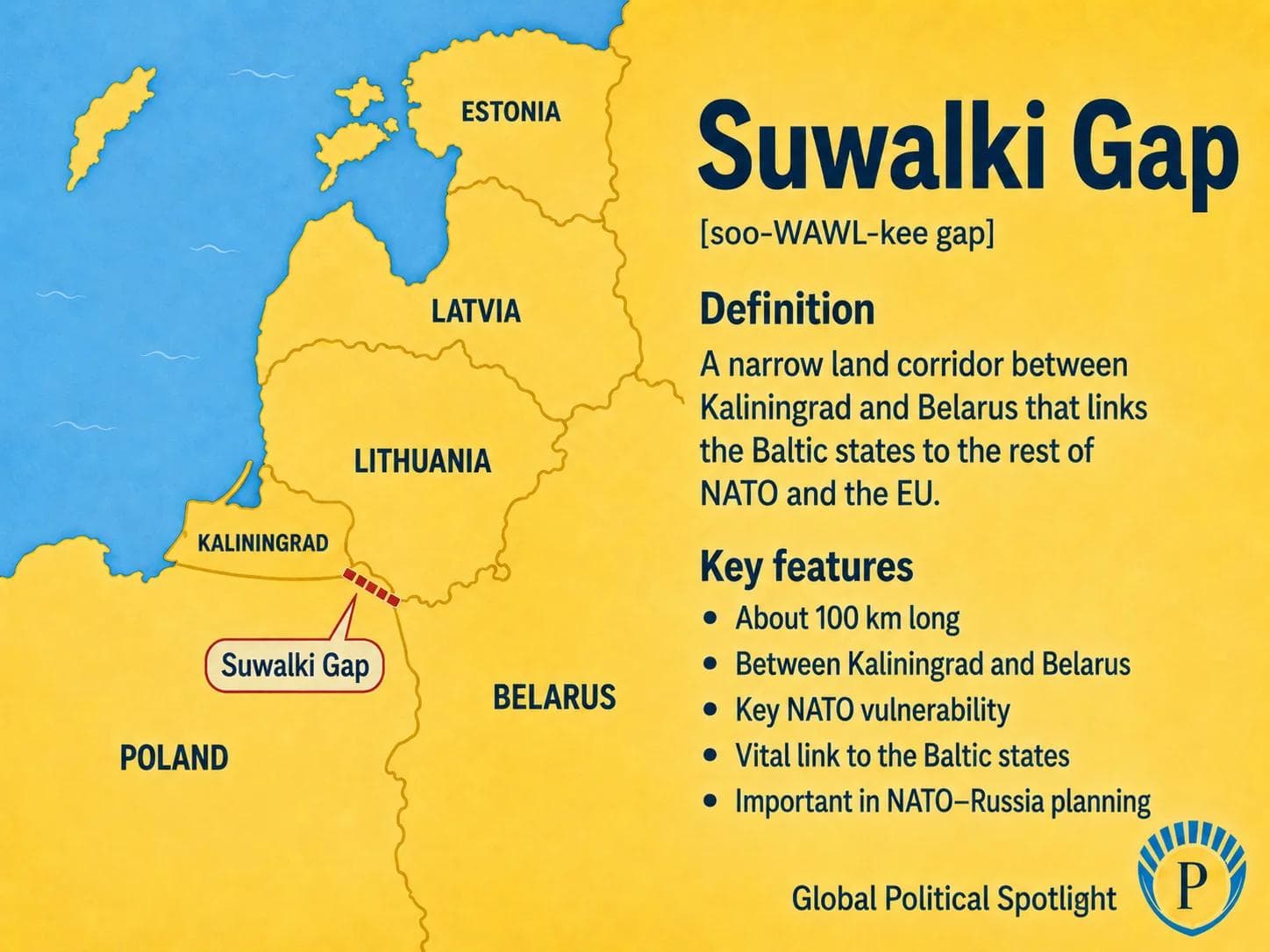
The Suwalki Gap is a narrow land corridor along the Poland-Lithuania border between Russia's Kaliningrad exclave and Belarus, linking the Baltic states to the rest of NATO and the European Union.
Definition
The Suwalki Gap is a narrow land corridor along the border between northeastern Poland and southern Lithuania. It lies between Russia's Kaliningrad exclave to the northwest and Belarus to the southeast, making it a strategically sensitive connection between the Baltic states and the rest of NATO territory.
The corridor is often discussed in NATO defense planning because Estonia, Latvia, and Lithuania depend on this land connection for military reinforcement, logistics, and overland connectivity with Poland and the broader European Union.
Why It Matters
The Suwalki Gap matters because it is a geographic vulnerability in NATO's northeastern flank. If access through the corridor were disrupted, the Baltic states could face greater difficulty receiving overland reinforcements, supplies, and equipment from the rest of the alliance.
Its strategic significance comes from its position between Kaliningrad, where Russia maintains military forces, and Belarus, a close Russian security partner. This makes the corridor central to discussions of deterrence, defense logistics, escalation risk, and NATO-Russia military planning.
GPS should watch the Suwalki Gap as a durable indicator of NATO eastern-flank vulnerability, Baltic defense planning, Polish-Lithuanian military cooperation, Russia-Belarus alignment, Kaliningrad's strategic role, and the alliance's ability to reinforce exposed member states during a crisis.
Key Facts
- Type
- Strategic land corridor
- Location
- Poland-Lithuania border region
- Approximate length
- About 100 km
- Nearby territories
- Between Kaliningrad and Belarus
- Strategic role
- Connects the Baltic states to the rest of NATO and the European Union
- Primary actors
- Poland, Lithuania, NATO, Russia, and Belarus
- Security relevance
- Central to NATO reinforcement and logistics planning for the Baltic region
- Main vulnerability
- Potential disruption could complicate overland access to Estonia, Latvia, and Lithuania
FAQ
What is the Suwalki Gap?
The Suwalki Gap is a narrow land corridor along the Poland-Lithuania border between Russia's Kaliningrad exclave and Belarus. It connects the Baltic states to the rest of NATO and the European Union.
Why is the Suwalki Gap important?
It is important because it is the main overland connection between Estonia, Latvia, Lithuania, and the rest of NATO territory. This makes it central to military reinforcement, logistics, and alliance defense planning.
Why is the Suwalki Gap considered vulnerable?
The corridor is considered vulnerable because it sits between Kaliningrad and Belarus. In a major crisis, disruption in this area could complicate NATO's ability to move forces and supplies by land to the Baltic states.
Which countries are connected to the Suwalki Gap?
The corridor lies on the border between Poland and Lithuania. Its strategic context also involves Estonia, Latvia, NATO, the European Union, Russia's Kaliningrad exclave, and Belarus.
Is the Suwalki Gap part of NATO territory?
Yes. The corridor lies between Poland and Lithuania, both of which are NATO and European Union members. Its importance comes from being a narrow NATO land link to the Baltic states.
How does the Suwalki Gap affect NATO-Russia strategy?
The Suwalki Gap affects strategy because it is a potential pressure point between NATO territory, Kaliningrad, and Belarus. It shapes deterrence planning, military exercises, logistics, and regional defense assumptions.
Recent Developments
NATO identified the eastern flank as a major deterrence priority
NATO's 2022 Strategic Concept emphasized collective defense, deterrence, and the security of allies facing Russia, reinforcing the long-term importance of vulnerable corridors such as the Suwalki Gap.
NATONATO continued strengthening regional defense planning
NATO summit decisions and regional defense planning continued to focus on deterrence, readiness, and reinforcement of the eastern flank, keeping Baltic connectivity and Polish-Lithuanian routes strategically relevant.
NATOSources5 references
- NATO
Official alliance source for NATO strategy, deterrence posture, eastern-flank defense, and summit decisions.
- NATO 2022 Strategic Concept
Official NATO strategy document outlining the alliance's security environment, collective defense priorities, and approach to Russia.
- European Union External Action Service
Institutional source for EU security policy, regional security, and European foreign policy context.
- Center for Strategic and International Studies
Think-tank source for analysis of Baltic security, NATO defense planning, and the strategic geography of the Suwalki Gap.
- RAND Corporation
Research source for military logistics, NATO deterrence, and Baltic defense analysis.

GPSNews App
Read GPSNews on iPhone
Daily geopolitical briefings, government updates, and prediction signals in one focused app.
Newsletter
Stay Ahead Of The Next Signal
Get briefings in your inbox when new analysis and reports are published.