
Suez Canal
A critical Egyptian waterway linking the Mediterranean Sea to the Red Sea and global trade routes
The Suez Canal is a man-made waterway in Egypt connecting the Mediterranean Sea with the Red Sea, allowing ships to travel between Europe and Asia without sailing around southern Africa.
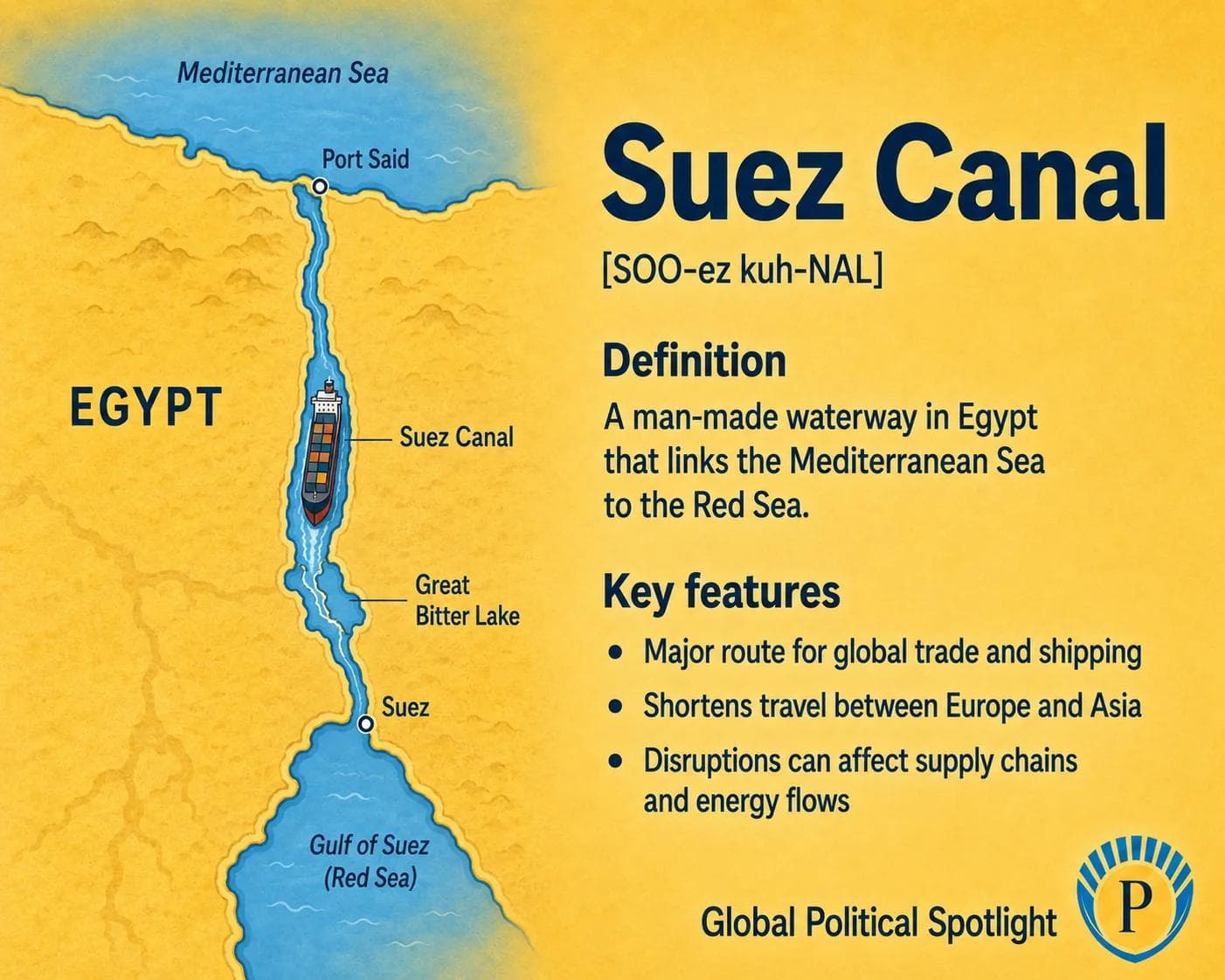
Definition
The Suez Canal is a man-made sea-level waterway in Egypt that connects the Mediterranean Sea to the Red Sea through the Isthmus of Suez. It provides a direct maritime route between Europe and Asia, avoiding the much longer journey around the Cape of Good Hope in southern Africa.
The canal is operated by Egypt through the Suez Canal Authority and is central to Egypt's strategic and economic position. Because it carries container ships, tankers, bulk carriers, and naval vessels, it links commercial logistics, energy transport, and maritime security.
Why It Matters
The Suez Canal matters because it shortens shipping routes between Europe and Asia, reducing time, fuel costs, and logistical complexity. Disruption can force vessels to reroute around Africa, delaying cargo and increasing costs for trade, energy, and consumer supply chains.
Its geopolitical importance comes from concentration risk: a narrow piece of infrastructure inside one country affects global shipping, energy flows, insurance costs, and naval planning. Control, access, security, and operational reliability are therefore watched by governments, shipping companies, and commodity markets.
GPS should watch the Suez Canal as a long-term indicator of maritime chokepoint risk, supply-chain exposure, Egyptian strategic leverage, Red Sea security dynamics, and the vulnerability of global trade routes to accidents, conflict, congestion, and regional instability.
Key Facts
- Type
- Man-made maritime canal and strategic chokepoint
- Location
- Egypt, crossing the Isthmus of Suez
- Connects
- Mediterranean Sea and Red Sea
- Strategic role
- Shortens maritime routes between Europe and Asia
- Operator
- Suez Canal Authority under the Egyptian state
- Opened
- 1869
- Market relevance
- Important for container shipping, oil, LNG, manufactured goods, and supply chains
- Main vulnerability
- Disruption can force vessels to reroute around the Cape of Good Hope
FAQ
What is the Suez Canal?
The Suez Canal is a man-made waterway in Egypt that connects the Mediterranean Sea to the Red Sea. It allows ships to move between Europe and Asia without sailing around the southern tip of Africa.
Why is the Suez Canal important?
It is important because it is one of the world's major shipping corridors. It reduces travel time, supports global supply chains, and carries trade linked to energy, manufactured goods, food, and containerized cargo.
Who controls the Suez Canal?
The Suez Canal is located in Egypt and is operated by the Suez Canal Authority. Egypt's control of the canal gives it an important role in global maritime trade and regional diplomacy.
What happens if the Suez Canal is blocked?
Ships may be delayed or forced to reroute around the Cape of Good Hope. This can increase fuel costs, insurance costs, delivery times, and uncertainty for companies that depend on predictable shipping schedules.
Are there alternatives to the Suez Canal?
The main alternative for large Europe-Asia shipping routes is sailing around the Cape of Good Hope. Rail and pipeline routes can support some trade or energy flows, but they do not fully replace the canal's maritime capacity.
How does the Suez Canal affect geopolitics?
The canal affects geopolitics by concentrating global trade through a narrow route. Its security links Egypt, the Red Sea, the Eastern Mediterranean, the Gulf, European markets, Asian exporters, and naval powers.
Recent Developments
Canal reopened after Ever Given blockage
The refloating of the Ever Given after several days of blockage highlighted how a single operational incident in the canal can affect global shipping schedules, freight rates, and supply-chain planning.
Suez Canal AuthorityRed Sea insecurity increased attention on Suez-linked routes
Attacks on commercial shipping in the Red Sea region reinforced the strategic connection between Suez Canal traffic, Bab el-Mandeb access, naval security, and global trade rerouting decisions.
International Maritime OrganizationSources5 references
- Suez Canal Authority
Official Egyptian authority responsible for canal operations, navigation rules, statistics, and infrastructure updates.
- Encyclopaedia Britannica
Reference background on the canal's geography, history, opening, and commercial role.
- U.S. Energy Information Administration
Reference source on global energy chokepoints and the canal's relevance to oil and petroleum product flows.
- International Maritime Organization
Institutional source for maritime security, shipping safety, and global shipping governance.
- World Bank
Institutional source for trade, logistics, infrastructure, and development context relevant to global shipping routes.

GPSNews App
Read GPSNews on iPhone
Daily geopolitical briefings, government updates, and prediction signals in one focused app.
Newsletter
Stay Ahead Of The Next Signal
Get briefings in your inbox when new analysis and reports are published.