
MSS
China's civilian intelligence, counterintelligence, and state security ministry
MSS is China's Ministry of State Security, the civilian intelligence and counterintelligence agency responsible for foreign intelligence, internal state security, and protecting the Chinese party-state from perceived threats.
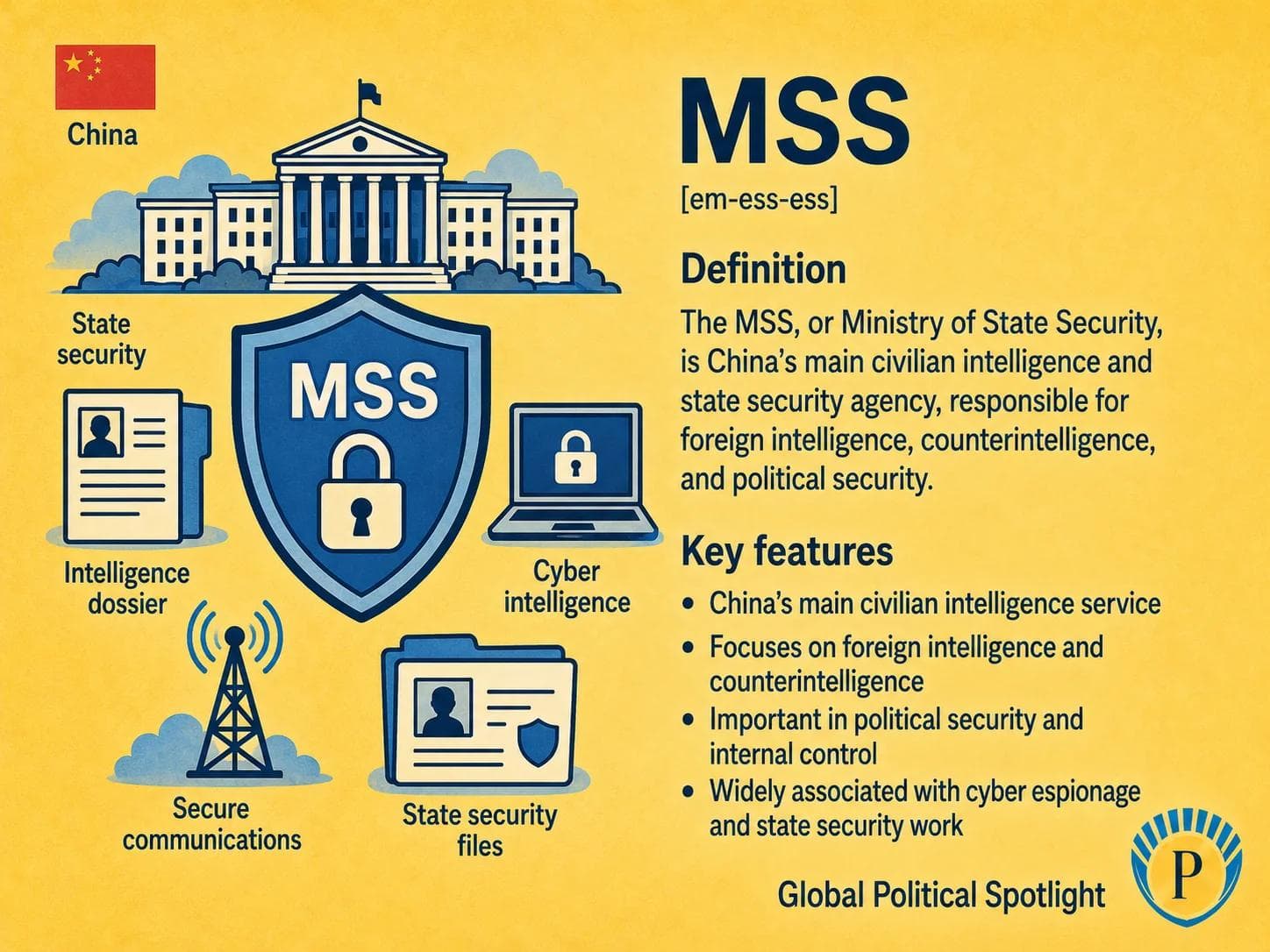
Definition
MSS, formally China's Ministry of State Security, is the country's main civilian intelligence and counterintelligence agency. It is associated with foreign intelligence collection, counterespionage, internal state security, and the protection of China's party-state system from perceived foreign and domestic threats.
The MSS operates within the People's Republic of China's broader national security architecture, which includes the Chinese Communist Party, state security organs, public security agencies, military intelligence structures, cyber authorities, and legal frameworks focused on state security and counterespionage.
Because intelligence work is secretive, many details about MSS organization and operations are not public. Foreign governments and security agencies frequently discuss MSS-linked activity in the context of espionage, cyber operations, technology acquisition, dissident monitoring, and great-power competition, while China frames state security as necessary to defend sovereignty and national development.
Why It Matters
The MSS matters because intelligence and counterintelligence are central to the strategic competition between China and other major powers. Alleged espionage, cyber intrusions, technology transfer, political influence, and protection of sensitive research can affect diplomacy, sanctions, export controls, corporate security, and alliance coordination.
The agency is also important for understanding China's party-state security model. Unlike intelligence services in systems with clearer institutional separation between ruling party and state, Chinese state security is closely linked to the Communist Party's concept of regime security, social stability, and control over sensitive information.
For geopolitics, MSS-related issues often become visible through indictments, sanctions, cyber advisories, espionage arrests, counterintelligence warnings, and disputes over technology, research security, diaspora monitoring, and foreign interference.
GPS should track the MSS as a core institution in China's intelligence and state security system, especially where foreign intelligence, counterintelligence, cyber allegations, technology security, diaspora monitoring, research protection, political influence concerns, and China-related great-power competition intersect with law, diplomacy, and alliance policy.
Key Facts
- Type
- Civilian intelligence and state security agency
- Country
- People's Republic of China
- Formal name
- Ministry of State Security
- Chinese name
- 国家安全部, commonly translated as Ministry of State Security
- Core functions
- Foreign intelligence, counterintelligence, internal state security, and protection against perceived threats to national and party-state security
- Strategic context
- Frequently discussed by foreign governments in relation to espionage, cyber activity, technology acquisition, and great-power competition
- Institutional setting
- Part of China's broader party-state security architecture, alongside public security, military, cyber, and Communist Party security structures
- Public visibility
- Often appears in public debate through foreign indictments, sanctions, cyber advisories, counterintelligence warnings, and state security campaigns
FAQ
What is the MSS?
MSS stands for China's Ministry of State Security. It is the country's main civilian intelligence and counterintelligence agency, with responsibilities linked to foreign intelligence, internal state security, and protection of the Chinese party-state from perceived threats.
Is the MSS the same as China's police?
No. The MSS is a state security and intelligence ministry. China's regular police and public order functions are mainly associated with the Ministry of Public Security, although the two systems can overlap in broader national security work.
Why does the MSS matter geopolitically?
The MSS matters because intelligence, counterintelligence, cyber activity, foreign interference concerns, and technology security are central to China's relations with the United States, Europe, regional neighbors, and other major powers.
What does the MSS do?
Publicly discussed MSS functions include foreign intelligence collection, counterespionage, protection of state secrets, internal state security, and work against perceived threats to China's national security and party-state system.
How is the MSS connected to cyber espionage concerns?
Foreign governments and cybersecurity agencies have repeatedly linked some China-related cyber and espionage cases to state-backed actors or Chinese security interests. Attribution is often politically sensitive, and specific operational details are usually based on official claims, indictments, sanctions, or cyber advisories.
What are the limits of public knowledge about the MSS?
Many details about MSS structure, personnel, budgets, operations, and authorities are not publicly available. Analysts usually rely on official Chinese laws and statements, foreign government assessments, court cases, sanctions notices, cybersecurity reports, and open-source research.
Recent Developments
Western governments attributed cyber activity to China-linked actors in a coordinated public response
The United States, United Kingdom, and other partners announced measures and public attributions related to China-linked cyber activity. The episode illustrated how alleged Chinese state security and cyber operations remain a recurring focus of allied counterintelligence, sanctions, and cyber defense policy.
U.S. Department of JusticeChina continued expanding public messaging on national security and counterespionage
Chinese authorities continued promoting public awareness around national security and counterespionage, reflecting the Chinese party-state's emphasis on internal vigilance, foreign threat monitoring, and the broadening role of state security concepts in governance.
XinhuaSources6 references
- China Law Translate - Counter-Espionage Law
Reference translation of China's revised Counter-Espionage Law, relevant to the legal environment around state security and espionage.
- National People's Congress Observer - Counter-Espionage Law
Reference coverage of China's counterespionage legislation and legal development.
- U.S. Department of Justice - China-linked cyber charges
Official U.S. government example of public attribution and legal action involving alleged China-linked cyber activity.
- UK National Cyber Security Centre - China state-affiliated cyber activity
Official UK cyber security source on public attribution of China state-affiliated cyber activity.
- Australian Security Intelligence Organisation - Annual Threat Assessment
Official Australian security assessments that discuss espionage, foreign interference, and state threats in an allied context.
- Center for Strategic and International Studies - Chinese espionage research
Think-tank reference material tracking public cases and allegations related to Chinese espionage.

GPSNews App
Read GPSNews on iPhone
Daily geopolitical briefings, government updates, and prediction signals in one focused app.
Newsletter
Stay Ahead Of The Next Signal
Get briefings in your inbox when new analysis and reports are published.