
NSA
The U.S. signals intelligence and cybersecurity agency
NSA is the U.S. National Security Agency, responsible for foreign signals intelligence, cybersecurity support, cryptologic capabilities, and intelligence assistance to U.S. national security and military operations.
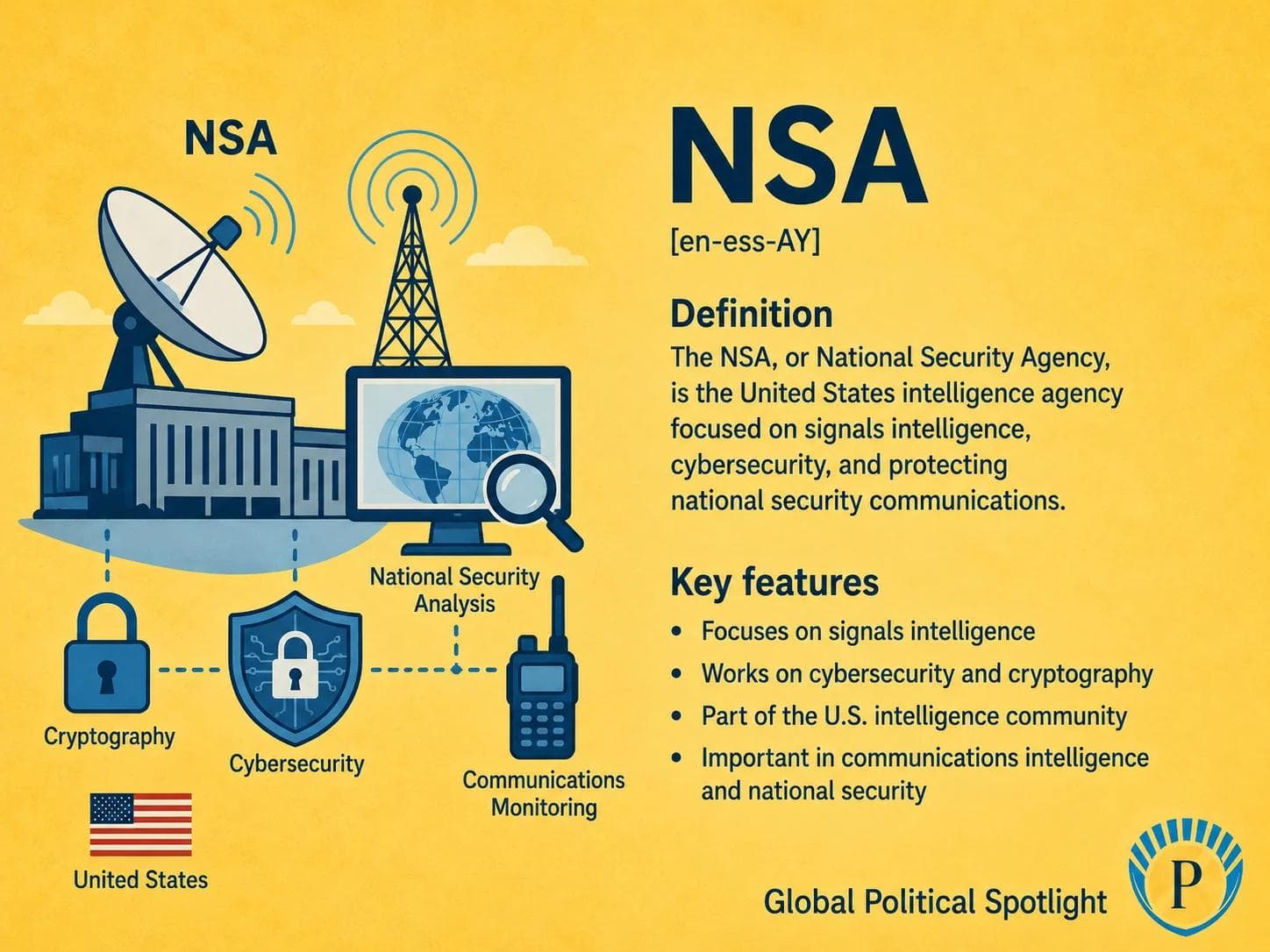
Definition
NSA, formally the National Security Agency, is the United States' main signals intelligence and cryptologic agency. It collects and analyzes foreign communications-related intelligence, supports cybersecurity, protects national security systems, and provides intelligence support to U.S. policymakers and military operations.
The NSA is part of the U.S. Department of Defense and the wider U.S. Intelligence Community. It is closely linked to U.S. Cyber Command, which is co-located with NSA at Fort Meade and has historically shared leadership through a dual-hat arrangement.
Because NSA operates in sensitive intelligence and cyber domains, many operational details are classified. Public debate often focuses on encryption, surveillance authorities, privacy, civil liberties, foreign intelligence collection, and the oversight systems used to control secret intelligence activities.
Why It Matters
NSA matters because signals intelligence and cyber capabilities are central to modern state power. Communications networks, encrypted systems, foreign military activity, cyber intrusions, terrorist communications, espionage, and critical infrastructure threats all shape U.S. security policy and allied threat assessments.
The agency is geopolitically important because it sits at the center of U.S. intelligence sharing with close allies, especially through the Five Eyes network. Its assessments and technical capabilities can influence sanctions, cyber advisories, military planning, technology controls, counterterrorism, and crisis response.
NSA is also a major reference point in democratic oversight debates. Its work raises persistent questions about how states balance national security, foreign intelligence collection, encryption policy, privacy rights, judicial authorization, congressional oversight, and civil liberties.
GPS should track NSA as a core U.S. signals intelligence and cybersecurity institution with relevance to great-power competition, cyber defense, foreign intelligence, encryption policy, Five Eyes cooperation, U.S. Cyber Command integration, surveillance controversies, and the legal oversight of intelligence activity in democratic states.
Key Facts
- Type
- Signals intelligence, cryptologic, and cybersecurity agency
- Country
- United States
- Formal name
- National Security Agency
- Headquarters
- Fort George G. Meade, Maryland
- Core mission
- Foreign signals intelligence, cybersecurity support, cryptologic capabilities, and protection of U.S. national security systems
- Institutional setting
- Part of the U.S. Department of Defense and the U.S. Intelligence Community
- Cyber Command link
- Closely connected to U.S. Cyber Command, with both institutions based at Fort Meade and historically linked through shared leadership
- Oversight debate
- Subject to legal, executive, congressional, and judicial oversight, while remaining central to privacy, surveillance, and civil-liberties debates
FAQ
What is the NSA?
NSA stands for National Security Agency. It is the United States' main signals intelligence and cryptologic agency, responsible for foreign communications intelligence, cybersecurity support, and protection of national security systems.
Is the NSA part of the military?
The NSA is part of the U.S. Department of Defense and also part of the U.S. Intelligence Community. It supports military and national security missions, but it is an intelligence agency rather than a conventional combat force.
What is signals intelligence?
Signals intelligence, or SIGINT, is intelligence derived from electronic signals and communications. It can include information relevant to foreign governments, militaries, cyber threats, terrorism, and other national security issues.
How is the NSA connected to U.S. Cyber Command?
NSA and U.S. Cyber Command are closely linked and co-located at Fort Meade. NSA focuses on signals intelligence and cybersecurity support, while U.S. Cyber Command conducts military cyberspace operations.
Why is the NSA controversial?
NSA is controversial because its work involves secret intelligence collection, surveillance authorities, encryption issues, and large-scale communications systems. Critics focus on privacy and civil liberties, while supporters emphasize national security and foreign intelligence needs.
What limits the NSA's powers?
NSA activities are constrained by U.S. law, executive orders, congressional oversight, court processes, inspector general review, minimization rules, and procedures intended to separate foreign intelligence collection from improper domestic surveillance.
Recent Developments
NSA joined allied agencies in a public cyber advisory on China-linked activity
The NSA joined U.S. and allied cybersecurity agencies in a public advisory on activity attributed to a China-linked actor targeting critical infrastructure. The advisory reflected the agency's role in public cyber defense coordination and allied threat attribution.
CISAU.S. intelligence oversight continued to focus on foreign surveillance authorities
The renewal of Section 702 of the Foreign Intelligence Surveillance Act kept public attention on the legal framework for foreign intelligence collection, oversight safeguards, privacy protections, and the role of intelligence agencies including NSA.
Office of the Director of National IntelligenceSources6 references
- National Security Agency - About NSA
Official overview of NSA's mission, structure, and role in signals intelligence and cybersecurity.
- National Security Agency - Cybersecurity
Official NSA cybersecurity advisories and public guidance.
- U.S. Cyber Command - About
Official description of U.S. Cyber Command's military cyberspace role and institutional relationship to the broader cyber mission.
- Office of the Director of National Intelligence - FISA
Official U.S. intelligence community material on Foreign Intelligence Surveillance Act authorities and transparency reporting.
- Foreign Intelligence Surveillance Court
Official court site relevant to judicial oversight of certain foreign intelligence surveillance activities.
- National Security Agency - UKUSA Agreement release
Official declassified material on the UKUSA Agreement framework associated with Five Eyes intelligence cooperation.

GPSNews App
Read GPSNews on iPhone
Daily geopolitical briefings, government updates, and prediction signals in one focused app.
Newsletter
Stay Ahead Of The Next Signal
Get briefings in your inbox when new analysis and reports are published.