
GCHQ
The United Kingdom's signals intelligence and cyber security agency
GCHQ is the United Kingdom's signals intelligence and cyber security agency, responsible for foreign intelligence support, cyber defense, national security missions, and intelligence sharing with close allies.
Definition
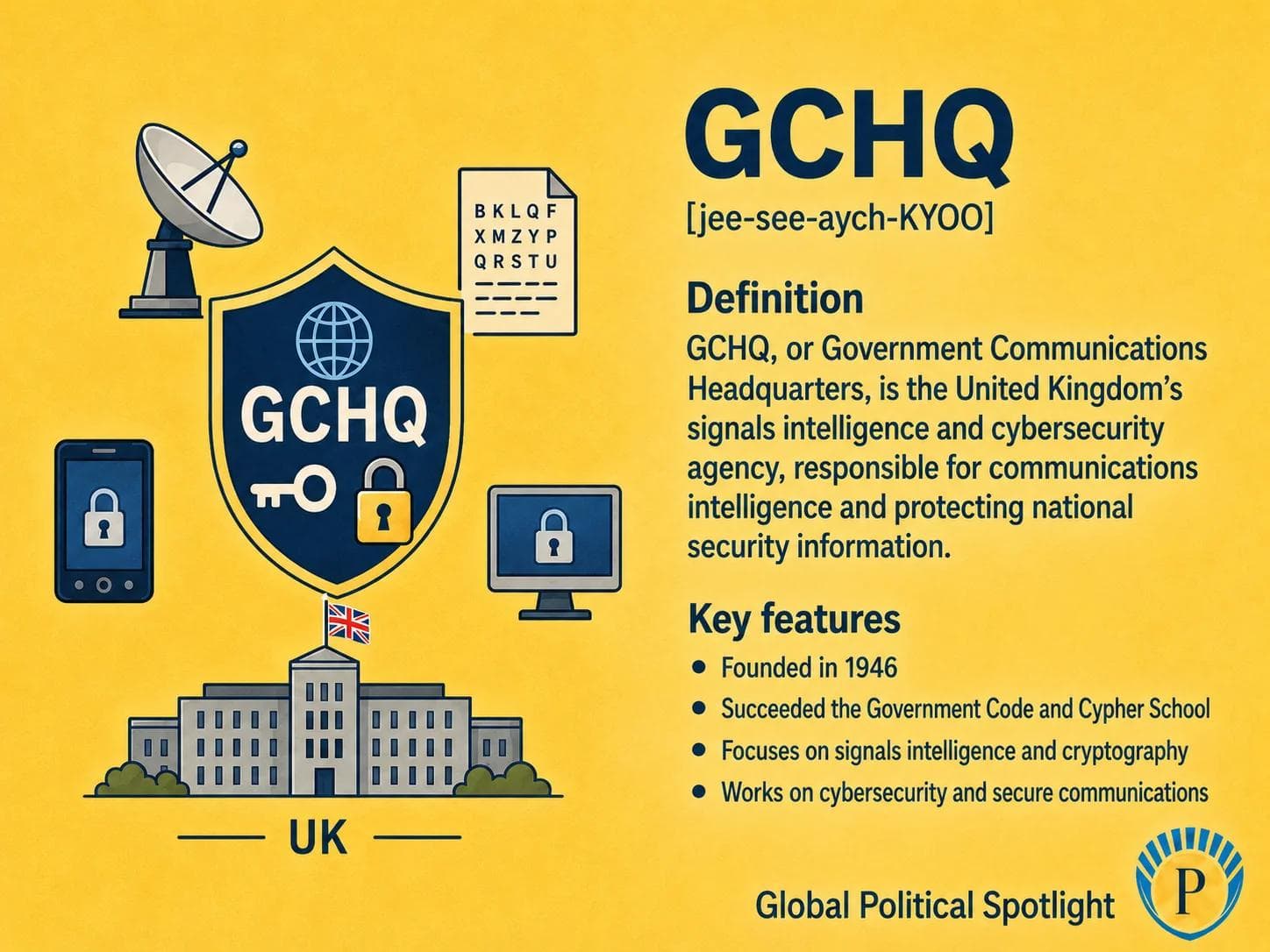
GCHQ, formally Government Communications Headquarters, is the United Kingdom's signals intelligence and cyber security agency. It supports national security by collecting and analyzing foreign communications-related intelligence, protecting UK networks, and assisting government decision-making.
The agency works alongside the UK's other intelligence bodies, including MI5 and MI6, and is part of the wider Five Eyes intelligence-sharing network with the United States, Canada, Australia, and New Zealand. Its public-facing cyber security role is largely carried out through the National Cyber Security Centre.
Because GCHQ operates in sensitive intelligence domains, many operational details are classified. Its work is shaped by UK law, ministerial authorization, warrants, parliamentary scrutiny, judicial oversight, and public debate over the boundary between foreign intelligence, domestic security, privacy, and civil liberties.
Why It Matters
GCHQ matters because signals intelligence and cyber security are central to modern state power. Communications data, cyber threat intelligence, encryption debates, foreign interference, espionage, terrorism, and critical infrastructure protection all sit within the broader strategic environment in which GCHQ operates.
The agency also matters geopolitically because the United Kingdom is a core Five Eyes member. GCHQ's intelligence relationships help connect British security policy to allied assessments of Russia, China, terrorism, cyber operations, military threats, and emerging technology risks.
At the same time, GCHQ is central to debates over democratic oversight of intelligence agencies. Its activities raise persistent questions about surveillance powers, proportionality, privacy safeguards, accountability, and how democracies manage secret capabilities under the rule of law.
GPS should track GCHQ as a core UK intelligence and cyber security institution with relevance to Five Eyes coordination, Russia and China threat assessments, cyber defense, foreign interference, terrorism, technology security, encryption policy, and the legal oversight of intelligence activity in democratic states.
Key Facts
- Type
- Signals intelligence and cyber security agency
- Country
- United Kingdom
- Formal name
- Government Communications Headquarters
- Headquarters
- Cheltenham, England
- Core mission
- Signals intelligence, cyber security, national security support, and protection of UK interests from communications and cyber threats
- Allied network
- A core UK participant in the Five Eyes intelligence-sharing partnership
- Cyber arm
- The National Cyber Security Centre is part of GCHQ and provides public cyber security guidance and incident support
- Oversight
- Subject to UK legal authorization, ministerial responsibility, parliamentary scrutiny, investigatory powers oversight, and judicial review mechanisms
FAQ
What is GCHQ?
GCHQ is the United Kingdom's signals intelligence and cyber security agency. It collects and analyzes communications-related intelligence, supports national security, and helps defend the UK against cyber threats.
What does GCHQ stand for?
GCHQ stands for Government Communications Headquarters.
Is GCHQ the same as MI5 or MI6?
No. GCHQ focuses on signals intelligence and cyber security. MI5 is the UK's domestic security service, while MI6, formally the Secret Intelligence Service, focuses on foreign human intelligence.
How is GCHQ connected to Five Eyes?
GCHQ is the UK's main signals intelligence agency within the Five Eyes intelligence-sharing partnership, which also includes the United States, Canada, Australia, and New Zealand.
What is the National Cyber Security Centre?
The National Cyber Security Centre, or NCSC, is part of GCHQ. It provides public cyber security guidance, supports incident response, and helps protect UK organizations and infrastructure from cyber threats.
What limits GCHQ's powers?
GCHQ operates under UK law and oversight systems. Its activities are constrained by legal warrants, ministerial authorization, investigatory powers oversight, parliamentary scrutiny, courts, and rules designed to protect privacy and civil liberties.
Recent Developments
Five Eyes cyber agencies issued a joint advisory on state-linked cyber activity
The UK's National Cyber Security Centre joined other Five Eyes cyber agencies in a public advisory on activity attributed to a China-linked actor targeting critical infrastructure. The advisory showed how GCHQ's public cyber role intersects with allied intelligence and cyber defense cooperation.
National Cyber Security CentreUK cyber authorities continued to emphasize state threats and resilience
Public reporting and guidance from the National Cyber Security Centre continued to frame cyber resilience, state-linked threats, ransomware, and critical infrastructure protection as central UK security priorities, reinforcing GCHQ's long-term cyber defense relevance.
National Cyber Security CentreSources6 references
- GCHQ - About us
Official overview of GCHQ's mission and role in UK national security.
- National Cyber Security Centre - About the NCSC
Official explanation of the NCSC as part of GCHQ and its public cyber security role.
- UK Investigatory Powers Commissioner
Official oversight body for the use of investigatory powers by UK intelligence and law-enforcement agencies.
- UK Intelligence and Security Committee of Parliament
Official parliamentary committee responsible for oversight of the UK intelligence community.
- UK Legislation - Investigatory Powers Act 2016
Primary UK legal framework governing investigatory powers and oversight arrangements.
- National Cyber Security Centre - Annual Review
Official annual reporting on UK cyber security priorities, threat trends, and NCSC activity.

GPSNews App
Read GPSNews on iPhone
Daily geopolitical briefings, government updates, and prediction signals in one focused app.
Newsletter
Stay Ahead Of The Next Signal
Get briefings in your inbox when new analysis and reports are published.