
FSB
Russia’s federal security service for domestic security, counterintelligence, border protection, and internal threat monitoring
The FSB is Russia’s federal security service, responsible for domestic security, counterintelligence, border security, counterterrorism, internal threat monitoring, and state security functions.
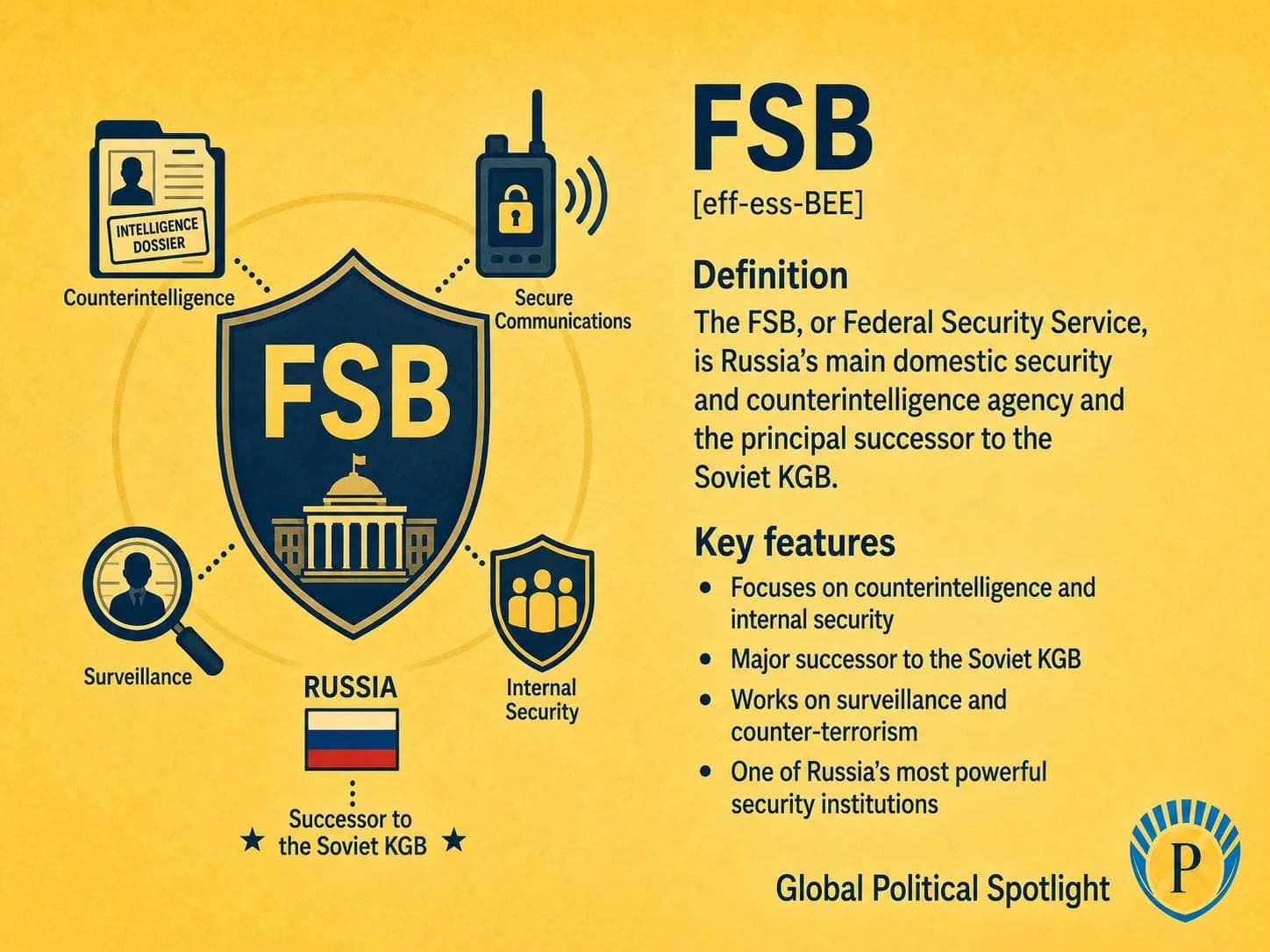
Definition
The Federal Security Service of the Russian Federation, commonly known as the FSB, is Russia’s main domestic security and counterintelligence agency. It is responsible for state security functions including counterintelligence, counterterrorism, border protection, internal threat monitoring, protection of sensitive information, and investigations linked to national security.
The FSB is a successor institution to parts of the Soviet KGB and operates within Russia’s wider security and intelligence system. It is distinct from the Foreign Intelligence Service, or SVR, which focuses on civilian foreign intelligence, and the military intelligence service commonly known as the GRU, which operates under the Russian military.
Because security service activity is often classified, public understanding of the FSB combines official Russian legal descriptions, government statements, court cases, sanctions records, investigative reporting, cybersecurity assessments, and foreign government attributions. Claims about specific operations should be treated carefully unless supported by official or well-documented evidence.
Why It Matters
The FSB matters because it sits close to the center of Russian state power. Its responsibilities cover counterintelligence, internal security, border control, counterterrorism, surveillance, and enforcement functions that affect Russia’s domestic politics, security environment, and relationship with foreign governments.
The agency is geopolitically relevant because Western governments and cybersecurity bodies have repeatedly accused Russian security-linked actors of espionage, cyber operations, disinformation-related activity, and targeting of dissidents or foreign institutions. Russia often rejects or disputes such allegations, making attribution and evidence standards important in analysis.
The FSB is also central to debates about political control inside Russia. Its domestic security mandate gives it a role in monitoring perceived internal threats, enforcing state security laws, and shaping the boundary between national security, political opposition, civil society, media freedom, and state authority.
The FSB should be tracked as a core institution of Russian state security and internal political control. GPS should watch counterintelligence cases, border security developments, cyber attributions, terrorism-related claims, repression and surveillance concerns, sanctions targeting security officials, coordination with the SVR and GRU, and how the agency’s domestic role interacts with Russia’s foreign policy, war posture, and relations with Europe and the United States.
Key Facts
- Full name
- Federal Security Service of the Russian Federation
- Russian name
- Federalnaya sluzhba bezopasnosti Rossiyskoy Federatsii
- Type
- Domestic security and counterintelligence service
- Country
- Russia
- Established
- 1995, as a successor to earlier post-Soviet security structures
- Core roles
- Counterintelligence, domestic security, counterterrorism, border security, internal threat monitoring, and protection of state secrets
- Institutional distinction
- The FSB is mainly domestic; the SVR handles civilian foreign intelligence and the GRU handles military intelligence
- Analytical constraint
- Many alleged activities are classified, denied, or disputed, so claims require careful attribution and evidence-based wording
FAQ
What is the FSB?
The FSB is the Federal Security Service of the Russian Federation. It is Russia’s main domestic security and counterintelligence agency, with responsibilities including counterintelligence, counterterrorism, border security, internal threat monitoring, and protection of state secrets.
Is the FSB the same as the KGB?
No. The FSB is not the Soviet KGB, but it is one of the main successor institutions to parts of the KGB after the Soviet Union collapsed. It inherited many domestic security and counterintelligence functions associated with earlier Soviet and Russian security structures.
How is the FSB different from the SVR and GRU?
The FSB is primarily responsible for domestic security and counterintelligence inside Russia. The SVR is Russia’s civilian foreign intelligence service, while the GRU is military intelligence under the Russian armed forces. Their roles can overlap in practice, but they are separate institutions.
Why does the FSB matter geopolitically?
The FSB matters because it influences Russian state security, counterintelligence, border control, cyber and espionage allegations, domestic political control, and Russia’s response to perceived internal and external threats.
Is the FSB involved in cyber operations?
Western governments and cybersecurity agencies have attributed some cyber and espionage activity to Russian security-linked actors, including activity associated with the FSB. Russia often denies or disputes such accusations, so analysis should identify the source of attribution and avoid treating all claims as automatically proven.
What are the main concerns about the FSB?
Common concerns include the agency’s role in political control, surveillance, counterintelligence prosecutions, pressure on civil society, alleged cyber activity, and the blurred boundary between state security, domestic politics, and foreign policy in Russia.
Sources6 references
- FSB Official Website
Official Russian source for public information about the Federal Security Service, its legal identity, and institutional role.
- President of Russia
Official Russian presidential source relevant to the institutional environment of Russian security services.
- U.S. Office of the Director of National Intelligence
Official U.S. intelligence community source for public threat assessments and foreign intelligence context related to Russia.
- U.S. Cybersecurity and Infrastructure Security Agency
Official U.S. cybersecurity source for public advisories and attributions concerning state-linked cyber activity.
- UK National Cyber Security Centre
Official UK cybersecurity source for public advisories and threat assessments involving Russian state-linked cyber actors.
- Encyclopaedia Britannica
Reference overview of the FSB’s history, institutional background, and relationship to earlier Russian and Soviet security bodies.

GPSNews App
Read GPSNews on iPhone
Daily geopolitical briefings, government updates, and prediction signals in one focused app.
Newsletter
Stay Ahead Of The Next Signal
Get briefings in your inbox when new analysis and reports are published.