
DGSE
France’s external intelligence agency for foreign intelligence, strategic warning, counterterrorism, and covert operations
DGSE is France’s external intelligence agency, responsible for foreign intelligence, strategic analysis, counterterrorism support, covert operations, overseas collection, and intelligence work linked to French national security.
Definition
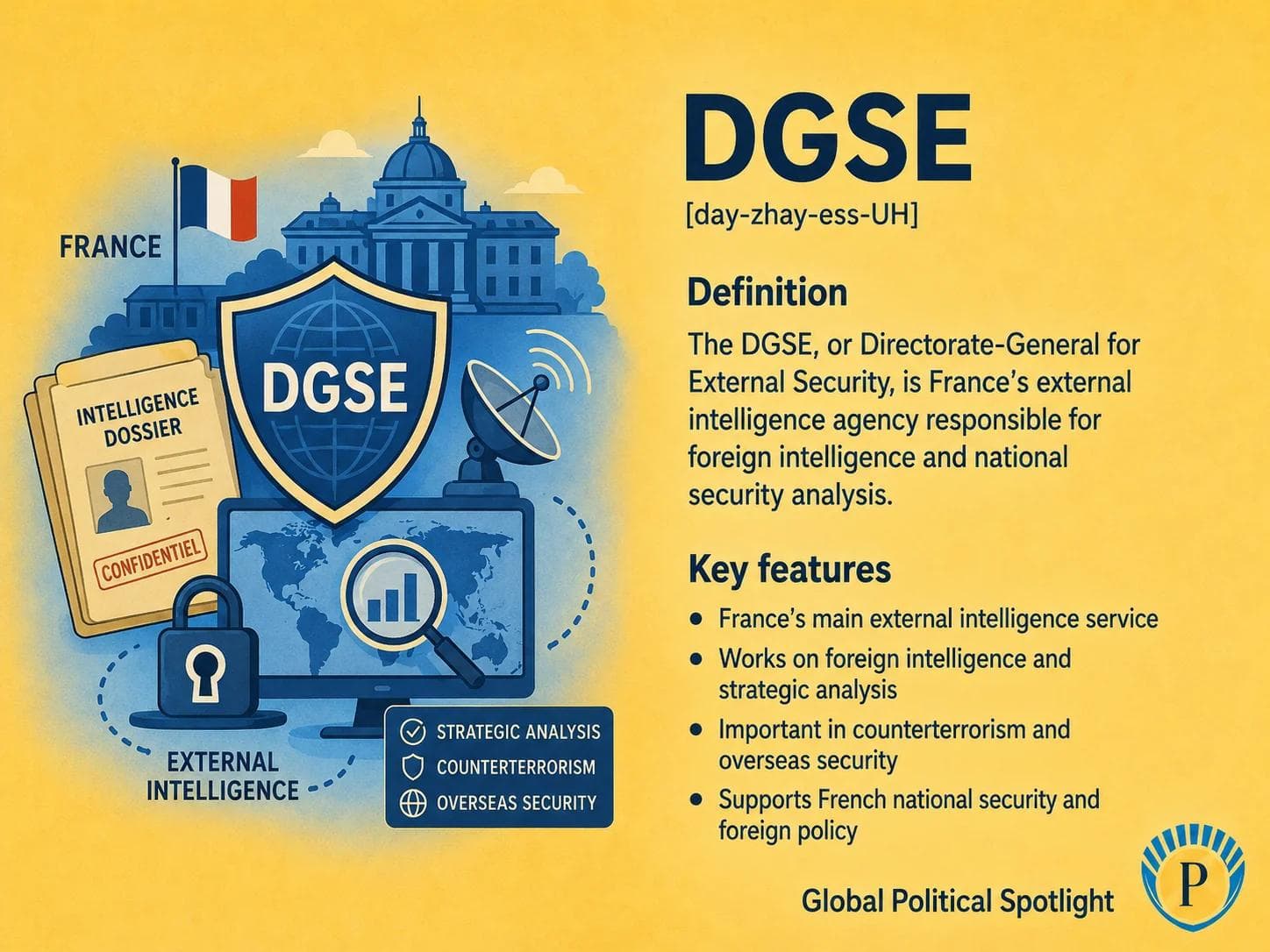
The Directorate-General for External Security, known in French as the Direction générale de la sécurité extérieure and abbreviated DGSE, is France’s external intelligence service. It is responsible for foreign intelligence collection, strategic analysis, counterterrorism support, covert operations, and intelligence activities outside France that support national security decision-making.
DGSE operates under France’s Ministry for the Armed Forces, linking it closely to defense policy, military planning, overseas operations, and strategic warning. It sits within a broader French intelligence system that also includes domestic security, military intelligence, cyber defense, and financial intelligence bodies.
Because external intelligence work is classified, public knowledge about DGSE is limited. Responsible analysis should distinguish official institutional descriptions from alleged operations, historical cases, media reporting, and claims that cannot be independently verified.
Why It Matters
DGSE matters because France is a nuclear-armed permanent member of the UN Security Council, a major European military actor, and a state with overseas territories, global diplomatic networks, and security interests across Europe, Africa, the Middle East, the Indo-Pacific, and the Atlantic.
Foreign intelligence supports French decision-making on terrorism, hostage risks, hostile state activity, military deployments, cyber threats, proliferation, maritime security, migration pressures, and instability in regions where France has strategic, historical, or economic interests.
DGSE is also important in the European security context. France’s intelligence posture interacts with NATO, European Union security cooperation, bilateral partnerships, defense industrial policy, counterterrorism coordination, and debates over strategic autonomy.
DGSE should be tracked as a foreign intelligence actor within France’s wider defense and national security system. GPS should watch how French external intelligence priorities relate to counterterrorism, Russia-related threats, cyber and hybrid activity, instability in Africa and the Middle East, Indo-Pacific posture, hostage diplomacy, defense cooperation, and Europe’s evolving security architecture.
Key Facts
- Full French name
- Direction générale de la sécurité extérieure
- English name
- Directorate-General for External Security
- Type
- External intelligence agency
- Country
- France
- Government link
- Operates under France’s Ministry for the Armed Forces
- Established
- 1982, succeeding earlier French external intelligence structures
- Primary role
- Foreign intelligence, strategic warning, counterterrorism support, covert operations, overseas collection, and intelligence liaison
- Institutional distinction
- DGSE focuses on external intelligence, while France’s DGSI is responsible for domestic security and internal intelligence
FAQ
What is DGSE?
DGSE is France’s external intelligence agency. It collects and analyzes foreign intelligence, supports counterterrorism and strategic warning, conducts classified external operations, and contributes to French national security decision-making.
What does DGSE stand for?
DGSE stands for Direction générale de la sécurité extérieure, which is commonly translated as the Directorate-General for External Security.
Is DGSE the same as DGSI?
No. DGSE is France’s external intelligence service and focuses on foreign intelligence outside France. DGSI, the Directorate-General for Internal Security, focuses on domestic security, counterterrorism, counterintelligence, and internal threats within France.
Why does DGSE matter geopolitically?
DGSE matters because France has global security interests, overseas territories, military deployments, nuclear forces, and diplomatic influence. External intelligence helps France assess threats, protect citizens, support defense planning, and coordinate with allies.
Does DGSE conduct covert operations?
DGSE is publicly associated with covert external operations, but specific activities are generally classified. Public analysis should avoid treating alleged operations as confirmed unless they are supported by official sources, court records, or strong evidence.
Who oversees DGSE?
DGSE operates under France’s Ministry for the Armed Forces and within France’s national intelligence framework. Political and legal oversight exists through executive authorities and French institutional mechanisms, although operational details are usually classified.
Sources6 references
- DGSE Official Website
Official public source for DGSE’s mission, organization, recruitment, and institutional identity.
- French Ministry for the Armed Forces
Official ministry source for France’s defense policy context and DGSE’s broader institutional environment.
- French National Intelligence and Counter-Terrorism Coordination
Official French Presidency source explaining the coordination framework for intelligence and counterterrorism.
- DGSI Official Website
Official source for France’s domestic security service, useful for distinguishing DGSE’s external role from domestic intelligence.
- French Defence and National Security Strategic Review
Official strategic review providing context on France’s national security priorities, threat perceptions, and strategic posture.
- Encyclopaedia Britannica
Reference overview of DGSE’s institutional background and role.
GPSNews App
Read GPSNews on iPhone
Daily geopolitical briefings, government updates, and prediction signals in one focused app.
Newsletter
Stay Ahead Of The Next Signal
Get briefings in your inbox when new analysis and reports are published.